Parking garage fireproofing is one of the most misunderstood areas of commercial fire protection. Most building owners and specifiers treat parking garages like any other commercial structure, reaching for standard cementitious spray-applied fire-resistive materials (SFRM) without considering the exposure conditions that make parking garages fundamentally different. The result is fireproofing that deteriorates within years, leaving structural steel unprotected when it matters most. According to the U.S. Fire Administration (USFA), approximately 650 parking garage fires occur annually in the United States, causing an estimated $8 million in property damage and 15 injuries each year. Those numbers tell only part of the story. Modern vehicle fires burn hotter, spread faster, and involve materials that did not exist when most parking structures were designed. Structural steel retains only about 60 percent of its yield strength at about 1,022 degrees Fahrenheit, and roughly 50 percent by 1,100 degrees Fahrenheit per AISC, a temperature that multi-vehicle parking garage fires reach routinely. Parking garage fireproofing must withstand not only fire but also the weather exposure, moisture cycling, vehicle impact, and chemical attack that make these structures uniquely challenging.
TLDR
- Approximately 650 parking garage fires occur annually in the U.S. (USFA), and modern vehicles with 91 percent more plastic content than 1970s vehicles have significantly increased fire spread risk and intensity in parking structures.
- Structural steel retains only about 60 percent of its yield strength at about 1,022 degrees Fahrenheit and roughly 50 percent by 1,100 degrees Fahrenheit, temperatures readily achieved in multi-vehicle parking garage fires as demonstrated by catastrophic incidents in Liverpool (2017), Stavanger (2020), and Jacksonville (2025).
- Standard cementitious SFRM is generally not suitable for parking garage fireproofing because it deteriorates when exposed to moisture, freeze-thaw cycling, UV, and vehicle exhaust common in semi-exposed parking structures.
- Epoxy intumescent coatings are the recommended parking garage fireproofing solution because they resist weather exposure, provide corrosion protection, and deliver fire-resistance ratings up to 4 hours per ASTM E119 and UL 1709.
- IBC classification of a parking garage as “open” or “enclosed” under IBC (2021) Section 406.5 determines fire-resistance requirements, sprinkler obligations, and parking garage fireproofing specifications. A licensed professional must verify the classification and specify all fire protection systems.
Why Parking Garage Fireproofing Requires a Different Approach
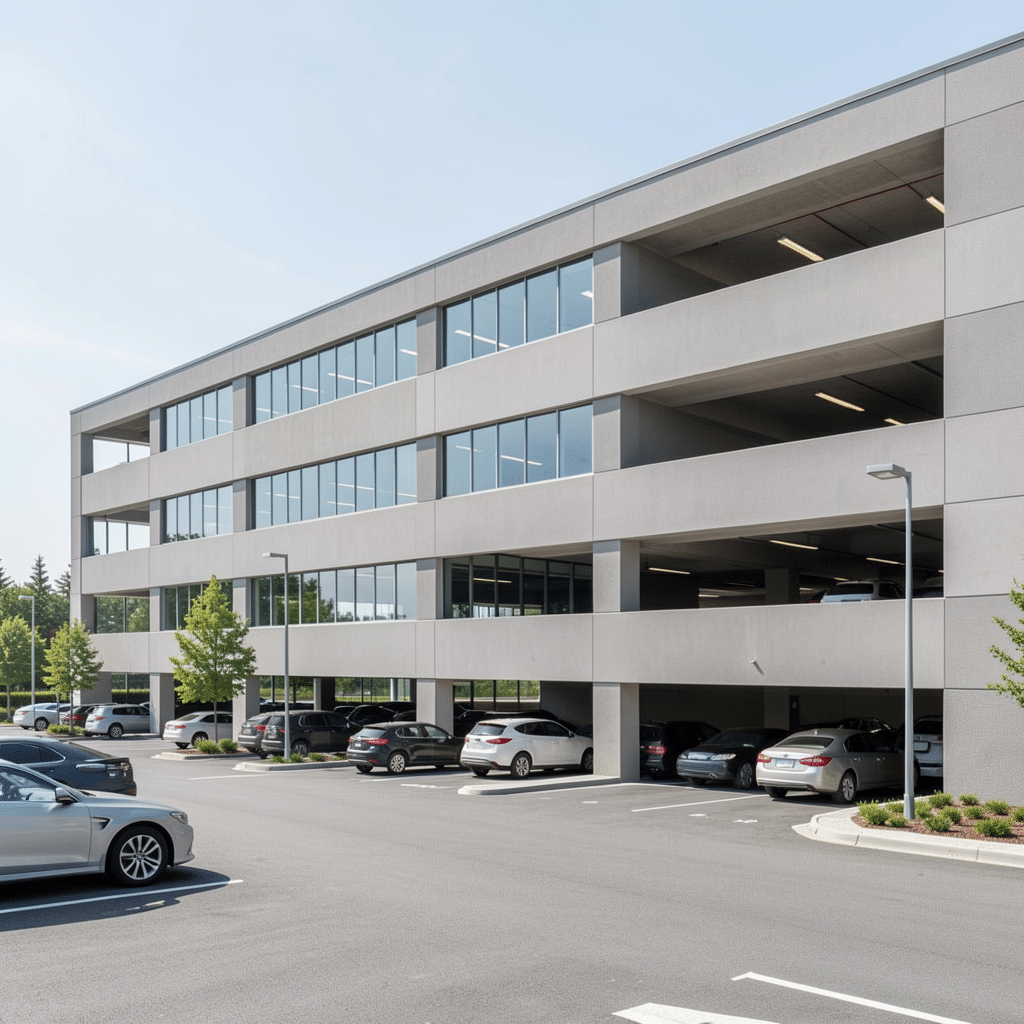
Parking garage steel is semi-exposed, meaning it faces environmental conditions that standard interior fireproofing products cannot withstand. Unlike the protected steel inside an office building or hospital, parking garage structural members are routinely subjected to rain, wind-driven moisture, humidity, freeze-thaw cycling, UV exposure on open sides, vehicle exhaust, road salt, de-icing chemicals, and potential vehicle impact. In Texas, summer heat and humidity create moisture cycling that degrades porous materials. In Kansas and Oklahoma, winter freeze-thaw conditions are even more destructive, as water absorbed into porous fireproofing expands when it freezes, fracturing the material from within.
Code note: unless otherwise stated, code references on this page are to the 2021 International Building Code. Code adoption is state and local. Across the states we serve, adopted IBC editions currently range from the 2012 edition to the 2024 edition, some states have no statewide commercial building code, and several enforce NFPA 1 or NFPA 101 rather than the International Fire Code. Minnesota and Wisconsin publish state-amended code books whose numbering and requirements differ from the model code. This is general technical information, not a code determination for your project. Confirm the adopted edition and any local amendments with your authority having jurisdiction.
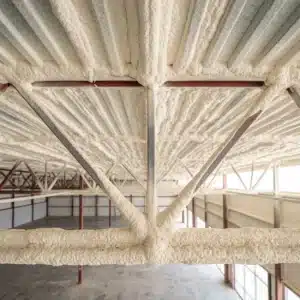
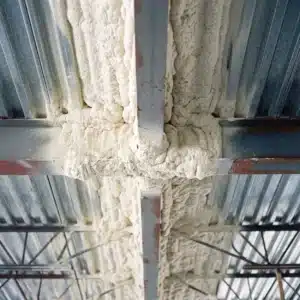
Standard cementitious SFRM is an interior product. Manufacturers specify that it is not suitable for surfaces exposed to moisture or high humidity because moisture will deteriorate the material. The porous nature of cementitious SFRM also creates conditions for mold growth when exposed to recurring moisture. While some manufacturers produce weather-resistant SFRM formulations designed for freeze-thaw conditions, these are specialized products that require specific application protocols and are not appropriate for all parking garage environments. SFRM also requires a minimum ambient temperature of 40 degrees Fahrenheit during application and for at least 24 hours after, which limits installation windows in colder climates.
The bottom line for parking garage fireproofing is straightforward: if the structural steel is exposed to weather, moisture, vehicle traffic, or semi-exposed conditions on any side, standard interior SFRM is not the right product. These conditions demand fireproofing systems specifically engineered for exterior and semi-exposed environments.
Modern Vehicle Fires Have Changed the Parking Garage Fireproofing Equation
The fire risk in parking garages has increased significantly over the past three decades, and this trend directly affects how parking garage fireproofing must perform.
The average U.S. vehicle in 2018 contained 91 percent more plastic by weight than the average vehicle in 1970. That increase in combustible plastic content yields an equivalent increase in potential chemical energy of approximately 2,300 megajoules per vehicle. While peak heat release rates above 7 megawatts have been measured in vehicle fire tests from every decade since the 1970s (meaning the maximum intensity of a single vehicle fire has not changed dramatically), the behavior of modern vehicle fires has changed substantially. Modern materials reduce time to ignition, increase the probability of fire spread to adjacent vehicles, and alter fire development in ways that create sustained high-temperature exposure to structural elements.
Vehicle-to-vehicle fire spread is where the data tells the most alarming story. A French study comparing parking garage fires from 1995 to 1997 against fires from 2010 to 2014 found a stark shift. In the earlier period, 98 percent of fires involved fewer than 4 vehicles and none involved more than 7. By 2014, 14 percent of parking structure fires involved more than 5 vehicles. Available test data shows that initial fire spread to an adjacent vehicle typically occurs within 10 to 20 minutes. Once two or more cars are involved, time to ignition of additional vehicles drops to less than 5 minutes. Plastic fuel tanks can begin showing failure after just 2 to 5 minutes of pool fire exposure, releasing flowing liquid fire that accelerates spread across the floor.
Electric and hybrid vehicles introduce additional concerns for fire protection in parking structures. Lithium-ion battery thermal runaway can produce temperatures up to 5,000 degrees Fahrenheit at the cell level, compared to approximately 1,500 degrees for a standard gasoline vehicle fire. Thermal runaway in EV batteries creates self-sustaining fires that can reignite hours or even days after initial extinguishment. Suppressing an EV fire typically requires two to three times longer and significantly more water (often 10 times or more) than extinguishing a conventional vehicle fire.
Real-World Catastrophic Incidents
Three recent incidents demonstrate why parking garage fireproofing cannot be treated as optional or secondary.
Liverpool King’s Dock (2017): A single vehicle fire in an open-air concrete parking garage spread to more than 1,150 vehicles across multiple levels. Ceiling-level temperatures exceeded levels known to cause concrete spalling, creating floor penetrations that enabled vertical fire spread between levels. The garage had no sprinkler system.
Stavanger Airport, Norway (2020): A multi-story parking structure partially collapsed due to prolonged high-temperature exposure to structural elements. Post-incident analysis determined that fire design had shortcomings in load-bearing capacities, meaning the structure was not adequately designed for the fire severity it experienced.
Jacksonville International Airport (2025): Approximately 50 vehicles were damaged and partial structural collapse occurred. The fire floor had no sprinklers per local ordinance. The fire originated from a single midsize vehicle and spread unimpeded across the 3rd and 4th floors.
Each of these incidents involved steel or concrete structures that were either unprotected or inadequately protected against the sustained temperatures that multi-vehicle fires produce. The critical steel failure threshold of 1,000 degrees Fahrenheit was exceeded in all three cases.
Open vs. Enclosed: How IBC Classification Drives Parking Garage Fireproofing Requirements
Whether a parking garage qualifies as “open” under IBC (2021) Section 406.5 determines fire-resistance requirements, sprinkler obligations, and parking garage fireproofing specifications. A licensed professional must verify the classification based on actual opening dimensions, not assumptions.
IBC 406.5.2: Open Parking Garage Definition
An open parking garage must meet all of the following requirements: uniformly distributed openings on two or more exterior sides, opening area equal to or greater than 20 percent of the total perimeter wall area of each tier, and aggregate length of openings equal to or greater than 40 percent of the perimeter of each tier (with an exception when openings are uniformly distributed over two opposing sides). If a garage fails to meet any of these criteria, it is classified as an enclosed parking garage and must comply with standard IBC Chapter 5 height and area limits.
Open parking garages are permitted in Types I, II, or IV construction per IBC 406.5.1, with more generous height and area allowances under IBC (2021) Table 406.5.4. Enclosed parking garages follow standard Chapter 5 requirements with corresponding restrictions.
IBC Table 601 Fire-Resistance Ratings
Parking garages are classified as Group S-2 (Low-Hazard Storage) occupancy. IBC Table 601 fire-resistance ratings for parking garage construction types depend on the construction type, which is determined by building height, area, and occupancy:
- Type IA: 3-hour structural frame, 2-hour floor construction, 1.5-hour roof construction
- Type IB: 2-hour structural frame, 2-hour floor construction, 1-hour roof construction
- Type IIA: 1-hour structural frame, 1-hour floor construction, 1-hour roof construction
- Type IIB: 0-hour construction (no fire-resistance rating required for structural elements)
Even in Type IIB (0-hour) construction, if the building exceeds allowable height and area limits without sprinklers, a higher construction type with fire-resistance ratings will be required. Open parking garages with fire separation distance of 10 feet or greater are not required to have fire-resistance rated exterior walls per the footnotes to IBC (2021) Table 705.5 (Table 602 in the 2018 and earlier editions) (IBC (2021) Table 602 in the 2018 and earlier editions), but this exception does not eliminate IBC (2021) Table 601 structural frame requirements for the applicable construction type.
A licensed professional must determine the applicable construction type and corresponding fire-resistance ratings for each specific parking garage project.
2021 IBC Critical Changes for Sprinklers
The 2021 IBC made significant changes to parking garage sprinkler requirements that directly affect parking garage fireproofing decisions. IBC (2021) Section 903.2.10 eliminated the blanket sprinkler exception for open parking garages. Open parking garages classified as Group S-2 now require automatic sprinklers where the fire area exceeds 48,000 square feet under IBC (2021) Section 903.2.10. A separate provision, IBC (2021) Section 903.2.11.3, requires sprinklers where a story with an occupant load of 30 or more sits 55 feet or more above the lowest level of fire department vehicle access, and that provision now reaches open parking garages because the former exemption was deleted. NFPA 88A goes further still, requiring all new parking structures, both open and enclosed, to be fully sprinklered regardless of size, but only where the authority having jurisdiction has adopted it. NFPA 13 (2022 edition) reclassified parking garages from Ordinary Hazard Group 1 to Ordinary Hazard Group 2, increasing required sprinkler density to 0.20 gpm per square foot over 1,500 square feet. FM Global’s 2021 classification is even higher at Ordinary Hazard 3 (0.30 gpm per square foot over 2,500 square feet).
These changes reflect the industry’s recognition that modern vehicle fires exceed the assumptions behind previous parking garage fire protection provisions. Sprinklers and structural fireproofing work together as complementary systems: sprinklers control fire development and limit heat exposure, while parking garage fireproofing protects structural integrity if sprinklers are overwhelmed or unavailable.
Texas adopted the 2021 IBC effective July 1, 2024. Kansas and Oklahoma follow IBC editions with local amendments. However, local jurisdictions may not have adopted the 2021 IBC yet. The local Authority Having Jurisdiction (AHJ) determines specific requirements in all three states.
Parking Garage Fireproofing Options: SFRM vs. Intumescent Coatings
Selecting the right parking garage fireproofing system depends on the exposure conditions, required fire-resistance rating, construction type, and environmental factors specific to the garage design.
Cementitious SFRM: Limited to Enclosed, Climate-Controlled Applications
Standard cementitious SFRM costs $5 to $14 per square foot installed and is the most economical option for enclosed parking garages where structural steel is fully protected from weather exposure. In climate-controlled enclosed garages with mechanical ventilation and no direct weather exposure, SFRM performs reliably and meets ASTM E119 standard fire test for structural steel fireproofing systems when properly applied. However, SFRM is not suitable for open or semi-exposed parking garage applications due to its vulnerability to moisture, freeze-thaw damage, UV degradation, and mechanical impact from vehicle traffic.
Weather-resistant SFRM formulations exist for specialized applications, but they remain more vulnerable to environmental degradation than intumescent systems and require more frequent inspection and maintenance in semi-exposed conditions.
Intumescent Coatings: The Recommended Parking Garage Fireproofing Solution
Epoxy intumescent coatings are the recommended structural steel fireproofing services solution for open and semi-exposed parking garages. These coatings provide weather resistance (moisture, UV, freeze-thaw cycling), corrosion protection for steel substrates, thin-film aesthetic finish, impact and abrasion resistance from vehicle traffic, and chemical resistance to vehicle fluids, road salt, and de-icing chemicals.
Multiple product categories address different parking garage exposure conditions:
Water-based intumescent coatings ($4 to $12 per square foot installed) are appropriate for interior and climate-controlled enclosed garage applications where weather exposure is minimal. These products provide cellulosic fire protection per ASTM E119 with lower VOC content than solvent-based alternatives.
Solvent-based intumescent coatings ($6 to $14 per square foot installed) offer improved durability for semi-exposed conditions with moderate weather exposure. They provide better moisture resistance than water-based alternatives but are not rated for full exterior exposure.
Epoxy intumescent coatings ($10 to $30 per square foot installed) are the premium parking garage fireproofing solution for open structures with full weather exposure. Products like Sherwin-Williams FIRETEX FX6002 and FX9502 provide cellulosic fire protection per ASTM E119 with ratings up to 4 hours, plus UL 2431 durability certification and integrated corrosion protection. For parking garages where hydrocarbon fire exposure is a concern (garages with maintenance areas, fuel storage, or significant EV charging infrastructure), the Sherwin-Williams FIRETEX M90/03 provides UL 1709 hydrocarbon fire protection, mesh-free certification up to 2 hours (up to 4 hours with mesh), and UL 2431 1-A heavy industrial outdoor rating. The M90/03 is a 100 percent solids epoxy with zero VOC unreduced and dry-heat resistance up to 248 degrees Fahrenheit. The FIRETEX M90/02 adds resistance to acid spillage, alkali spillage, petroleum solvents, and aliphatic solvents for parking garages in heavy industrial or coastal environments.
Which Fire Curve Applies to Parking Garage Fireproofing?
The fire exposure scenario determines which test standard applies to the parking garage fireproofing system:
ASTM E119 (cellulosic curve) is appropriate for standard parking garages. Vehicle fires in standard parking garages are typically evaluated against the ASTM E119 cellulosic curve, which is the established industry standard for parking structure fire design.
UL guide to structural steel fire protection and intumescent coating certification may be warranted for garages with fuel storage areas, vehicle maintenance operations, or significant EV battery fire risk. The hydrocarbon curve reaches higher temperatures faster than the cellulosic curve, reflecting the rapid temperature rise characteristic of pool fires and high-energy fuel sources.
A licensed professional must determine the appropriate fire exposure scenario and corresponding fireproofing specification for each parking garage project.
Inspection and Maintenance for Parking Garage Fireproofing
IBC (2021) Section 1705.15 (Section 1705.14 in the 2018 and earlier editions) requires special inspections for spray-applied fire-resistive materials, including verification of substrate condition, applied thickness, density (minimum 150 psf bond strength), and finished condition. For parking garage fireproofing, inspection takes on additional importance because of the environmental stresses these systems face.
Intumescent coatings in parking garages should be inspected regularly for signs of mechanical damage from vehicle impact, coating delamination, corrosion breakthrough, and UV degradation on exposed surfaces. Damage to parking garage fireproofing can occur from vehicles striking structural members, maintenance activities, or water intrusion, and repairs must use the same system and follow manufacturer specifications to maintain the fire-resistance rating.
Bahl Fireproofing serves commercial projects throughout Texas, Oklahoma, Kansas, Nebraska, Minnesota, and Wisconsin, including parking garage fireproofing for both new construction and retrofit applications. Working with a contractor experienced in semi-exposed applications ensures proper product selection, surface preparation, application protocols, and inspection coordination.
Key Takeaways
- Approximately 650 parking garage fires occur annually (USFA), and modern vehicles with significantly higher plastic content have increased fire spread risk, with 14 percent of recent parking fires involving more than 5 vehicles.
- Structural steel retains only about 60 percent of its yield strength at about 1,022 degrees Fahrenheit and roughly 50 percent by 1,100 degrees Fahrenheit, thresholds routinely exceeded in multi-vehicle parking garage fires.
- Standard cementitious SFRM is generally not suitable for parking garage fireproofing in open or semi-exposed conditions due to vulnerability to moisture, freeze-thaw cycling, UV exposure, and vehicle impact.
- Epoxy intumescent coatings ($10 to $30 per square foot installed) are the recommended parking garage fireproofing system for open structures, providing weather resistance, corrosion protection, and fire-resistance ratings up to 4 hours.
- IBC classification of a parking garage as “open” (IBC (2021) Section 406.5.2) or “enclosed” determines fire-resistance requirements, sprinkler obligations, and product selection. The 2021 IBC eliminated the blanket sprinkler exemption for open garages exceeding 55 feet or 48,000 square feet.
- EV and hybrid vehicle thermal runaway can produce temperatures up to 5,000 degrees Fahrenheit at the cell level and create conditions that reignite after initial suppression, increasing the fire severity that parking garage fireproofing must withstand.
- A licensed professional must determine the IBC classification, construction type, applicable fire-resistance ratings, fire exposure scenario, and fireproofing product specification for each parking garage project.
If your parking garage project requires fireproofing that performs under real-world conditions, not just lab conditions, we can help. Bahl Fireproofing specializes in semi-exposed and exterior applications where standard products fail. Contact Bahl Fireproofing today to schedule a consultation or request a bid.
This article provides general educational information about fireproofing and insulation systems and does not constitute professional engineering advice or product specification. System selection must be based on project-specific fire ratings, thermal requirements, acoustic performance needs, environmental conditions, substrate requirements, and budget constraints. Code requirements vary by jurisdiction and project type. Always consult with a licensed professional and verify UL or FM assembly listings before finalizing specifications.