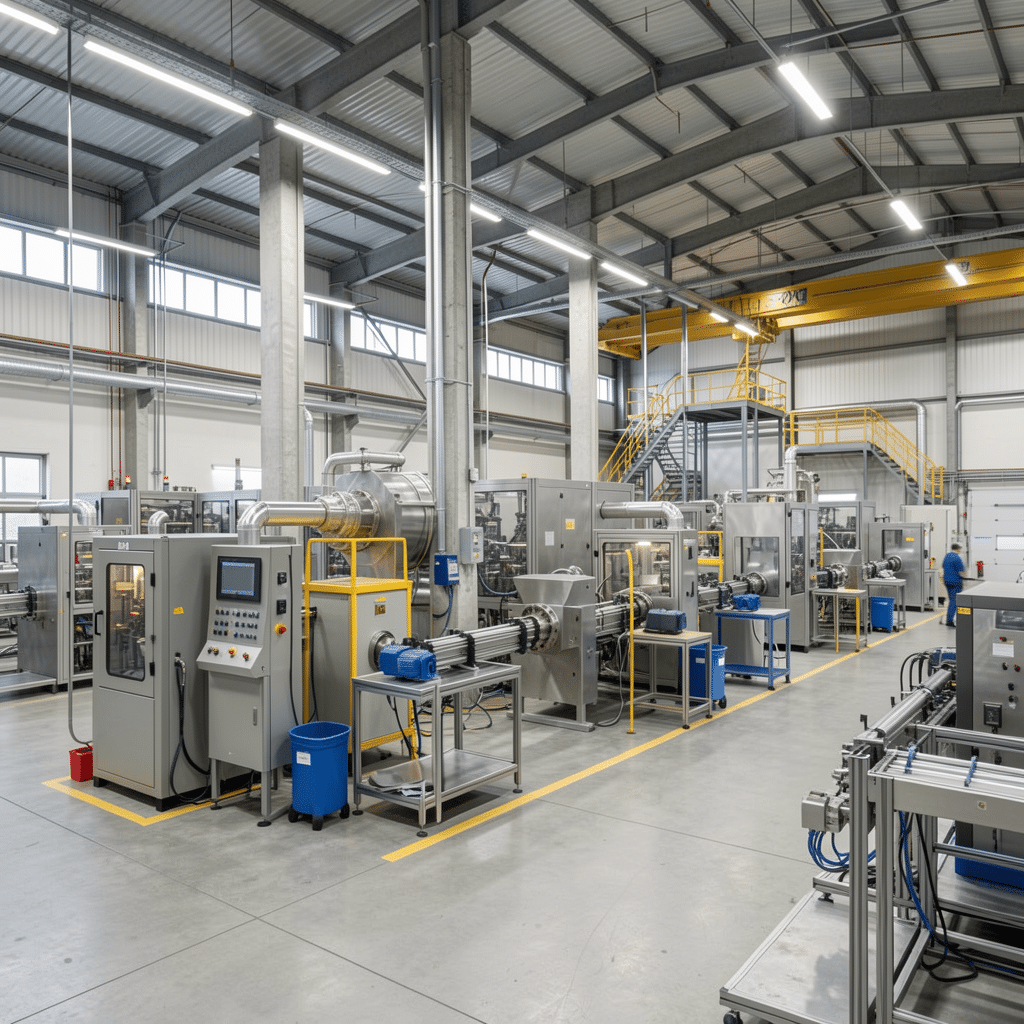
Every manufacturing facility owner knows the sound. Stamping presses hammering at 95 to 101 dBA. Compressors running at 90 to 100 dBA. Metal-cutting machines screaming at 105 to 115 dBA. All of it bouncing off bare metal deck and concrete walls, compounding with every reflection until the noise floor makes normal conversation impossible. OSHA’s occupational noise exposure guidance puts the figure at roughly 22 million U.S. workers exposed to potentially damaging noise each year, and manufacturing floors account for a significant share of that exposure. Manufacturing insulation that addresses both noise control and thermal performance is not a luxury in these environments. It is a regulatory requirement and an operational necessity.
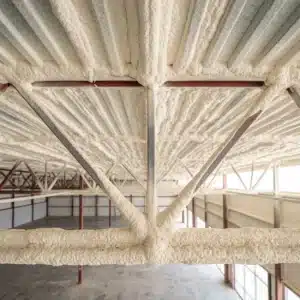
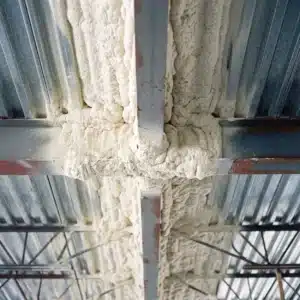
K-13 spray-applied insulation from International Cellulose Corporation delivers acoustic absorption, thermal resistance, and condensation control in a single monolithic application. For manufacturing facilities with metal deck ceilings (the most common substrate in industrial construction), K-13 insulation achieves an NRC of 1.05 at just 1.5 inches on 1.5-inch metal deck. That level of acoustic performance from a single, thin-profile application is difficult to match with any competing system.
TLDR
- Manufacturing insulation must address 29 CFR 1910.95 noise requirements (90 dBA permissible exposure limit, 85 dBA action level) alongside thermal performance and condensation control.
- K-13 spray-applied insulation achieves NRC 1.05 at 1.5 inches on 1.5-inch metal deck, providing exceptional acoustic absorption from minimal thickness.
- K-13 provides R-3.7 per inch (ASTM C 518), with a 2-inch application delivering R-7.4 thermal value plus NRC 1.05 acoustic performance on metal deck.
- K-13 is thermal and acoustical insulation only. It is NOT structural fireproofing. Its Class A rating (ASTM E 84) is a surface burning classification, not an ASTM E 119 fire-resistance rating.
- K-13 carries a 75-year reference service life per the manufacturer’s Environmental Product Declaration, verified by NSF to ISO 21930:2017.
The Noise Problem in Manufacturing Facilities
OSHA’s Occupational Noise Exposure standard (29 CFR 1910.95) establishes two critical thresholds that drive manufacturing insulation decisions. The Permissible Exposure Limit (PEL) is 90 dBA over an 8-hour time-weighted average. The Action Level is 85 dBA, which triggers a mandatory Hearing Conservation Program including noise monitoring, baseline and annual audiometric testing, hearing protectors at no cost to employees, annual training, and recordkeeping on the OSHA 300 log. For facilities running 12-hour shifts, a constant noise level of approximately 82 dBA can produce an 8-hour TWA at or above the 85 dBA action level.
Most common manufacturing equipment operates at or above the 85 dBA action level in 29 CFR 1910.95. Stamping presses produce 95 to 101 dBA at 15 to 25 feet (NIOSH/CDC). Compressors and industrial fans generate 85 to 100 dBA. Electric motors run at 85 to 95 dBA. Even printing presses reach 85 to 90 dBA. OSHA uses a 5 dB exchange rate, so every 5 dB above 90 dBA halves the allowable exposure time under 29 CFR 1910.95 Table G-16. At 95 dBA the limit is 4 hours, at 100 dBA it is 2 hours, and at 105 dBA it is 1 hour.
Here is the requirement that matters most for manufacturing insulation decisions: when exposures equal or exceed the 90 dBA PEL, 29 CFR 1910.95(b)(1) requires feasible administrative or engineering controls to be used. Personal protective equipment such as earplugs and earmuffs carries the load when those controls do not bring exposure within the limit. Acoustic treatment of the building envelope, including ceiling and wall manufacturing insulation, is a recognized engineering control. A bare metal deck ceiling (NRC approximately 0.05) reflects nearly all sound energy back into the space, amplifying the problem. Installing effective manufacturing insulation on that deck surface is one of the most impactful engineering controls available.
K-13 Acoustic Performance for Manufacturing Insulation Applications
K-13 is a spray-applied cellulose fiber insulation composed of natural, plant-based cellulose fibers with a specialty water-based adhesive (SK-2000). It contains 80% pre-consumer recycled content with no silica dust, asbestos, mineral fibers, glass fibers, or PCBs. It is UL GREENGUARD Gold Certified, Red List Free under the Living Building Challenge, and Cradle to Cradle Certified v.3.1 minimum Bronze.
What makes K-13 particularly effective as manufacturing insulation is its acoustic performance on the substrates most common in industrial construction. The Noise Reduction Coefficient (NRC) values below are tested per ASTM C 423 and published in ICC’s July 2025 Specification Guide.
On 1.5-inch metal deck (most common manufacturing ceiling):
K-13 at 1.5 inches thick delivers NRC 1.05 with R-5.6 thermal value. At 3.0 inches, it maintains NRC 1.05 with R-11.1.
On 2-inch metal deck:
K-13 at 1.0 inch delivers NRC 0.90 with R-3.7. At 2.0 inches, it reaches NRC 1.05 with R-7.4.
On 3-inch metal deck:
K-13 at 1.0 inch delivers NRC 0.95 with R-3.7. At 1.5 inches, NRC 1.00 with R-5.6. At 2.75 inches, NRC 1.05 with R-10.2.
On solid backing (concrete, gypsum, wood):
K-13 at 1.0 inch delivers NRC 0.80 with R-3.7. At 1.5 inches, NRC 0.90 with R-5.6. At 2.0 inches, NRC 1.00 with R-7.4.
The practical takeaway for manufacturing facility owners: on metal deck, K-13 achieves its peak NRC of 1.05 at lower thicknesses than on solid substrates. The corrugated profile of metal deck creates additional air space behind the K-13 layer, which improves low-frequency sound absorption. This is particularly relevant in manufacturing, where heavy equipment produces significant low-frequency noise energy that flat-surface treatments struggle to absorb.
For context, a bare metal deck has an NRC of approximately 0.05, meaning it absorbs only 5% of sound energy and reflects 95% back into the space. Installing 1.5 inches of K-13 on that same deck raises absorption to NRC 1.05. That transformation, from near-total reflection to near-total absorption, is what makes K-13 one of the most effective manufacturing insulation solutions for noise control.
K-13 vs. Alternative Manufacturing Insulation Solutions
Understanding how K-13 compares to other manufacturing insulation options helps facility owners and specifiers make informed decisions about the best manufacturing insulation system for their application.
K-13 spray-applied insulation ($1.50 to $3.00/sq ft installed) delivers NRC 1.00 to 1.05 on metal deck at 1.5 to 2.0 inches. It conforms to the deck profile without gaps, seams, or compressed areas. The monolithic application fills cracks, seams, and voids, reducing air infiltration. It installs in a single application up to 5 inches thick without mechanical support, and the K-13 High-R System allows mechanically supported applications up to 10 inches (R-37.0). Bond strength exceeds 150 psf per ASTM E 736, and bond deflection testing per ASTM E 759 shows no spalling or delamination at 6-inch deflection in a 10-foot span. This is important in manufacturing, where structural vibration and movement are constant.
Acoustic panels ($3.00 to $8.00/sq ft installed) deliver NRC 0.80 to 1.00. They work well on flat wall surfaces and in controlled environments but are limited by their inability to conform to irregular surfaces like corrugated metal deck. In manufacturing, they also face damage risk from forklift traffic, overhead crane operations, and material handling. Panel systems require mechanical fasteners that can loosen under vibration.
Fiberglass batts ($0.30 to $1.50/sq ft installed) deliver NRC 0.65 to 0.90. While low in initial cost, fiberglass batts present significant problems as manufacturing insulation. They sag over time, absorb moisture, leave gaps at joints and penetrations, and compress under their own weight, reducing both acoustic and thermal performance. Fiberglass has a manufacturer lifespan rating of 50 to 100 years when undisturbed, but field experience shows effectiveness degrades within 15 to 20 years due to compression, moisture absorption, and settling. In a manufacturing environment with vibration, humidity, and temperature fluctuation, that degradation accelerates.
Spray foam insulation ($1.00 to $4.50/sq ft installed) provides thermal performance but achieves only NRC approximately 0.70, which is significantly below K-13’s NRC 1.00 to 1.05 on metal deck. Spray foam is primarily a thermal and air-sealing product, not an acoustic solution. For facilities where noise control is a primary concern, spray foam alone will not deliver the engineering control performance the space needs.
K-13 is competitively priced against spray foam while delivering superior acoustic performance that spray foam cannot match. When a manufacturing facility needs both thermal and acoustic performance from a single system, K-13 provides both at a cost point that is typically lower than combining separate thermal and acoustic treatments.
Thermal and Energy Benefits of K-13 Manufacturing Insulation
K-13 provides R-3.7 per inch per ASTM C 518 (current manufacturer specification). At a typical 2-inch application on metal deck, that delivers R-7.4 thermal resistance combined with NRC 1.05 acoustic absorption, making it a dual-purpose manufacturing insulation in a single application.
For manufacturing facilities in Texas, Kansas, and Oklahoma, envelope minimums come from the adopted state energy code, and where the ANSI/ASHRAE/IES Standard 90.1 compliance path is used they vary by climate zone and space conditioning classification. Texas falls in Climate Zones 2 to 3, Oklahoma in Zones 3 to 4, and Kansas in Zones 4 to 5. Manufacturing spaces may be classified as conditioned (full 90.1 Section 5.5 envelope requirements), semiheated (reduced requirements, common for many manufacturing areas), or unconditioned (exempt from the thermal envelope provisions). Many manufacturing facilities contain a mix of all three classifications.
Beyond R-value, K-13 delivers thermal benefits that are particularly valuable as manufacturing insulation. The monolithic spray application fills cracks, seams, and voids in the deck surface, reducing air infiltration that prefabricated insulation products cannot address. There are no compressed areas, gaps at joints, or voids that reduce thermal efficiency. K-13 also provides condensation control on metal and concrete surfaces, a key advantage for manufacturing insulation in humid or temperature-variable environments. In manufacturing environments where temperature differentials between conditioned interior spaces and unconditioned roof decks create condensation risk, K-13’s continuous coverage helps prevent moisture accumulation that can lead to corrosion, mold, and product contamination.
K-13 Is NOT Structural Fireproofing: A Critical Distinction
This section addresses one of the most important technical distinctions in manufacturing insulation specification. K-13 is thermal and acoustical insulation. It is not structural fireproofing. Understanding this difference is essential for proper manufacturing insulation specification.
K-13 carries a Class A fire rating per ASTM E 84 and UL 723, with a flame spread index of 5 and a smoke development index of 5. Older data sheets also list NFPA 255 and UBC-42, both legacy references superseded by ASTM E84 and UL 723. It is FM Approved in Categories I through V. These are excellent surface burning characteristics.
However, ASTM E 84 measures surface flame spread and smoke development. It does not measure structural fire resistance. ASTM E 119 (the standard fire-resistance test) measures how long a structural assembly can maintain its load-bearing capacity and temperature limits under fire conditions. K-13 does not provide 1-hour, 2-hour, or 3-hour fire-resistance ratings tested under ASTM E 119. It does not replace spray-applied fire-resistive materials (SFRM) or intumescent coatings used for structural steel fireproofing.
K-13 can be installed over SFRM per UL design assemblies (including D779, D798, D925, D985, P725, and P732), providing acoustic and thermal performance on top of the structural fire protection. This is a common configuration in manufacturing facilities where structural steel requires fire-resistance ratings per IBC (2021) Table 601 and the facility also needs noise control and thermal insulation. The two systems serve different functions and work together.
For manufacturing facilities that require both structural fireproofing and acoustic or thermal manufacturing insulation, Bahl Fireproofing provides both services. Our team installs SFRM and intumescent fireproofing for structural protection, and K-13 for acoustic and thermal performance, ensuring each system is specified and applied correctly for its intended purpose throughout Texas, Oklahoma, Kansas, Nebraska, Minnesota, and Wisconsin.
High-Ceiling Manufacturing Insulation Applications
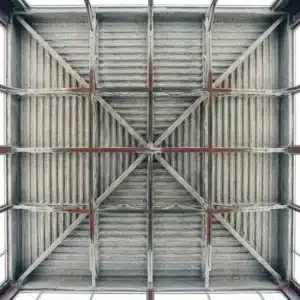
Manufacturing facilities typically feature high ceilings, open floor plans, and large uninterrupted deck areas. These conditions create specific challenges for manufacturing insulation installation that K-13 is designed to address.
K-13 can be applied up to 5 inches thick in a single application without mechanical support. At 5 inches on solid backing, K-13 delivers R-18.5 thermal resistance and NRC 1.00 acoustic absorption. For facilities requiring even higher thermal performance, the K-13 High-R System uses mechanical support to achieve applications up to 10 inches thick (R-37.0).
Application is performed exclusively by applicators licensed by International Cellulose Corporation, using manufacturer-approved fiber machines and nozzles. This controlled application process is why K-13 maintains consistent thickness and density across large deck areas. For manufacturing facilities with complex ceiling geometries, ductwork, conduit runs, and structural members, K-13’s spray application conforms to irregular surfaces and penetrations without the gaps and voids that prefabricated insulation products leave.
Bond strength exceeds 150 psf per ASTM E 736 (current July 2025 specification). Bond deflection testing per ASTM E 759 demonstrates no spalling or delamination at 6-inch deflection in a 10-foot span. In manufacturing environments where overhead cranes, heavy equipment, and process operations create vibration and structural movement, this adhesion performance ensures the manufacturing insulation stays in place over the long term.
K-13 carries a 75-year reference service life per the manufacturer’s Environmental Product Declaration, verified by NSF to ISO 21930:2017, EN 15804, and ISO 14025:2006. The EPD states that no maintenance or replacement is required to achieve the product’s lifespan. For a manufacturing facility owner evaluating lifecycle cost, a 75-year service life with no required maintenance represents exceptional long-term value.
Specifying Manufacturing Insulation: What Licensed Professionals Need to Know
Proper specification of K-13 for manufacturing applications requires attention to several project-specific factors.
Thickness selection depends on the acoustic and thermal targets for the space. For noise control as the primary objective, 1.5 inches on 1.5-inch metal deck achieves NRC 1.05. For combined acoustic and thermal performance, 2.0 inches on 2-inch metal deck delivers NRC 1.05 and R-7.4. For high-thermal applications in colder climate zones (Kansas Climate Zones 4 to 5), thicker applications or the K-13 High-R System may be appropriate to meet the envelope minimums in 90.1 Table 5.5-4 or 5.5-5, or the equivalent IECC Section C402 requirement.
K-13 must comply with 2009 through 2021 IBC editions. The manufacturer (International Cellulose Corporation) is ISO 9001:2015 Certified. K-13 is listed under CSI MasterFormat 07 21 29 (Sprayed Insulation) and 09 83 16 (Acoustic Ceiling Coating).
Noise monitoring under 29 CFR 1910.95(d) should be conducted by a qualified professional to establish baseline levels, identify equipment driving exposure, and determine the acoustic treatment needed. The relationship between NRC values and actual noise reduction in a specific space depends on room geometry, surface area treated, equipment placement, and other factors that require professional acoustic analysis.
A licensed architect or engineer should verify the adopted energy code and edition, the applicable 90.1 Section 5.5 or IECC Section C402 requirement for the climate zone and space classification, and coordination with any structural fireproofing already installed.
Key Takeaways
- 29 CFR 1910.95(b)(1) requires feasible administrative or engineering controls (including acoustic manufacturing insulation) when noise exceeds the 90 dBA PEL, and most manufacturing equipment operates at or above the 85 dBA action level, where hearing protectors must be made available.
- K-13 achieves NRC 1.05 at 1.5 inches on 1.5-inch metal deck per ASTM C 423, transforming a surface that reflects 95% of sound energy into one that absorbs virtually all of it.
- K-13 provides R-3.7 per inch per ASTM C 518, delivering dual acoustic and thermal performance from a single manufacturing insulation application.
- K-13 is NOT structural fireproofing. Its Class A rating (ASTM E 84, flame spread 5, smoke development 5) is a surface burning classification, not an ASTM E 119 fire-resistance rating. K-13 can be installed over SFRM per UL design assemblies.
- K-13 installs at $1.50 to $3.00/sq ft, competitively priced against spray foam ($1.00 to $4.50/sq ft) while delivering significantly higher acoustic performance (NRC 1.05 vs. approximately 0.70).
- K-13 carries a 75-year reference service life per the manufacturer’s EPD (NSF-verified), with no maintenance or replacement required.
- A qualified professional should assess employee noise exposure under 29 CFR 1910.95(d), specify K-13 thickness for the target NRC and R-value, and verify coordination with any required structural fireproofing.
Whether your facility needs noise control to support 29 CFR 1910.95 compliance, thermal performance to satisfy the adopted energy code, or both from a single system, K-13 delivers. Contact Bahl Fireproofing today to schedule a consultation or request a bid for your manufacturing insulation project.
This article provides general educational information about fireproofing and insulation systems and does not constitute professional engineering advice or product specification. System selection must be based on project-specific fire ratings, thermal requirements, acoustic performance needs, environmental conditions, substrate requirements, and budget constraints. Code requirements vary by jurisdiction and project type. Always consult with a licensed professional and verify UL or FM assembly listings before finalizing specifications.