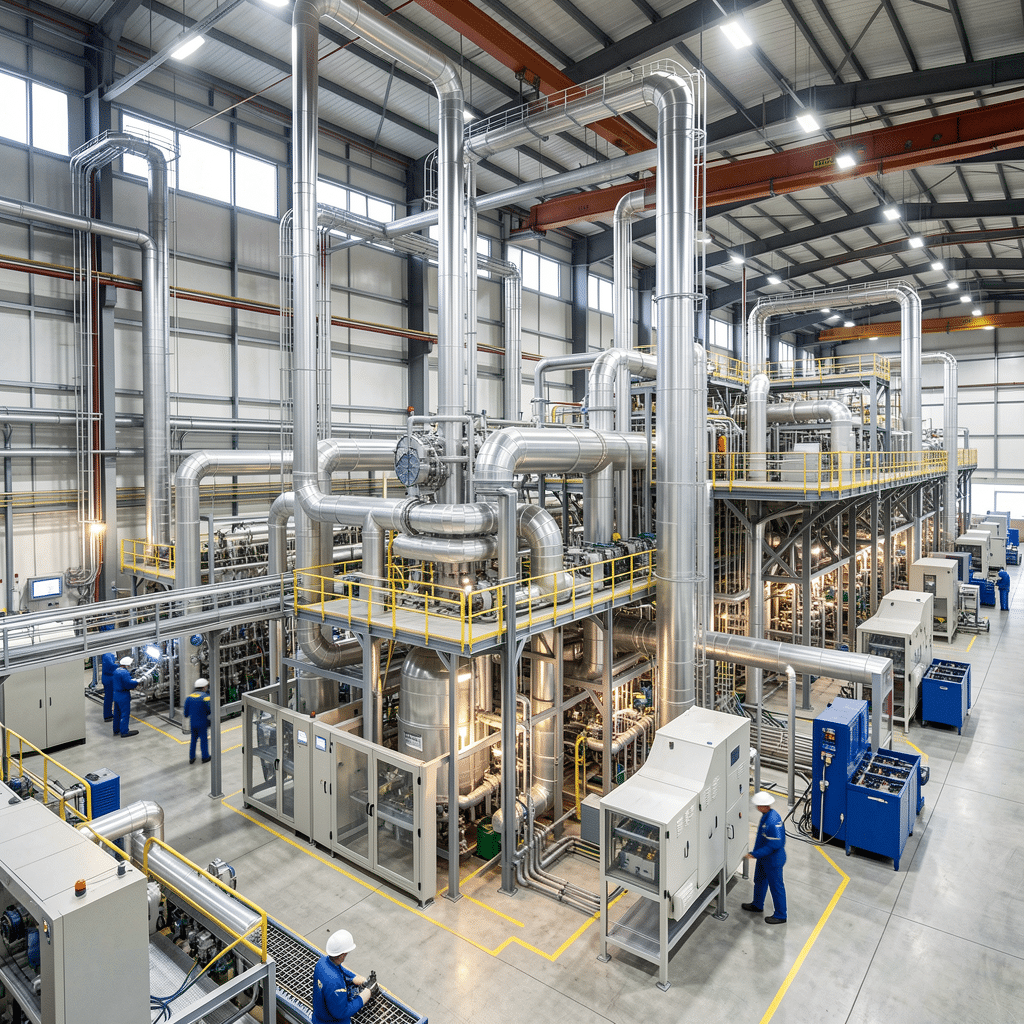
Manufacturing plants combine heavy machinery, chemical processes, and high-value equipment under one roof, and a single fire can shut down operations for months. According to NFPA data, U.S. fire departments respond to an estimated 36,784 fires annually (2017-2021 average) at industrial and manufacturing properties, causing $1.5 billion in direct property damage annually. Manufacturing plant fireproofing is the critical line of defense that keeps structural steel standing long enough for occupants to evacuate and firefighters to respond.
Structural steel loses approximately 50% of its strength at 1,000°F. Under the ASTM E119 standard fire test, furnace temperatures reach 1,000°F in just five minutes. Without proper manufacturing plant fireproofing, the steel frame supporting your operation can begin failing before the first fire truck arrives.
TLDR
- Manufacturing plant fireproofing protects structural steel from reaching its critical failure temperature of 1,000°F, which an unprotected member can reach within five minutes of fire exposure.
- IBC occupancy classification (F-1, F-2, or H-1 through H-5) determines required fire-resistance ratings, and a licensed professional must assess process risks to establish the correct classification.
- Cementitious SFRM ($5 to $14/sq ft installed) works for low-impact interior environments, while intumescent coatings ($4 to $30/sq ft installed) are recommended for vibration, chemical, or moisture exposure.
- Epoxy intumescent coatings provide the strongest performance in heavy industrial settings with chemical resistance, vibration tolerance, and corrosion protection.
- Code requirements vary by jurisdiction across Texas, Kansas, and Oklahoma. Always verify local requirements with a licensed professional.
Why Manufacturing Plants Need Specialized Fireproofing
Manufacturing environments are not standard commercial buildings. Processing and manufacturing areas account for 27% of fire origins in these facilities, followed by machinery rooms at 9% and service or equipment areas at 8%. Leading causes include equipment malfunctions (17%) and heating equipment (15%), with electrical distribution also a significant contributor.
What makes manufacturing plant fireproofing different from standard commercial fireproofing is the operating environment. Heavy presses, CNC machines, overhead cranes, and forklifts create constant vibration. Chemical processes introduce solvents, acids, and moisture. Furnaces and kilns add process heat that compounds fire risk. Standard fireproofing materials that perform well in an office building may fail prematurely under these conditions.
For facilities handling flammable liquids or chemicals, the UL 1709 hydrocarbon fire curve reaches approximately 2,000°F after five minutes, nearly double the standard cellulosic curve. Manufacturing plant fireproofing in these environments must be tested for hydrocarbon fire exposure, not just standard ASTM E119 conditions.
IBC Occupancy Classifications and Manufacturing Plant Fireproofing Requirements
The International Building Code classifies manufacturing facilities into two primary groups. Group F-1 (Moderate Hazard) covers operations involving combustible materials: woodworking, food processing, plastics, printing, and textiles. Group F-2 (Low Hazard) covers fabrication of noncombustible materials such as glass, ice, and metal assembly.
When hazardous material quantities exceed maximum allowable limits per control area, the classification shifts to Group H (High Hazard). H-2 occupancies (flammable liquids, gases, combustible dust) require at least 25% exterior wall perimeter and fire barriers with minimum 2-hour fire-resistance rated floor assemblies.
IBC Table 601 establishes fire-resistance ratings that drive manufacturing plant fireproofing requirements. Type IA construction requires a 3-hour structural frame rating, Type IB requires 2 hours, and Type IIA requires 1 hour. A critical detail many owners overlook: IBC (2021) Table 601 Footnote b specifically excludes F-1 and Group H occupancies from certain fireproofing exemptions. Manufacturing plants may require fireproofing even in construction types where other occupancies allow unprotected steel.
Code note: unless otherwise stated, code references on this page are to the 2021 International Building Code. Code adoption is state and local. Across the states we serve, adopted IBC editions currently range from the 2012 edition to the 2024 edition, some states have no statewide commercial building code, and several enforce NFPA 1 or NFPA 101 rather than the International Fire Code. Minnesota and Wisconsin publish state-amended code books whose numbering and requirements differ from the model code. This is general technical information, not a code determination for your project. Confirm the adopted edition and any local amendments with your authority having jurisdiction.
A licensed professional must assess process risks, hazardous material quantities, and occupancy classification to determine the correct fire-resistance ratings for your facility.
Manufacturing Plant Fireproofing Options: SFRM vs. Intumescent Coatings
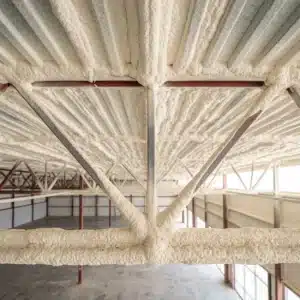
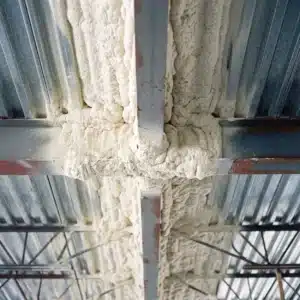
Cementitious spray-applied fire-resistive materials (SFRM) are the traditional choice, with installed costs typically ranging from $5 to $14 per square foot depending on region and project complexity. SFRM provides 1 to 4 hour fire resistance ratings with decades of proven performance. However, SFRM has significant limitations in manufacturing: vulnerability to cracking from continuous machinery vibration, moisture absorption leading to corrosion under fireproofing (CUF), dust and flaking unsuitable for clean rooms or food processing, and damage susceptibility from forklift strikes.
Intumescent coatings are thin-film products applied like paint that expand when heated (typically at 350 to 400°F), forming an insulating char layer. Water-based intumescent ($4 to $12/sq ft installed) works best for interior, climate-controlled spaces. Solvent-based intumescent ($6 to $14/sq ft installed) offers more durability for semi-exposed applications. Epoxy intumescent ($10 to $30/sq ft installed) delivers chemical resistance, corrosion protection, and vibration tolerance for heavy industrial environments.
For most manufacturing plant fireproofing applications, epoxy intumescent coatings are the recommended solution. Sherwin-Williams FIRETEX FX9502 provides ASTM E119 cellulosic fire protection for up to 4 hours with UL 2431 durability certification. For hydrocarbon fire environments, Carboline Thermo-Lag 3000-P is tested to UL 1709 and ASTM E119 standards, providing 1 to 4 hours of fire protection with resistance to chemicals, abrasion, and vibration.
Heavy Industrial Challenges for Manufacturing Plant Fireproofing
Corrosion under fireproofing is the most costly challenge in manufacturing environments. CUF occurs when moisture infiltrates fireproofing materials and corrodes underlying steel, compromising structural integrity. Steel corrosion in the chemical, petrochemical, and pharmaceutical industries accounts for an estimated $1.7 billion in annual losses (NACE International), with corrosion under fireproofing being a major contributor. Epoxy intumescent coatings address this by creating a moisture barrier that protects steel from both fire and corrosion.
Crane-supporting steel presents another critical consideration. Crane runway beams, columns, and brackets form part of the primary structural frame under IBC Section 202. If the building requires fire-rated construction per IBC (2021) Table 601, these members must be fireproofed to the required rating. Dynamic loads from crane operations compound vibration and impact challenges, making proper product selection essential.
Bahl Fireproofing works with manufacturing facilities throughout Texas, Oklahoma, Kansas, Nebraska, Minnesota, and Wisconsin, where these industrial conditions are common. Matching the right system to your operating environment is critical for long-term performance.
Code Compliance and Inspection Requirements for Manufacturing Plant Fireproofing
IBC (2021) Section 1705.15 (Section 1705.14 in the 2018 and earlier editions) mandates special inspections for all SFRM applications, verifying substrate condition, coating thickness, density, bond strength (minimum 150 psf), and finished condition. Intumescent coatings require dry film thickness verification per manufacturer specifications and UL design listing requirements.
Beyond building codes, OSHA 29 CFR 1910.39 requires manufacturing plants to maintain fire prevention plans listing major fire hazards, proper handling procedures for hazardous materials, potential ignition sources, and housekeeping procedures to control flammable waste. Emergency action plans are a separate requirement under 1910.38, and Subpart L is the fire protection subpart, covering portable fire extinguishers under 1910.157. Texas adopted the 2021 IBC effective July 1, 2024, while Kansas and Oklahoma follow IBC editions with local amendments. Your local Authority Having Jurisdiction (AHJ) determines specific requirements.
Key Takeaways
- Manufacturing plant fireproofing must account for vibration, chemical exposure, moisture, impact, and process heat that standard commercial environments do not present.
- Steel loses 50% of its strength at 1,000°F, a temperature reached in just 5 minutes under ASTM E119 conditions.
- IBC occupancy classification (F-1, F-2, or Group H) determines fire-resistance ratings, and F-1 and H occupancies face stricter requirements than many other commercial uses.
- Cementitious SFRM ($5 to $14/sq ft) suits low-impact environments, while epoxy intumescent coatings ($10 to $30/sq ft) are recommended for heavy manufacturing.
- Corrosion under fireproofing costs industrial facilities billions annually, and proper coating selection is the primary prevention strategy.
- IBC (2021) Section 1705.15 requires special inspections for SFRM, and intumescent coatings require dry film thickness verification per UL design listings.
- A licensed professional must assess process risks, occupancy classification, and local code requirements to specify the correct manufacturing plant fireproofing system.
If your manufacturing facility needs fireproofing built for real industrial conditions, not just a lab test, let’s talk. Contact Bahl Fireproofing today to schedule a consultation or request a bid.
This article provides general educational information about fireproofing and insulation systems and does not constitute professional engineering advice or product specification. System selection must be based on project-specific fire ratings, thermal requirements, acoustic performance needs, environmental conditions, substrate requirements, and budget constraints. Code requirements vary by jurisdiction and project type. Always consult with a licensed professional and verify UL or FM assembly listings before finalizing specifications.