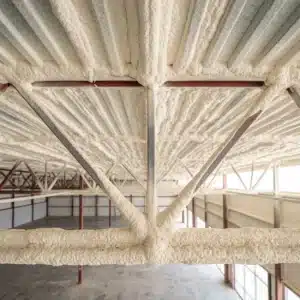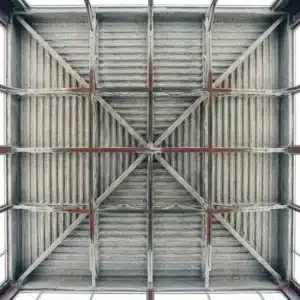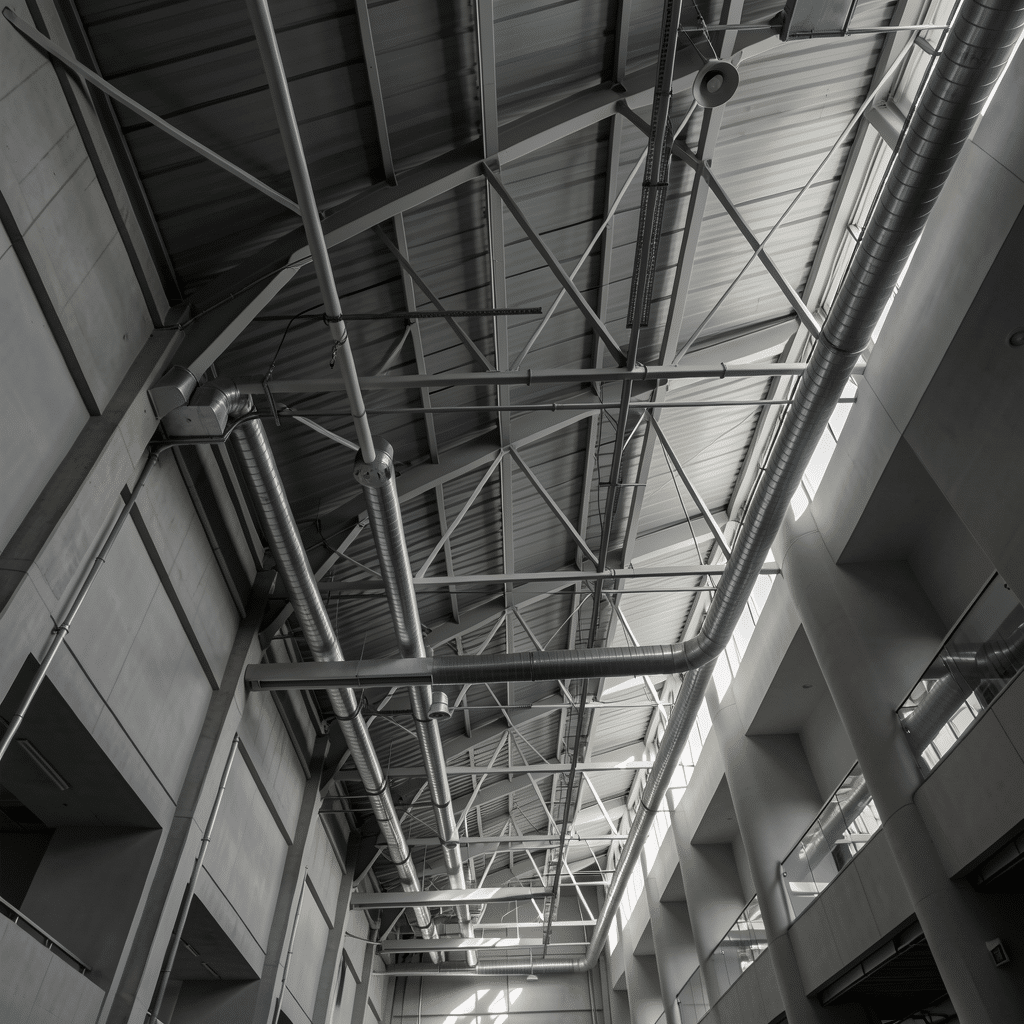
Open ceilings are everywhere. Walk into any new restaurant, brewery, coffee shop, or retail store and you will see exposed ductwork, pipes, and structural steel overhead. It is the industrial-modern look that customers love. But removing the drop ceiling does not remove the fire code. If your building’s structural steel requires fire protection, that steel still needs it, whether hidden or on full display. Intumescent fireproofing makes it possible to protect exposed steel while keeping the look your designer intended.
TLDR:
- Removing a drop ceiling does not remove fire code requirements for structural steel
- Intumescent fireproofing is the only practical option for visible steel (cementitious looks terrible)
- Three finish levels (standard, commercial, architectural) let you match appearance to viewing distance
- Any color and gloss level is possible through manufacturer-approved topcoats
- Restaurants face extra challenges from kitchen heat, grease, NFPA 96 clearances, and acoustics
Why Open Ceilings Still Need Intumescent Fireproofing
Fire code does not care about design trends. IBC 2024 Table 601 sets fire resistance requirements based on construction type, not ceiling style. Most single-story and low-rise retail stores and restaurants fall under Type IIA or Type IIB construction. Larger or multi-story buildings may require Type I or Type III, which carry higher fire resistance ratings.
| Construction Type | Structural Frame | Floor Assembly | Roof Assembly |
|---|---|---|---|
| Type IIA (most common for retail/restaurant) | 1 hour | 1 hour | 1 hour |
| Type IIB (smaller buildings, unprotected) | 0 hours | 0 hours | 0 hours |
| Type IIIA | 1 hour | 1 hour | 1 hour |
Type IIA buildings need a 1-hour fire resistance rating on the structural frame (columns, beams, girders, and trusses). Type IIB requires no fire protection, but many jurisdictions still require it depending on building size, height, and occupancy load. Local amendments to the IBC can change these requirements, so always verify with your local building official.
Group A-2 covers restaurants and bars with 50 or more occupants. Group M covers retail stores and shops. Important for retail: the 20-foot roof exception (where unprotected steel is allowed if the roof is 20 or more feet above the floor) does not apply to Mercantile (M) occupancies. Retail steel may need fire protection regardless of ceiling height. Sprinkler systems can sometimes substitute for 1-hour construction, but this varies by jurisdiction. Confirm requirements with your architect and local building official before finalizing your open ceiling design.
Why Intumescent Fireproofing Is the Go-To for Exposed Steel
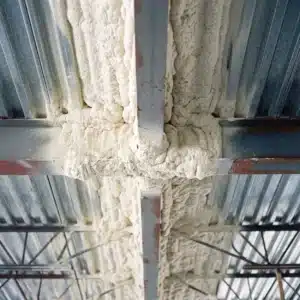
When steel is visible, appearance matters. Cementitious SFRM (spray-applied fire resistive material) creates a thick, lumpy, cement-like texture that defeats the purpose of an open-ceiling design.
Intumescent fireproofing for exposed structural steel is a fire-protective coating that expands when exposed to high heat (typically around 350°F or more) to insulate the steel beneath. The finish is thin, smooth, and paint-like, preserving the beauty of exposed beams, columns, and connections.
Intumescent coatings are used in airports, arenas, museums, and restaurants worldwide. The same fire ratings are available (1 to 3 hours for most commercial applications). In open-ceiling buildouts, intumescent allows exposed W-beams to become part of the design, painted black, charcoal, or a brand’s signature color. The cost premium over cementitious is real, but when steel is visible, there is no practical alternative.
A Texas restaurant chain recently converted three locations from drop ceilings to exposed steel. Architectural-finish intumescent coating on the W-beams, topped in matte black, gave each location the industrial look their brand wanted while meeting the 1-hour fire rating required under Type IIA construction.
Intumescent Fireproofing Finish Levels: Standard, Commercial, Architectural
Not all intumescent finishes look the same. Three levels are available, and the right choice depends on how close people will be to the steel. According to Carboline’s technical guidance on intumescent fireproofing materials, finish quality is driven by application method and labor, not fire performance.
| Finish Level | How It Is Applied | What It Looks Like | Best For | Cost Impact |
|---|---|---|---|---|
| Standard | Spray applied only | Stippled “orange peel” texture | Non-visible areas (behind walls, above drop ceilings) | Lowest cost |
| Commercial | Spray + thinned second coat + topcoat | Uniform with slight texture | High ceilings, mezzanines, areas viewed from a distance | Moderate |
| Architectural | Spray + sand flat + thinned coat + topcoat | Smooth, paint-like appearance | Restaurants, retail, lobbies (areas close to people) | Highest cost (more labor) |
For open-ceiling retail and restaurants, you will almost always want a commercial or architectural finish. The difference comes down to viewing distance. If the steel is 15 or more feet overhead, commercial finish looks great. If the steel is 8 to 12 feet above diners, architectural finish is worth the investment.
Finish level does not affect fire rating. A standard finish provides the same fire protection as an architectural finish. You are paying for appearance, not performance. Budget 30 to 50 percent more for architectural due to extra labor.
Custom Colors: Unlimited Design Freedom with Intumescent Fireproofing
Intumescent base coats cannot be tinted. They are typically white, gray, or off-white. Color comes from an approved decorative topcoat applied after the intumescent coating cures.
Think of it as a two-layer system. The intumescent base coat protects the steel from fire. The topcoat makes it look the way your designer wants. Together, they provide fire protection and unlimited color freedom.
Topcoats can be any color and any gloss level: matte, satin, semi-gloss, or high-gloss. Match Sherwin-Williams, Benjamin Moore, RAL, or custom brand colors. Matte reads as industrial, semi-gloss as modern, and high-gloss as upscale. The topcoat must be manufacturer-approved, since not every paint is compatible with every intumescent system.
Restaurant-Specific Challenges for Intumescent Fireproofing
Restaurants bring challenges that standard retail projects do not. Kitchen proximity is the biggest concern. NFPA 96 governs commercial kitchen ventilation and fire protection. Under IMC 507.9, a minimum 18 inches of clearance is required from Type 1 kitchen hoods to any combustible material, meaning wood framing and combustible ceiling tiles, not steel.
But steel beams near kitchen areas face their own challenges. Constant exposure to grease vapor, heat, steam, and cleaning chemicals can degrade intumescent coatings over time. Intumescent coatings in these zones typically need a chemical-resistant topcoat to maintain long-term durability. Coordinate with your kitchen designer and mechanical engineer early in the process.
Acoustics matter too. Removing the drop ceiling eliminates acoustic absorption, and open-ceiling restaurants get loud fast. Acoustic baffles, panels, or ceiling clouds are often added alongside intumescent-coated steel. Budget for both fire protection and acoustic treatment.
Water-based, low-VOC intumescent coatings are preferred for restaurant environments due to low odor and food-service safety. Solvent-based systems are not recommended due to strong odor and high VOC content.
What to Expect: Cost and Timeline
Typical cost ranges for open-ceiling intumescent fireproofing vary by finish level. Architectural finish typically runs $8 to $16 per square foot of steel coverage. Commercial finish ranges from $6 to $12 per square foot. Standard finish runs $4 to $8 per square foot. As noted in Hilti’s intumescent steel protection guide, product selection and required fire rating affect final cost.
Removing a drop ceiling saves roughly $3 to $8 per square foot in ceiling materials but adds $4 to $16 per square foot in intumescent cost. Timeline for a typical buildout is 2 to 4 weeks. Costs vary by region, project size, and finish level.
Key Takeaways
- Open ceilings do not eliminate fire code. If your steel needs a fire rating, it still needs fireproofing.
- Intumescent fireproofing provides a smooth, paint-like finish that preserves the exposed-steel look.
- Three finish levels (standard, commercial, architectural) let you choose based on viewing distance and budget.
- Unlimited colors are available through approved topcoats to match any design scheme.
- Restaurants have extra challenges: kitchen heat, NFPA 96 clearances, acoustics, and low-VOC requirements.
Planning an open-ceiling buildout for a restaurant, brewery, or retail space? Getting intumescent fireproofing right from the start saves time, money, and design headaches. Experience across hundreds of open-ceiling projects throughout Texas, Oklahoma, Kansas, Nebraska, Minnesota, and Wisconsin shows what works, from finish levels to color matching to kitchen-adjacent challenges. Contact Bahl Fireproofing today to discuss your project and get a realistic cost estimate.
This article provides general educational information about fireproofing and insulation systems and does not constitute professional engineering advice or product specification. System selection must be based on project-specific fire ratings, thermal requirements, acoustic performance needs, environmental conditions, substrate requirements, and budget constraints. Code requirements vary by jurisdiction and project type. Always consult with a licensed professional and verify UL or FM assembly listings before finalizing specifications.