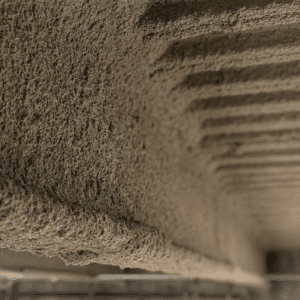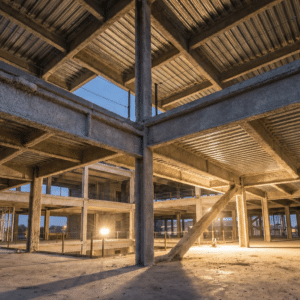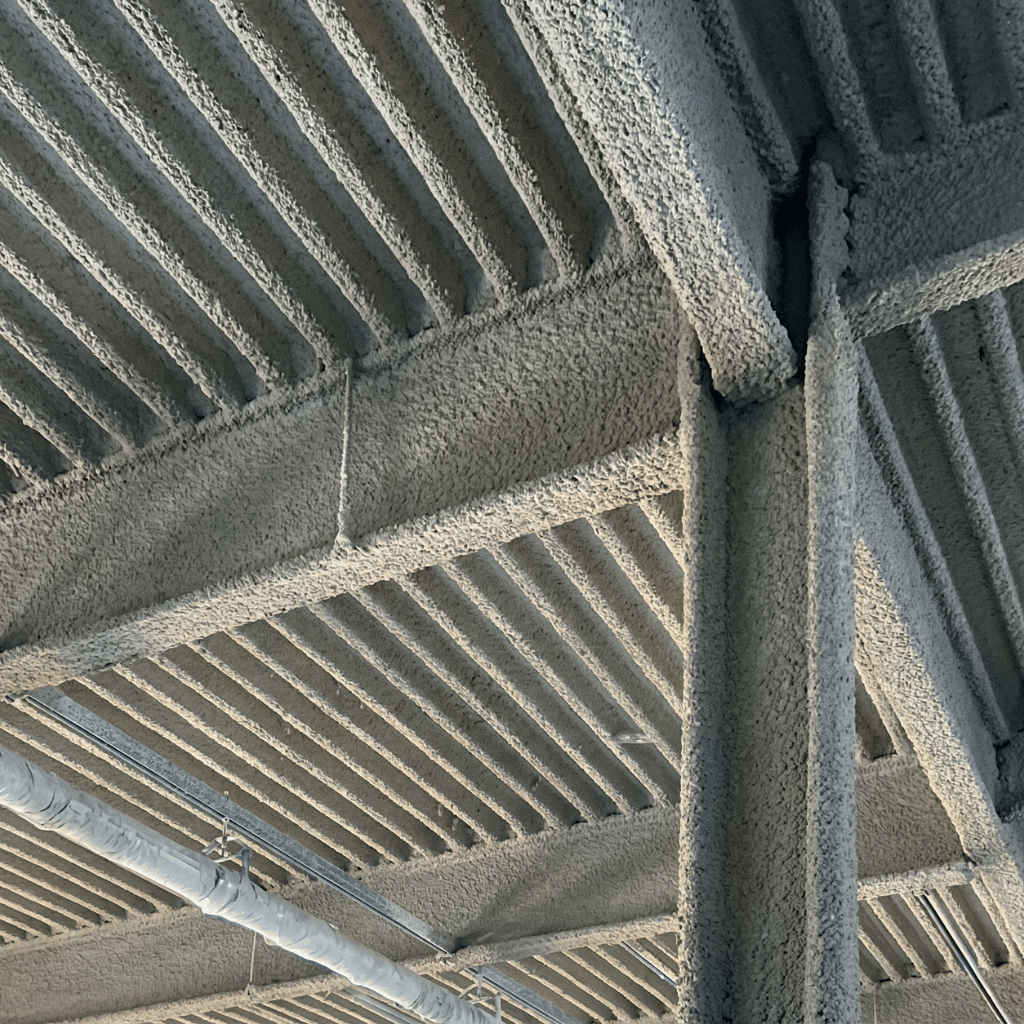
Spray-applied fireproofing looks simple from the outside: mix it, spray it, move on. But every GC who has managed a commercial steel project knows the reality is more complicated. The application sequence, environmental controls, pass thickness limits, and trade coordination behind SFRM determine whether your project passes inspection on the first try or gets shut down for rework. This guide walks you through every step of the process, from steel verification to final patching, so you know exactly what to expect and where things go wrong.
TLDR: SFRM application follows a strict sequence: verify the UL design, prepare the steel substrate, confirm temperature and humidity conditions, spray in controlled passes to design thickness, allow proper curing, and coordinate inspections per ASTM E605 and ASTM E736. Skipping steps or rushing passes is the fastest way to fail a bond test and blow your schedule. Read on for the full field process.
What Spray-Applied Fireproofing Actually Does
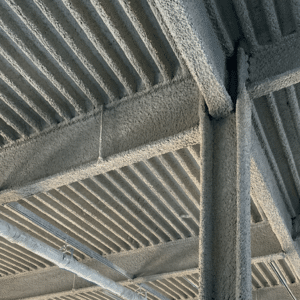
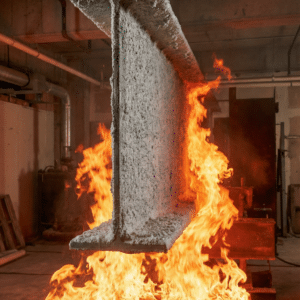
Spray-applied fire-resistive material (SFRM) is a cementitious or calcium silicate-based coating sprayed directly onto structural steel, metal deck, and concrete assemblies to achieve fire-resistance ratings of 1 to 4 hours. Those ratings are proven through standardized fire tests per ASTM E119 or UL 263, which expose the assembly to a controlled time-temperature curve and measure how long the structural element maintains its load-bearing capacity.
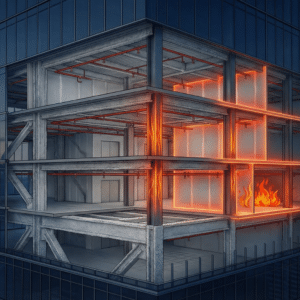
The material does not prevent fire. It slows heat transfer into the steel. Structural steel loses roughly half its load-bearing strength at about 1,000 degrees Fahrenheit. SFRM insulates the steel so it stays below that critical temperature threshold for the rated duration, giving occupants time to evacuate and firefighters time to respond. IBC Section 703 and Chapter 7 govern where fire-resistance-rated construction is required, and the specific SFRM product, thickness, and application method must match the tested UL or ASTM design assembly exactly.
For a broader overview of SFRM types, density categories, and where they fit in commercial construction, see our complete spray-applied fireproofing guide.
How Is Spray-Applied Fireproofing Installed on Structural Steel?
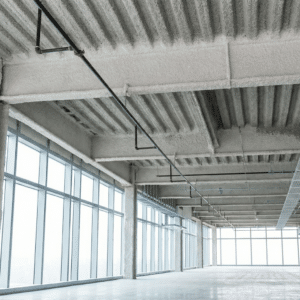
Spray-applied fireproofing is installed by cleaning and inspecting the steel, verifying the correct UL design assembly, then spraying SFRM in one or more controlled passes using wet-spray or dry-spray equipment until the specified thickness is reached. After curing for a minimum of 24 hours, inspectors verify thickness, density, and bond strength per ASTM E605 and ASTM E736. The entire process depends on tight coordination between the fireproofing crew, steel erector, and MEP trades.
Here is the step-by-step sequence that every GC should understand before commercial spray-applied fireproofing begins on your project.
Step 1: Verify the UL/ASTM Design and Fire Ratings
Before any material touches the steel, the fireproofing contractor must confirm which UL design assembly applies to each structural element on the project. The UL design specifies the exact SFRM product, the required thickness for the fire-resistance rating (1-hour, 2-hour, 3-hour, or 4-hour), the steel section type (columns, beams, joists, or deck), and whether the assembly is restrained or unrestrained.
This is not optional. Spraying the wrong product or the wrong thickness voids the fire rating entirely. The design architect and structural engineer of record identify the required ratings. The fireproofing contractor matches those ratings to published UL designs from the SFRM manufacturer.
Step 2: Coordinate Surface Preparation and Primers
Steel must be clean, dry, and free of oil, dust, loose rust, mill scale, curing compounds, and overspray from other trades. NFCA 100 (Standard Practice for the Application of SFRM) and every major SFRM manufacturer require this baseline per NFCA 100.
Here is the detail that catches GCs off guard: most UL fire test designs are conducted on unprimed steel. That means the SFRM must bond directly to bare steel unless the UL design specifically lists a compatible primer. Generic shop primers, epoxy coatings, and high-build paint systems can prevent adhesion and invalidate the fire rating. If your steel fabricator applied a primer before delivery, the fireproofing contractor and the manufacturer must confirm compatibility before spraying proceeds.
I have seen projects lose entire weeks because the structural steel arrived with an incompatible primer. The fix is coordination: get the SFRM manufacturer’s approved primer list to the steel fabricator before shop drawing approval, not after the steel is on site.
Step 3: Check Weather, Temperature, and Access
NFCA 200 and all major SFRM manufacturers require that both the substrate (steel) temperature and the ambient air temperature remain at or above 40 degrees Fahrenheit during application and for at least 24 hours after. Below 40 degrees, the water in cementitious SFRM can freeze before the binder fully hydrates, resulting in poor adhesion, soft material, and eventual delamination.
In projects across Texas, Kansas, and Oklahoma, this 40-degree rule creates real scheduling challenges. Texas summer projects rarely have temperature issues, but Kansas and Oklahoma winter projects in unheated structures can drop below 40 degrees overnight even when daytime temperatures are fine. I have seen bond test failures on Kansas warehouse projects where the steel cooled below the minimum threshold after the crew left for the day. The fireproofing looked normal, but the bond pull tests came back below specification.
The solution: temporary heat, temperature monitoring at the steel surface (not just ambient air), and scheduling SFRM work during windows when conditions will hold for the full 24-hour cure period.
Adequate ventilation is also critical. Trapped moisture slows cure and can cause sagging or soft spots in the finished material. On enclosed floor levels, portable fans or open building perimeters help air exchange during the curing window.
Step 4: Set Up Wet-Spray or Dry-Spray Equipment
SFRM is applied using one of two methods, depending on the product formulation and project conditions.
Wet-spray is the more common method for commercial projects. Dry SFRM material is mixed with water into a slurry at a pump unit, pumped through a hose to the nozzle, and atomized air creates a fan-shaped spray pattern. Wet-spray tends to be faster in production and delivers consistent density, but it is sensitive to freezing temperatures and high ambient humidity.
Dry-spray conveys dry SFRM pneumatically through the hose, with atomized water introduced at the nozzle tip. This method works well in cold or exposed conditions where pre-mixed slurry could freeze in the hose, and it gives the applicator more control over water content. The tradeoff is more rebound material on the floor, which means more cleanup.
Both methods require calibrated equipment, consistent air pressure, and trained applicators who maintain the correct gun distance, angle, and hand speed for uniform coverage.
Step 5: Spray in Passes to Design Thickness
This is where GCs need to understand a critical constraint: you cannot spray SFRM to full design thickness in a single pass.
Most cementitious SFRM products allow a maximum of approximately 3/4 inch per pass. For a 2-hour fire rating on a W-shape column that requires 1-1/2 inches of SFRM, the applicator must spray two passes with adequate set time between coats. Trying to build up the full thickness in one heavy pass causes the wet material to sag, crack, or slough off under its own weight. Even if it stays on the steel initially, the compressed material will have inconsistent density and will likely fail thickness and bond tests at inspection.
The set time between passes depends on the product and conditions, but is typically at least several hours. GCs should plan for this in the project schedule. SFRM is not a one-afternoon activity on a multi-story steel structure.
The applicator works methodically across beams, columns, and deck assemblies, building up each pass evenly. On complex steel profiles (connections, stiffeners, wide-flange webs), achieving uniform thickness requires varying the gun angle and distance to avoid thin spots and heavy corners.
Step 6: Curing, Protection, and Trade Coordination
After the final pass, SFRM needs a minimum of 24 to 48 hours of initial curing before it can tolerate moisture exposure or mechanical contact. Full strength develops over days to weeks depending on thickness, product, and environmental conditions.
During this curing window, the SFRM must be protected from water, vibration, and mechanical damage. This is the point where trade coordination matters most. MEP contractors installing hangers, conduit, ductwork, seismic bracing, or sprinkler drops will inevitably need to cut through or work around cured SFRM. That work should happen after the SFRM has fully cured and been inspected, not before.
When trades do damage cured SFRM (and they will), the fireproofing contractor must return for patching. Patches are applied by hand trowel or localized spray and must restore the original design thickness. Patching over debris, dust, or loose material is not acceptable. Understanding the real-world cost and schedule impact of fireproofing repair after MEP trades is critical for accurate project planning.
Wet Spray vs. Dry Spray vs. Trowel Application
The choice between application methods depends on the product, conditions, and project requirements. Here is how they compare in commercial practice.
| Factor | Wet Spray | Dry Spray | Trowel |
|---|---|---|---|
| Typical use | Most commercial interior applications | Cold weather, exposed conditions, controlled overspray | Patching, touch-up, exposed finish areas |
| Production rate | Higher | Moderate | Lowest (labor-intensive) |
| Density control | Consistent (pre-mixed slurry) | Operator-dependent (water at nozzle) | Consistent (hand-placed) |
| Rebound/waste | Moderate | Higher (more material on floor) | Minimal |
| Temperature sensitivity | High (slurry can freeze in hose) | Lower (dry conveying) | Low |
| Finish quality | Rough, textured | Rough, textured | Smooth to semi-smooth |
On most commercial projects, wet-spray handles 90% or more of the production work. Dry-spray fills specific conditions. Trowel work handles final patching, connection details, and any areas where spray access is limited.
Thickness, Passes, and Curing: Why You Cannot Rush the Schedule
GCs under schedule pressure sometimes ask whether the fireproofing crew can “just spray it thicker and faster.” The answer is no, and the reasons are structural, not procedural.
SFRM products are tested and listed at specific thicknesses for specific fire ratings. The published UL fire protection guide for structural steelwork documents that UL designs specify exact thickness, density, and application methods. Deviating from those parameters means the assembly no longer matches the tested design, and the fire rating is not valid.
Pass thickness limits exist because cementitious SFRM relies on proper hydration and cohesion within each layer. A single heavy pass does not cure the same way as two properly timed passes. The internal moisture cannot escape evenly, the bond to the substrate is weaker, and the material develops internal stress as it dries, leading to cracking and delamination.
A typical curing timeline for cementitious SFRM in favorable conditions (above 40 degrees Fahrenheit, good ventilation) is 24 to 48 hours for initial set and protection from moisture, with full bond strength developing over days to weeks depending on thickness and humidity. The fireproofing contractor and the manufacturer’s technical data sheet dictate the specific timeline for each product.
Field Quality Control and Inspection Touchpoints
Inspection is not a single event at the end. For SFRM, quality control happens in stages, and GCs who understand the inspection sequence can avoid the most expensive rework scenarios.
Measuring Thickness and Density (ASTM E605)
ASTM E605/E605M is the standard test method for measuring SFRM thickness and density in the field. Inspectors (and the fireproofing crew doing self-checks) use pin gauges inserted through the SFRM to the substrate to measure thickness at multiple points across each structural member. The measurements must meet or exceed the UL design thickness.
Density is verified by cutting a sample of known dimensions from the cured SFRM, weighing it, and calculating the density. If density is below the manufacturer’s specification, the material may not provide the rated fire protection even at the correct thickness.
The fireproofing crew should be doing these checks throughout the application, not waiting for the third-party inspector. Catching a thin spot during application costs minutes. Catching it at final inspection costs days.
Bond Pull Testing (ASTM E736)
ASTM E736/E736M measures the cohesion and adhesion (bond strength) of SFRM to the substrate. A test disc is adhered to the surface of the SFRM, and a calibrated pull device measures the force required to detach the material. The result tells you whether the SFRM is properly bonded to the steel and whether the material has adequate internal cohesion.
Bond failures are almost always traceable to one of four causes: dirty substrate, incompatible primer, cold steel during application, or compressed material from too-thick passes. All four are preventable with proper preparation and application discipline.
What Inspectors Look for Per NFCA and IBC
Third-party inspectors working under IBC Chapter 17 special inspection requirements will verify thickness (per UL design), density (per manufacturer specification), bond strength (per ASTM E736 minimum values), substrate condition documentation, product labeling and batch records, and environmental conditions during application.
NFCA inspection guidance emphasizes that inspectors should not test uncured material, as it gives artificially low results, and should not flatten the SFRM surface before testing. Both practices can lead to false failures that trigger unnecessary rework.
Common Application Defects and How to Avoid Them
Every fireproofing inspector has a short list of defects they see repeatedly. Understanding what causes them helps GCs prevent them through proper trade coordination and application oversight.
Uneven spray and undulations result from inconsistent gun distance, variable hand speed, or spraying at too shallow an angle. The fix is maintaining 18 to 24 inches of gun distance and keeping the nozzle perpendicular to the steel surface.
Drips, sags, and heavy corners come from over-thick passes, too much water in the mix, or spraying onto wet uncured layers before the previous pass has set. Pass discipline and proper set times between coats prevent this.
Cracks develop when SFRM is over-built beyond the specified thickness, dries too rapidly (direct sunlight, high heat, strong air currents), or the substrate moves before the material reaches full cure. Controlling environmental conditions during curing is the primary prevention.
Exposed mesh or “bird’s nests” occur when reinforcing mesh or support pins are installed improperly, sitting too high relative to the final SFRM surface. The fix requires full removal and reinstallation of the mesh, not just patching over it with additional material.
Delamination is the most serious defect. The SFRM separates from the substrate in sheets, typically caused by dirty or cold steel, incompatible primer, or heavy mechanical impact before the material has cured. Delaminated areas must be completely removed and re-applied, not patched.
Cold-Weather and High-Humidity Projects in TX, KS, and OK
Temperature and moisture are the two environmental variables that cause the most SFRM failures in our service territory.
In Texas, humidity is the bigger concern. Gulf Coast projects during summer can have ambient humidity above 80%, which dramatically slows SFRM curing. The material stays soft longer, making it vulnerable to mechanical damage from other trades. Adequate ventilation and fan circulation during the cure window are essential.
In Kansas and Oklahoma, cold is the primary risk. I have managed winter projects where we maintained temporary heat on every floor during SFRM application, only to have a heating unit fail overnight. The steel temperature dropped below 40 degrees Fahrenheit, and the SFRM that had been sprayed that afternoon never bonded properly. The bond pull tests failed, and we had to remove and re-spray two full floors of fireproofing. That is a schedule hit no GC wants, and it is entirely preventable with redundant heating, continuous temperature monitoring, and conservative scheduling.
The practical rule: if you cannot guarantee that both the steel surface and the ambient air will stay at or above 40 degrees for 24 hours after application, do not spray. Wait for conditions to improve. Spray-applied fireproofing cost per square foot is typically far less than the cost of removal and re-application after a bond failure.
Related Reading
Explore more about commercial fireproofing application and quality across our content library:
- Before SFRM goes on, the substrate must be right. See why surface preparation matters in commercial fireproofing.
- Want to understand what happens after application from the owner’s perspective? Read our fireproofing inspection process guide for building owners.
- Comparing SFRM to acoustic insulation systems? See our K-13 spray-applied insulation contractor guide for the differences in product, process, and performance.
Frequently Asked Questions
Q: How thick should SFRM be for a 2-hour fire rating?
A: The required thickness depends on the specific SFRM product, the steel section size, and whether the assembly is restrained or unrestrained. A typical cementitious SFRM may require 1 to 1-1/2 inches on a W14 column for a 2-hour rating, but a lighter section may require more. Always reference the published UL design for your specific combination of product and structural member.
Q: Can you apply SFRM over painted or primed steel?
A: Only if the primer is specifically listed in the UL fire test design for that SFRM product. Most UL designs are tested on unprimed (bare) steel. Generic shop primers, epoxies, and high-build coatings can prevent adhesion and void the fire rating. Confirm primer compatibility with the SFRM manufacturer before application.
Q: How long before other trades can work around new SFRM?
A: A minimum of 24 to 48 hours for initial cure, depending on the product, thickness, and environmental conditions. SFRM must be protected from water, vibration, and mechanical impact during this window. Trades that need to cut, drill, or hang from fireproofed steel should wait until after the material has fully cured and been inspected.
Q: What happens if fireproofing gets damaged by other trades?
A: The fireproofing contractor must return to patch the damaged areas. Patches must be applied to clean, intact SFRM and must restore the original UL design thickness. Patching over loose or contaminated material is not acceptable. The patched area is subject to the same inspection standards as the original application.
Q: What is NFCA 100?
A: NFCA 100 is the Standard Practice for the Application of Spray-Applied Fire-Resistive Materials, published by the National Fireproofing Contractors Association. It covers preparation, application methods (wet and dry), safety, quality control, and repair procedures. Most commercial specifications reference NFCA 100 as the governing application standard for SFRM.
Q: Can SFRM be applied in freezing weather?
A: Not without environmental controls. Both the steel substrate and the ambient air must be at or above 40 degrees Fahrenheit during application and for at least 24 hours after. Below that threshold, the cementitious binder cannot hydrate properly, leading to bond failures. Winter projects require temporary heat, temperature monitoring, and conservative scheduling.
Q: How are SFRM thickness and bond strength tested in the field?
A: Thickness is measured by inserting pin gauges through the SFRM to the substrate per ASTM E605. Bond strength is tested by adhering a disc to the SFRM surface and pulling it with a calibrated device per ASTM E736. Both tests are performed on cured material at multiple locations across the project.
Q: What is the difference between restrained and unrestrained fire ratings?
A: In a restrained assembly, the structural member is connected so that thermal expansion is resisted by surrounding construction. In an unrestrained assembly, the member is free to expand. Unrestrained assemblies typically require thicker SFRM because the steel must carry its load longer without the benefit of load redistribution. The design engineer specifies which condition applies.
Key Takeaways
SFRM application follows a strict sequence that cannot be compressed.
- Verify the UL design, prepare the substrate, confirm environmental conditions, spray in controlled passes, cure, and inspect.
- Skipping steps or combining them to save schedule time is the fastest path to failed inspections and expensive rework.
Surface preparation and primer coordination are the most common failure points.
- Most UL designs require unprimed steel. Incompatible primers void the fire rating.
- Get the SFRM manufacturer’s approved primer list to the steel fabricator before shop drawings, not after steel is on site.
Pass thickness limits exist for structural reasons, not convenience.
- Most cementitious SFRM allows approximately 3/4 inch per pass with adequate set time between coats.
- Over-thick single passes cause sag, cracking, low density, and bond test failures.
For standard cementitious SFRM, the 40-degree rule is effectively non-negotiable.
- Both steel surface and ambient air must stay at or above 40 degrees Fahrenheit during application and for 24 hours after.
- Kansas and Oklahoma winter projects need temporary heat, continuous monitoring, and conservative scheduling.
Field QC should happen throughout application, not just at final inspection.
- The crew should self-check thickness and density per ASTM E605 during every shift.
- Catching a deficiency during application costs minutes. Catching it at inspection costs days.
Trade coordination determines whether your SFRM survives to final inspection.
- MEP trades cutting into uncured SFRM is the number one source of patching costs.
- Schedule SFRM inspection before releasing MEP rough-in access to those areas.
If your next commercial project needs SFRM applied by a crew that understands the full process, from UL design verification to final inspection, we can help. We have been applying spray-applied fireproofing on structural steel across Texas, Kansas, and Oklahoma for over 20 years. Contact Bahl Fireproofing at 512-387-2111 or email ross@bahlfireproofing.com to schedule a consultation or request a bid.
This article provides general educational information about spray-applied fireproofing application processes and procedures. It is not a substitute for project-specific engineering, code analysis, or professional consultation. Building codes, material specifications, and installation requirements vary by jurisdiction, building type, and project conditions. Always consult with a licensed professional and your local authority having jurisdiction before making specification or purchasing decisions. Bahl Fireproofing is not responsible for decisions made based on general information provided in this article.