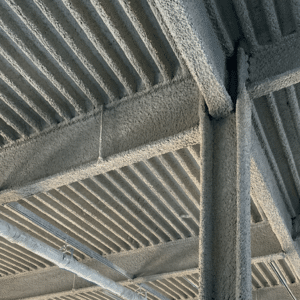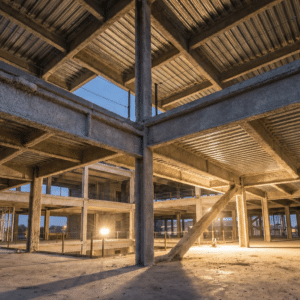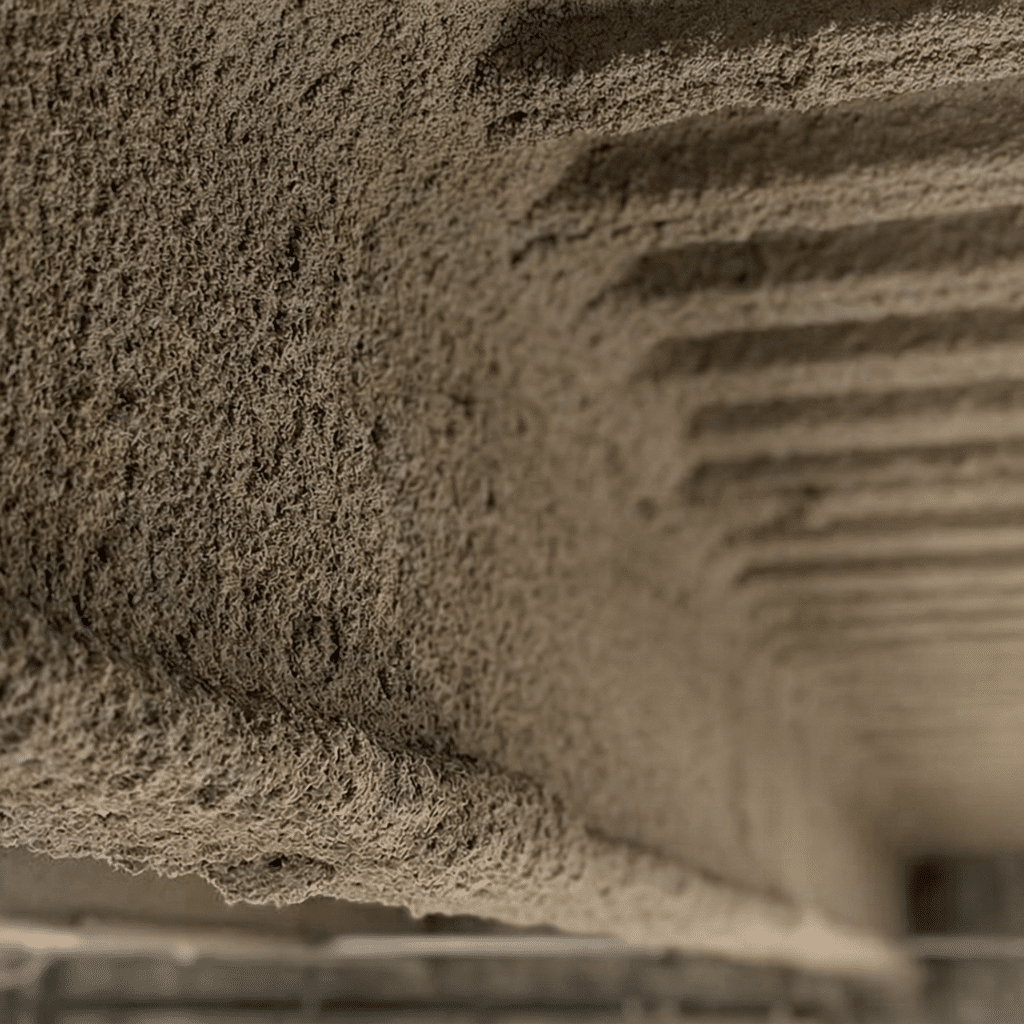
Spray-applied fire-resistive material (SFRM) comes in three density categories, and the one your project specifies determines how well the fireproofing survives on the steel throughout construction and the life of the building. If you are a general contractor, specifier, architect, or facility manager making or reviewing a fireproofing specification, this guide explains what each density category does, which products fall into each one, and how to choose the right density for your specific project conditions.
TLDR: SFRM density is measured in pounds per cubic foot (pcf) and falls into three categories: commercial (15 to 21 pcf), medium (22 to 39 pcf), and high (40+ pcf). Density governs physical durability, moisture resistance, and bond strength. It does not determine fire rating hours. Fire rating comes from the UL-tested assembly design and application thickness. Getting the density category right at specification time is the most cost-effective decision in the entire fireproofing scope.
In over 20 years of applying SFRM across Texas, Kansas, and Oklahoma, the single most common misconception I encounter from building owners and GCs is that specifying higher-density product buys more fire protection hours. It does not. That misconception costs projects money and creates specification errors that show up at inspection.
This article explains what density actually governs, breaks down all three categories with specific products and pcf values, walks through the decision logic for choosing the right density, and covers the IBC bond strength requirements that may narrow your product options before you even look at a UL design. If you are specifying or reviewing a spray-applied fireproofing scope, this is the technical foundation you need.
What Is SFRM Density, and Why Does It Matter?
SFRM density measures how much a given volume of applied fireproofing material weighs, expressed in pounds per cubic foot (pcf). Higher density means a harder, heavier, more durable material. Lower density means a lighter, softer material that covers faster and costs less per square foot.
Density is tested using ASTM E605, the standard test method for thickness and density of spray-applied fire-resistive material. An inspector extracts a core sample of known volume, dries it to stable weight, and divides mass by volume to calculate density in pcf. IBC Section 1705.15.5 requires that the installed density must meet or exceed the minimum specified in the approved fire-resistance design. If it falls short, the project requires rework before it can proceed.
What density governs is physical performance: how well the SFRM resists impact damage, moisture absorption, freeze-thaw cycling, and construction traffic. What density does not govern is how many hours of fire resistance the assembly provides. That distinction is the most important concept in this article, and we will cover it in detail below.
What Is the Difference Between Low, Medium, and High Density SFRM?
SFRM comes in three density categories measured in pounds per cubic foot (pcf). Commercial density (15 to 21 pcf) most commonly uses gypsum binders for concealed applications, though Portland cement-based commercial-density products also exist for exterior conditions. Medium density (22 to 39 pcf) uses cement binders for exposed interior and indirect weather conditions. High density (40 pcf and above) uses Portland cement for exterior environments, parking garages, and industrial applications including UL 1709 hydrocarbon fire-rated assemblies.
| Factor | Commercial / Low Density | Medium Density | High Density |
|---|---|---|---|
| PCF Range | 15 to 21 pcf | 22 to 39 pcf | 40+ pcf |
| Binder Type | Gypsum | Portland cement or cement/gypsum blend | Portland cement |
| Key Products | CAFCO 300 (gypsum, wet-mix), Carboline Pyrolite 22 (gypsum); CAFCO BLAZE-SHIELD II (Portland cement, dry-mix, UL exterior-classified) | CAFCO 400 (22 pcf min, tested at 25 pcf), CAFCO BLAZE-SHIELD HP, CAFCO 400 ES | CAFCO FENDOLITE M-II (40 to 44 pcf), Carboline Pyrocrete 241 (55 pcf), Pyrocrete 241 HD (70 pcf) |
| Best Applications | Concealed steel behind ceilings and walls; standard commercial interiors | Exposed interior applications, mechanical rooms, high-rise bond strength compliance, indirect weather exposure | Exterior steel, open parking garages, aviation/petrochemical facilities, UL 1709 hydrocarbon fire applications |
| Moisture Resistance | Poor (gypsum absorbs water) | Good (cement-based resists moisture) | Excellent (Portland cement plus vermiculite; designed for direct weather exposure) |
| Impact Resistance | Low | Moderate | High |
| Relative Cost | $5 to $9 per SF installed | $7 to $12 per SF installed | $10 to $20+ per SF installed |
Commercial / Low Density (15 to 21 pcf)
Commercial density SFRM is the workhorse of the industry. The most common product in this category is CAFCO 300 (wet-mix, minimum 15 pcf), which uses a gypsum binder that allows fast coverage rates and lower material costs. This is the right product for concealed applications where the SFRM is protected by ceilings, walls, or other finishes. Office buildings, retail spaces, and standard commercial interiors where the steel is not exposed to traffic, moisture, or weather are the core market for gypsum-based commercial density.
CAFCO BLAZE-SHIELD II (dry-mix, also commercial density at 15 pcf minimum) is the important exception. Unlike CAFCO 300, BLAZE-SHIELD II uses a Portland cement binder, which gives it significantly better moisture and freeze-thaw resistance than gypsum-based products at the same density. BLAZE-SHIELD II is UL-classified as investigated for exterior use, making it the only commercial-density SFRM product with that classification. For projects where commercial density is specified but the steel may be exposed to weather during construction, BLAZE-SHIELD II provides a cement-based option without stepping up to medium density.
The gypsum binder in products like CAFCO 300 is the limiting factor for that subset of the category. Gypsum absorbs moisture. It softens under physical contact. It degrades under freeze-thaw cycling. If the SFRM will be exposed to any of those conditions, gypsum-based commercial density is the wrong choice regardless of cost savings.
Medium Density (22 to 39 pcf)
Medium density SFRM uses Portland cement or a cement/gypsum blend that produces a harder, more durable coating. CAFCO 400 (wet-mix, minimum 22 pcf, tested at 25 pcf) and CAFCO BLAZE-SHIELD HP (dry-mix, exterior-rated) are the primary products in this category. CAFCO 400 ES is a delayed-set variant designed for high-rise pump-and-spray application. For the full range of commercial, medium, and high density product specifications, Isolatek’s specification assistance page covers the complete CAFCO product line.
Medium density is the right specification for exposed interior applications: mechanical rooms, elevator shafts, parking garage interiors, and any area where the SFRM will be visible and subject to incidental contact. CAFCO BLAZE-SHIELD HP is the only medium-density SFRM product UL-classified for exterior use, making it the minimum specification for steel exposed to indirect weather conditions during or after construction.
Medium density also plays a critical role in high-rise construction. IBC Section 403.2.4 requires minimum bond strengths that historically only medium-density products could achieve, which is why medium density became the default specification for buildings over 75 feet. We will cover that code connection in detail below.
High Density (40+ pcf)
High density SFRM is built for the most demanding conditions. CAFCO FENDOLITE M-II (40 to 44 pcf, Portland cement plus vermiculite) handles direct exterior exposure, open parking garages, and severe freeze-thaw environments. At roughly one-third the density of concrete, it provides weather-grade durability without the dead load of concrete encasement.
For industrial and petrochemical applications requiring UL 1709 hydrocarbon fire ratings, the products move even higher: Carboline Pyrocrete 241 at 55 pcf, Pyrocrete 241 HD at 70 pcf, and Pyrocrete 241 HY at 50 pcf. These are the products specified for oil refineries, aviation manufacturing facilities with jet fuel storage, offshore platforms, and pharmaceutical plants where rapid-rise hydrocarbon pool fires are the design scenario.
Standard commercial density and medium density SFRM are not rated for UL 1709 hydrocarbon applications. That is a specification-disqualifying distinction, not a preference.
Does Higher SFRM Density Mean a Better Fire Rating?
No. This is the single most common and most costly misconception in the SFRM market, and it is worth stating clearly: density and fire rating are separate specifications governed by separate tests, verified through separate inspection steps, and documented in separate IBC sections.
Density governs physical performance. It determines how well the SFRM survives on the steel: impact resistance, moisture tolerance, freeze-thaw durability, bond strength. Density is tested per ASTM E605 and verified under IBC Section 1705.15.5.
Fire rating (1 hour, 2 hour, 3 hour, 4 hour) is governed by the UL-tested assembly design. Understanding fire ratings for structural steel from 1 to 4 hours requires looking at the specific SFRM product plus the application thickness as tested in a UL fire resistance design listed in the BXUV directory (tested to ANSI/UL 263 for cellulosic fire exposure or UL 1709 for hydrocarbon fire exposure). Thickness is verified under IBC Section 1705.15.4, a separate special inspection requirement from the density check.
You can have a 4-hour-rated commercial-density assembly if the UL design calls for sufficient thickness of that product at that density. You cannot substitute a higher-density product at a thinner application and assume you have met the fire rating, because no UL design exists for that untested combination.
In my experience, the projects that get this wrong usually start with a well-intentioned assumption: “If we spend more on high-density product, we get better fire protection.” What they actually get is better physical durability, which may or may not be what the project needs. The fire rating question and the density question are two separate specifications that must be resolved independently.
How SFRM Density Connects to IBC Bond Strength Requirements
After the World Trade Center collapse, the National Institute of Standards and Technology (NIST) investigation concluded that SFRM dislodged from structural steel columns during impact contributed to the progressive failure of the buildings. NIST recommended that the International Code Council (ICC) introduce stepped bond strength requirements for SFRM in high-rise construction.
The result is IBC Section 403, which governs high-rise construction requirements. Section 403.2.4 and Table 403.2.4 within it set minimum SFRM bond strength by building height, tested per ASTM E736.
| Building Height | Minimum Bond Strength (ASTM E736) |
|---|---|
| 0 to 75 ft (non-high-rise) | 150 psf |
| 75 to 420 ft | 430 psf throughout entire building |
| Over 420 ft | 1,000 psf throughout entire building |
For decades, only medium-density cement-based products could reliably achieve 430 psf, which is why medium density became the default specification for high-rise buildings between 75 and 420 feet. CAFCO 400 (medium density, wet-mix) exceeds 430 psf with a tested value of 434 psf.
However, newer commercial-density products are changing that landscape. CAFCO 300 HS (Isolatek Type 300 HS) is a commercial-density product specifically designed to meet the 75-to-420-foot bond strength category. This means that for some high-rise projects, a commercial-density product can now qualify where medium density was previously the only option. For buildings over 420 feet requiring 1,000 psf, CAFCO 3000 (Isolatek Type 3000), a commercial-density, gypsum-based product, is formulated specifically to meet that top-tier bond strength threshold, further demonstrating that bond strength and density category are separate properties. Like CAFCO 400 ES, the CAFCO 3000 product line includes an extended-set variant (CAFCO 3000 ES) designed for high-rise pump-and-spray application.
The key point: bond strength and density are correlated but separately tested properties. Bond strength is tested per ASTM E736. Density is tested per ASTM E605. A product’s density category does not automatically determine its bond strength. Bond strength also depends on surface preparation requirements before SFRM application, because contaminants on the steel surface reduce adhesion regardless of the product’s tested capability. On every high-rise bid in Dallas, OKC, or Wichita, the first question is the building height. That determines the bond strength category under IBC Table 403.2.4, which may narrow product options before we even look at the UL fire resistance design.
Selecting the Right SFRM Density: A Practical Decision Guide
Product selection for SFRM density follows a five-question decision sequence. Answer them in order, and the right density category emerges.
Question 1: Will the SFRM be concealed behind ceilings, walls, or other finishes? If yes, commercial density (15 to 21 pcf) is typically appropriate. Products like CAFCO 300 or CAFCO BLAZE-SHIELD II provide cost-effective coverage for protected interior steel. If the steel may be temporarily exposed to weather during construction, CAFCO BLAZE-SHIELD II (Portland cement-based, UL exterior-classified) can serve at commercial density where gypsum-based products cannot. Proceed to Question 4 to verify bond strength.
Question 2: Will the SFRM be exposed in the interior? If the steel is visible in mechanical rooms, elevator shafts, open ceilings, or any area subject to incidental physical contact, specify medium density (22+ pcf) minimum. CAFCO 400 or CAFCO BLAZE-SHIELD HP provides the impact resistance and durability that exposed conditions demand.
Question 3: Will the steel be exposed to weather, freeze-thaw cycling, or direct moisture before or after envelope closure? For indirect weather exposure (steel temporarily exposed during construction), CAFCO BLAZE-SHIELD HP (medium density, exterior-rated) is the minimum specification. For direct, permanent exterior exposure (open parking garages, exterior structural steel), specify high-density CAFCO FENDOLITE M-II (40+ pcf).
Question 4: Is the building over 75 feet tall? If yes, verify bond strength requirements per IBC Section 403.2.4, Table 403.2.4. Buildings from 75 to 420 feet require 430 psf minimum. Buildings over 420 feet require 1,000 psf. This may limit product selection to medium-density products or specifically engineered commercial-density products like CAFCO 300 HS.
Question 5: Is there jet fuel, petroleum, or industrial hydrocarbon exposure near the structural steel? If yes, UL 1709 hydrocarbon fire-rated high-density SFRM is required: CAFCO FENDOLITE M-II/P, Carboline Pyrocrete 241, or Pyrocrete 241 HD. Standard commercial and medium density products do not carry UL 1709 ratings. This is not a preference; it is a specification requirement.
SFRM Density and Climate: Why Regional Conditions Change the Equation
The binder chemistry that defines each density category also determines how that product performs under specific climate conditions. This is where product selection becomes regional.
Zone 4A: Wichita and the Freeze-Thaw Problem
Wichita sits in IECC Climate Zone 4A, the coldest market in Bahl Fireproofing’s service territory. With 70-plus nights below freezing per year, any structural steel that is exposed to weather before envelope closure will subject the SFRM to repeated freeze-thaw cycling.
Gypsum-based commercial-density SFRM absorbs moisture. When that moisture freezes, it expands inside the material. Repeated cycling fractures the gypsum binder from the inside out. In my experience, gypsum-based low-density product on exposed steel in a Wichita winter does not survive to pass the special inspection. CAFCO BLAZE-SHIELD HP (medium density, exterior-rated) is the minimum specification for any Wichita project where steel will be exposed during construction. For permanently exposed exterior steel, CAFCO FENDOLITE M-II (high density) is the correct product.
Gulf Coast Texas: Humidity and Unconditioned Spaces
In Houston and the Southeast Texas corridor, persistent humidity in unconditioned coastal warehouses and industrial facilities accelerates the degradation of gypsum-based low-density SFRM faster than dry-climate markets. The gypsum binder absorbs ambient moisture continuously, weakening the material over time. For interior-exposed conditions in coastal Texas facilities that are not climate-controlled, cement-based medium density is often the right specification even when commercial density would be acceptable in a conditioned DFW office building.
SFRM Density and Cost: What to Expect
Higher density costs more per square foot. The premium comes from two sources: the material itself (cement-based formulations cost more than gypsum) and the application rate (denser products cover fewer square feet per hour, increasing labor cost).
| Density Category | Installed Cost Per SF | Primary Cost Driver |
|---|---|---|
| Commercial / Low (15 to 21 pcf) | $5 to $9 | Lower material cost; faster coverage rate reduces labor |
| Medium (22 to 39 pcf) | $7 to $12 | Cement-based formulation; slightly slower application |
| High (40+ pcf) | $10 to $20+ | Highest material cost; UL 1709 industrial products at upper range; requires more passes |
The lifecycle cost argument is straightforward. Specifying commercial density where medium density is required (exposed mechanical rooms, parking garages, high-traffic areas) and then remediating after construction damage costs far more than the upcharge at specification time. Repairing SFRM after MEP trade damage is one of the most common remediation scenarios we encounter, and one mechanical room where the crew strips failed low-density product and replaces it with the correct medium-density specification costs more than the original density premium across the entire project.
We see this on projects where a GC chose the cheapest product at bid and then paid for it twice. Get the density right at specification time.
SFRM Density Testing: What the Special Inspector Verifies
Special inspections for SFRM under IBC Section 1705.15 include both thickness verification (Section 1705.15.4) and density verification (Section 1705.15.5). These are separate requirements checked through separate procedures.
For density, the inspector extracts core samples per ASTM E605, dries them, and calculates density in pcf. The calculated density must meet or exceed the minimum individual value specified in the approved fire-resistance design. If the density falls below the specified minimum, the project requires corrective action: either additional material application or removal and re-application, followed by re-inspection.
For a deeper dive into how the full SFRM inspection process works, including thickness gauges, adhesion testing, and what happens when a section fails, see our guide on the fireproofing inspection process.
Frequently Asked Questions
Q: What is commercial density SFRM?
Commercial density SFRM (also called standard density or low density) is the lightest category, ranging from 15 to 21 pcf. Most products in this category use gypsum binders that allow fast application rates and lower material costs, including CAFCO 300 (wet-mix). The exception is CAFCO BLAZE-SHIELD II (dry-mix), which uses a Portland cement binder and is UL-classified for exterior use. Commercial density is primarily designed for concealed applications where the steel is protected by ceilings, walls, or other finishes.
Q: What is medium density SFRM used for?
Medium density SFRM (22 to 39 pcf) uses Portland cement or cement/gypsum blend binders. It is specified for exposed interior applications (mechanical rooms, elevator shafts, open ceilings), indirect weather exposure during construction, and high-rise buildings requiring 430 psf bond strength per IBC Section 403.2.4. Key products include CAFCO 400 and CAFCO BLAZE-SHIELD HP.
Q: What SFRM density is required for parking garages?
Open parking garages with direct weather exposure require high-density SFRM (40+ pcf) such as CAFCO FENDOLITE M-II. Enclosed parking garages with indirect exposure may use medium-density products like CAFCO BLAZE-SHIELD HP, depending on the specific exposure conditions and the authority having jurisdiction’s requirements.
Q: Does SFRM density affect fire rating?
No. Density governs physical performance: durability, moisture resistance, impact resistance, and bond strength. Fire rating (1 hour, 2 hour, 3 hour, 4 hour) is determined by the specific product plus application thickness as tested in a UL fire-resistance design. IBC verifies these as separate inspection steps: density under Section 1705.15.5 and thickness under Section 1705.15.4.
Q: What is the minimum density for SFRM in a high-rise building?
The IBC does not set a minimum density for high-rise SFRM. It sets minimum bond strength per IBC Section 403.2.4: 430 psf for buildings 75 to 420 feet, and 1,000 psf for buildings over 420 feet. Historically, only medium-density products (22+ pcf) met the 430 psf threshold. Newer commercial-density products like CAFCO 300 HS are now designed to meet the 75-to-420-foot bond strength requirement.
Q: What is CAFCO 300 density?
CAFCO 300 (Isolatek Type 300) is a wet-mix commercial-density SFRM with a minimum density of 15 pcf (240 kg/m³). It is the most widely used SFRM product in commercial construction for concealed applications on structural steel.
Q: What density SFRM is required for UL 1709 applications?
UL 1709 (hydrocarbon rapid-rise fire test) applications require high-density SFRM at 40 pcf or above. Products include CAFCO FENDOLITE M-II/P (petrochemical grade), Carboline Pyrocrete 241 (55 pcf), and Pyrocrete 241 HD (70 pcf). Standard commercial and medium density SFRM products do not carry UL 1709 ratings.
Q: Can low-density SFRM be used on exposed steel?
Most commercial-density gypsum-based SFRMs are not suitable for exposed applications. The gypsum binder absorbs moisture, softens under physical contact, and degrades under freeze-thaw cycling. The exception is CAFCO BLAZE-SHIELD II, a Portland cement-based commercial-density dry-mix product that is UL-classified for exterior use. For all other commercial-density products, any steel that will be visible, subject to incidental contact, or exposed to weather requires medium density (22+ pcf) at minimum. For direct, permanent exterior exposure, high density (40+ pcf) is required.
Key Takeaways
Density Governs Physical Performance, Not Fire Rating
- SFRM density determines durability, moisture resistance, impact resistance, and bond strength
- Fire rating is determined by the UL-tested assembly design and application thickness
- You cannot substitute density for thickness without a matching UL design
- IBC verifies these as separate inspection steps: density (Section 1705.15.5) and thickness (Section 1705.15.4)
Three Density Categories Serve Three Different Conditions
- Commercial density (15 to 21 pcf): mostly gypsum-based for concealed interiors; CAFCO BLAZE-SHIELD II (Portland cement) is the exception with UL exterior classification
- Medium density (22 to 39 pcf, cement-based): exposed interior, indirect weather, high-rise bond strength
- High density (40+ pcf, Portland cement): direct exterior, parking garages, UL 1709 industrial
IBC Bond Strength Requirements Narrow Product Selection by Building Height
- 0 to 75 feet: 150 psf (most products qualify)
- 75 to 420 feet: 430 psf (medium density or CAFCO 300 HS)
- Over 420 feet: 1,000 psf (limited product selection)
- Bond strength (ASTM E736) and density (ASTM E605) are separately tested properties
Climate and Exposure Conditions Drive Product Selection
- Zone 4A freeze-thaw (Wichita): gypsum-based low density will not survive on exposed steel
- Gulf Coast humidity (Houston): cement-based medium density is often right even for interior-exposed conditions
- UL 1709 hydrocarbon applications: high density (40+ pcf) is a specification requirement, not a preference
Getting Density Right at Specification Saves Money
- Remediation after wrong-density product fails costs more than the density upcharge at bid
- The decision sequence starts with exposure conditions and building height, not with cost per square foot
Related Reading
- For a comprehensive overview of SFRM types, application methods, and code requirements, see our spray-applied fireproofing guide.
- Wondering when intumescent coatings are a better fit than cementitious SFRM? Our intumescent fireproofing guide covers the full selection and specification process.
- For a practical look at how density specifications play out during high-bay steel fireproofing, read our guide on warehouse fireproofing installation.
Choose the Right SFRM Density for Your Next Project
If you are specifying or reviewing a fireproofing scope and want to make sure the density category, bond strength, and UL assembly design all align before the project goes to bid, I would like to hear about it. Bahl Fireproofing serves commercial construction projects throughout Texas, Kansas, and Oklahoma with 20-plus years of SFRM application experience. Contact Bahl Fireproofing today at 512-387-2111 or email ross@bahlfireproofing.com to discuss your project specifications.
This article provides general educational information about fireproofing and insulation services. It is not a substitute for professional engineering, architectural, or code-compliance advice. Fireproofing specifications, code requirements, and installation methods vary by project, jurisdiction, and building type. Always consult a licensed professional for project-specific guidance. Bahl Fireproofing is not responsible for decisions made based solely on the content of this article.