IBC Table 601 is the single page in the International Building Code that determines whether your structural steel needs fireproofing. Every construction type, every fire-resistance rating requirement, and every SFRM specification on a commercial project traces back to this table. If you are a general contractor, architect, specifier, or building owner trying to understand when spray-applied fireproofing is required and when it is not, this guide walks through every row of Table 601 and connects it directly to the fireproofing decision.
TLDR: IBC Table 601 sets minimum fire resistance ratings by construction type. Type I-A requires 3 hours for the structural frame. Type I-B requires 2 hours. Types II-A, III-A, and V-A require 1 hour. Types II-B, III-B, and V-B require 0 hours, meaning no fire-resistance rating and no SFRM. The table is identical across the 2018, 2021, and 2024 editions of the IBC.
The most common question I hear from GCs in Dallas, OKC, and Wichita is some version of: “My building is steel. Do I need fireproofing?” The answer does not come from the material. It comes from the construction type. A Type II-B steel warehouse needs no SFRM on its structural frame. The same building footprint built to Type II-A because it exceeds the Type II-B height or area limits for its occupancy requires 1-hour ratings on the structural frame, and that means SFRM on every primary steel member.
Table 601 is where that distinction lives. In 20-plus years of commercial fireproofing services, I have seen more specification confusion caused by misreading this table (or not reading it at all) than by any other single code provision. This guide is designed to eliminate that confusion.
What Is IBC Table 601?
IBC Table 601 sets minimum fire-resistance ratings for structural building elements by construction type. Type I-A requires 3 hours for the structural frame. Type I-B requires 2 hours. Types II-A, III-A, and V-A require 1 hour. Types II-B and V-B require 0 hours, meaning no fire-resistance rating is required for structural members. The table applies to structural frames, bearing walls, floor construction, and roof construction across all nine IBC construction types.
Table 601 lives in IBC Chapter 6 (Types of Construction). It is the bridge between the construction type classification your design team selects and the fire-resistance ratings that your fireproofing contractor must achieve. The ratings in this table have remained identical across the 2018, 2021, and 2024 editions of the IBC, so this guide applies regardless of which current-generation code edition your jurisdiction has adopted.
The ratings are expressed in hours: 3, 2, 1.5, 1, or 0. These hourly ratings are established through standardized fire testing per ASTM E119 (Standard Test Methods for Fire Tests of Building Construction and Materials), which measures how long a structural assembly maintains its load-bearing capacity and limits heat transfer when exposed to a controlled fire. A “0 hour” rating means that building element has no fire-resistance requirement, and bare structural steel is permitted without any protective coating. That single zero is the reason most single-story warehouses have no SFRM on their steel.
IBC Table 601: Complete Fire Resistance Ratings
The following table reproduces the complete IBC Table 601 fire-resistance rating requirements for structural building elements. All values are in hours.
| Building Element | I-A | I-B | II-A | II-B | III-A | III-B | IV (HT) | V-A | V-B |
|---|---|---|---|---|---|---|---|---|---|
| Structural Frame (columns, girders, trusses) | 3 | 2 | 1 | 0 | 1 | 0 | HT | 1 | 0 |
| Bearing Walls, Exterior | 3 | 2 | 1 | 0 | 2 | 2 | 2 | 1 | 0 |
| Bearing Walls, Interior | 3 | 2 | 1 | 0 | 1 | 0 | 1 | 1 | 0 |
| Floor Construction (incl. supporting beams/joists) | 2 | 2 | 1 | 0 | 1 | 0 | HT | 1 | 0 |
| Roof Construction (incl. supporting beams/joists) | 1.5 | 1 | 1 | 0 | 1 | 0 | HT | 1 | 0 |
Nonbearing exterior walls are governed by IBC Table 602 (based on fire separation distance), not Table 601. Interior nonbearing walls and partitions require 0 hours across all construction types. “HT” under Type IV means Heavy Timber, which has specific dimensional lumber requirements rather than an hourly SFRM rating.
How Construction Type Is Determined
Table 601 does not activate on its own. The construction type for your building is determined through a three-step code path that starts well before anyone looks at Table 601.
Step 1: Occupancy Classification (IBC Chapter 3)
The building’s intended use determines its occupancy group. Assembly occupancies (Group A) include arenas, theaters, and restaurants. Business occupancies (Group B) include offices. Educational (Group E) covers schools. Factory (Group F) covers manufacturing facilities. Institutional (Group I) covers hospitals and detention facilities. Storage (Group S) covers warehouses. Each occupancy group carries different risk assumptions that feed into the next step.
Step 2: Height and Area Limits (IBC Chapter 5)
IBC Tables 504.3, 504.4, and 506.2 set maximum allowable building heights (in feet and stories) and maximum floor areas per story for each combination of occupancy group and construction type. A building that exceeds the height or area limits for a less restrictive construction type must be classified as a more restrictive type, which increases the Table 601 fire-resistance requirements.
This is the step where most SFRM requirements are triggered. A warehouse that fits within the Type II-B height and area limits for its occupancy has 0-hour structural frame requirements. The same warehouse footprint that exceeds those limits must upgrade to Type II-A, which triggers a 1-hour structural frame rating and requires SFRM on all primary structural steel.
Step 3: Table 601 Sets the Ratings
Once the construction type is established, Table 601 provides the minimum fire-resistance rating for each structural building element. IBC Section 704 within Chapter 7 then governs how structural members must achieve those ratings, including requirements for SFRM, concrete encasement, and other approved fire-resistance methods. If the structural frame rating is greater than 0 hours and the frame is steel, spray-applied fireproofing (or an equivalent protection method such as intumescent coatings or concrete encasement) is required.
Which Construction Types Require Spray-Applied Fireproofing?
This is the connection that no one else in the industry puts on paper in plain language. The following table translates Table 601’s hourly ratings into a direct SFRM decision for structural steel.
| Construction Type | Structural Frame Rating | SFRM on Steel Required? | Typical Buildings |
|---|---|---|---|
| Type I-A | 3 hours | Yes | Hospitals, high-rises over 420 ft, large arenas |
| Type I-B | 2 hours | Yes | Mid-rise offices, large hotels, large schools |
| Type II-A | 1 hour | Yes | Low-rise commercial, retail, larger warehouses |
| Type II-B | 0 hours | No | Most single-story warehouses, light industrial |
| Type III-A | 1 hour (interior) | Yes (on steel interior frame) | Mixed-use, apartments, downtown commercial |
| Type III-B | 0 hours (interior) | No (interior steel) | Small commercial, low-rise mixed-use |
| Type IV (HT) | HT | No (SFRM not used) | Heavy timber achieves fire resistance through mass |
| Type V-A | 1 hour | Rarely (typically wood frame) | Protected wood-frame residential, small commercial |
| Type V-B | 0 hours | No | Unprotected wood frame, most single-family homes |
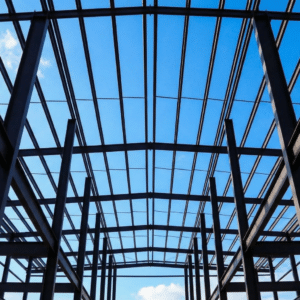
The “0 hours” designation in Types II-B, III-B, and V-B means exactly what it says: no fire-resistance rating is required for the structural frame. Bare structural steel is permitted. This is why the majority of single-story distribution centers across Texas, Kansas, and Oklahoma have exposed, uncoated structural steel with no SFRM anywhere on the building.
SFRM is one method of achieving fire-resistance ratings. Intumescent coatings and concrete encasement are alternatives that may be specified depending on aesthetic requirements, exposure conditions, and project budget.
Type I Construction: Fire-Resistive Buildings
Type I construction is the most demanding category in Table 601. All building elements must be noncombustible, and fire-resistance ratings are the highest of any construction type.
Type I-A: 3-Hour Structural Frame
Type I-A requires a 3-hour fire-resistance rating on the structural frame, 3 hours on exterior and interior bearing walls, 2 hours on floor construction, and 1.5 hours on roof construction. This is the construction type for hospitals, high-rise buildings exceeding 420 feet, large stadiums, and major public assembly facilities.
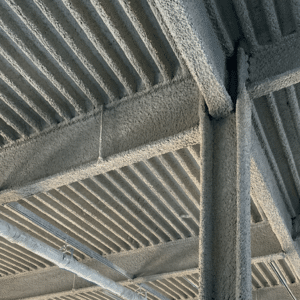
From a fireproofing scope perspective, Type I-A projects have SFRM on virtually every steel member in the building. The 3-hour frame rating requires thicker SFRM application than lower-rated construction types, which increases both material cost and application time. Buildings over 75 feet also trigger IBC Section 403.2.4 bond strength requirements, which may narrow product selection to medium-density or high-bond commercial-density SFRM products.
Type I-B: 2-Hour Structural Frame
Type I-B requires a 2-hour structural frame rating, 2 hours on bearing walls, 2 hours on floor construction, and 1 hour on roof construction. This is the most common construction type for mid-rise office buildings, large hotels, large educational facilities, and mixed-use projects in the 4-to-12-story range.
Type I-B is the construction type I see most frequently in the Dallas-Fort Worth and Oklahoma City metro markets. The 2-hour frame rating is achievable with standard cementitious SFRM products at moderate application thicknesses, making it the most common SFRM specification in Bahl Fireproofing’s service territory.
Type II Construction: Noncombustible Buildings
Type II construction also requires noncombustible structural elements (steel, concrete, masonry), but the fire-resistance requirements drop significantly compared to Type I.
Type II-A: 1-Hour Structural Frame
Type II-A requires a 1-hour structural frame rating, 1 hour on bearing walls, 1 hour on floor construction, and 1 hour on roof construction. This is the most common construction type that triggers SFRM in low-rise commercial, retail, and larger warehouse projects.
When a warehouse or distribution center exceeds the Type II-B area or height limits for its occupancy classification under IBC Chapter 5, the next step up is typically Type II-A. That upgrade from 0 hours to 1 hour is the threshold that creates the entire SFRM scope on the project. One hour of structural frame protection is the minimum that requires SFRM, and it is the most frequently bid specification in our service territory.
Type II-B: 0-Hour Structural Frame (No SFRM Required)
Type II-B requires noncombustible structural elements but assigns 0-hour fire-resistance ratings across the board: structural frame, bearing walls, floor construction, and roof construction. No SFRM is required.
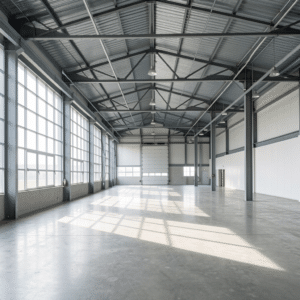
This is the construction type for most single-story steel warehouses, light industrial buildings, and simple retail structures that fit within the Chapter 5 height and area limits for their occupancy group. The steel is noncombustible (satisfying the Type II material requirement), but it does not need to be fire-resistance-rated.
Understanding the boundary between Type II-A and Type II-B is where the SFRM cost decision happens on most warehouse and industrial projects. If your building fits within Type II-B limits, you avoid the entire SFRM scope. If it exceeds those limits by even one square foot of floor area or one foot of building height, you are looking at Type II-A and a 1-hour rating on every primary steel member.
Types III, IV, and V: Where SFRM Fits and Where It Does Not
Type III: Ordinary Construction
Type III requires noncombustible exterior walls but permits any material for interior structural elements. Type III-A requires a 1-hour interior frame rating and 2-hour exterior bearing walls. Type III-B requires 0 hours on the interior frame but still requires 2-hour exterior bearing walls. Type III construction is common in mixed-use buildings, apartment buildings, and older downtown commercial structures. Where the interior frame is steel, Type III-A triggers SFRM at a 1-hour rating.
Type IV: Heavy Timber
Type IV (Heavy Timber) uses large-dimension solid or laminated wood members that achieve fire resistance through mass charring behavior. The “HT” designation in Table 601 refers to specific dimensional requirements (such as minimum 8×8 inch column dimensions), not an hourly SFRM rating. SFRM is not used in Type IV construction.
Type V: Any Material Permitted
Type V permits any material for all structural elements. Type V-A requires 1-hour ratings throughout, achieved through fire-rated wood-frame assemblies. Type V-B requires 0-hour ratings. Both are typically wood-frame construction, and SFRM is not applicable. Type V-A is common for protected wood-frame residential buildings and small commercial. Type V-B covers unprotected wood frame, including most single-family homes.
Table 601 Footnotes: Three Provisions That Change Field Outcomes
The footnotes to Table 601 contain provisions that can significantly change the SFRM scope on a project. Three in particular are worth understanding.
Footnote a: Roof Support 1-Hour Reduction
Structural frame members and bearing walls that support only a roof (not a floor above) are permitted to have their fire-resistance rating reduced by 1 hour. In a Type I-A building with a 3-hour structural frame requirement, roof-supporting steel can be protected to 2 hours instead of 3. In a Type I-B building, roof-supporting members can be reduced from 2 hours to 1 hour. This is a meaningful cost reduction on roof-level steel in large Type I-A and I-B facilities, because lower fire-resistance ratings require thinner SFRM application.
Footnote b: 20-Foot Roof Height Exemption
Fire protection of structural members is not required, including roof framing and decking, where every part of the roof construction is 20 feet or more above any floor immediately below. This exemption does not apply to Group F-1 (moderate-hazard factory), Group H (high-hazard), Group M (mercantile), or Group S-1 (moderate-hazard storage) occupancies.
This footnote is the reason many large-bay industrial and distribution facilities have SFRM on columns and lower-level steel but bare steel roof framing. If the roof deck is 20 feet or more above the floor and the occupancy is not one of the excluded groups, the roof steel does not require fire protection even in Type II-A construction.
One important exception for Bahl’s service territory: aviation manufacturing facilities along Wichita’s K-96 corridor with jet fuel storage may trigger F-1 or H occupancy classifications, which disqualify this exemption. In those facilities, roof framing may require SFRM regardless of height.
The Deleted Footnote d: Sprinkler Substitution (Removed in 2015 IBC)
The 2000 through 2012 editions of the IBC contained a footnote allowing an NFPA 13 automatic sprinkler system to substitute for 1-hour fire-resistance-rated construction in certain conditions. This provision was deleted in the 2015 IBC and does not exist in the 2018, 2021, or 2024 editions.
This is one of the most common sources of incorrect specifications I encounter in the field. Projects designed under older code editions, or under the assumption that the sprinkler substitution still applies, may be incorrectly omitting SFRM. If a specification or drawing note references a “sprinkler substitution for 1-hour fire-resistance construction,” verify which code edition your jurisdiction has adopted. IBC Chapter 6, Types of Construction is where Table 601 and its footnotes live in the 2024 edition. In the 2018, 2021, or 2024 IBC, the sprinkler substitution provision does not exist.
Primary vs. Secondary Structural Frame: The Scope Boundary That Matters
Table 601’s “Structural Frame” row applies specifically to the primary structural frame as defined in IBC Section 202. Understanding the boundary between primary and secondary members affects which steel requires SFRM and which does not.
Primary Structural Frame (SFRM Required at Table 601 Rating)
The primary structural frame includes columns, girders, beams, and trusses that have direct connections to columns, members of floor and roof construction having direct connections to columns, and bracing members essential to vertical stability under gravity loading. All of these members require the fire-resistance rating specified in Table 601 for the building’s construction type.
Secondary Members (Not Part of Primary Frame)
Secondary structural members are those without direct connections to columns: infill floor beams spanning between primary girders, secondary roof joists, and bracing members that are not part of the primary gravity load path. These members do not require the Table 601 structural frame rating, though they may still need protection as part of fire-rated floor or roof construction assemblies.
On a large-bay warehouse framing plan, this distinction has real cost implications. The main columns and primary girders connected directly to columns are primary frame members requiring the full Table 601 rating. Infill beams and secondary joists spanning between those girders, without direct column connections, are secondary members and fall outside the structural frame row. An incorrect assumption that all steel requires the frame rating can dramatically overstate the SFRM scope on large industrial projects.
Once the construction type determines the required rating and the primary frame members are identified, selecting the right SFRM density category for those members becomes the next specification decision. Understanding how SFRM density categories map to project conditions helps match the right product to the right application.
How to Read Table 601 in Practice: Two Real Examples
Example 1: Type I-B Mid-Rise Office (8 Stories, 85 Feet, Steel Frame)
The structural frame rating is 2 hours per Table 601. Floor construction requires 2 hours. Roof construction requires 1 hour. The building exceeds 75 feet, so IBC Section 403.2.4 applies, requiring minimum 430 psf bond strength for SFRM throughout. Product selection narrows to medium-density SFRM (such as CAFCO 400) or high-bond commercial-density products (such as CAFCO 300 HS). Footnote a permits a 1-hour reduction on roof-supporting frame members, reducing the roof steel requirement from 2 hours to 1 hour. Specific SFRM thickness comes from the UL fire-resistance design for the selected product at the required rating.
Example 2: Type II-B Single-Story Warehouse (32-Foot Clear Height, Sprinklered)
The structural frame rating is 0 hours per Table 601. No SFRM is required on any structural steel. Roof framing also carries a 0-hour rating, and Footnote b separately confirms no protection is required when the roof is 20 feet or more above the floor (32-foot clear height qualifies). The result: bare exposed steel throughout the building with no SFRM scope.
The difference between these two projects is not the steel. Both use structural steel frames. The difference is the construction type, which is determined by occupancy, building size, and height under IBC Chapter 5. The material does not drive the SFRM requirement. The code path does.
What Table 601 Means for Your Project in Texas, Kansas, or Oklahoma
Table 601 applies the same way in every jurisdiction that has adopted the IBC. In Bahl Fireproofing’s service territory, the 2024 IBC is the currently adopted edition in most major markets (Dallas, Houston, Wichita, Oklahoma City). The fire-resistance ratings in Table 601 are identical across the 2018, 2021, and 2024 editions, so even jurisdictions still on an earlier edition apply the same structural frame ratings.
The regional factors that affect your Table 601 outcome are not in the table itself. They are in the project characteristics that determine your construction type: occupancy classification, total building area, number of stories, and building height. A 200,000 SF distribution center in DFW that fits within Type II-B limits has no SFRM scope. The same footprint classified as Type II-A because it exceeds those limits creates a 1-hour SFRM scope on every primary steel member.
If you are bidding a project and need to understand whether Table 601 triggers SFRM on your structural steel, our complete guide to spray-applied fireproofing covers the full specification process from construction type through product selection and inspection.
Frequently Asked Questions
Q: What is IBC Table 601?
IBC Table 601 is the code table that sets minimum fire-resistance ratings for structural building elements by construction type. It covers the structural frame, exterior and interior bearing walls, floor construction, and roof construction across all nine IBC construction types (I-A, I-B, II-A, II-B, III-A, III-B, IV, V-A, V-B). Ratings range from 0 hours (no protection required) to 3 hours (highest protection).
Q: Does Type II-B construction require fireproofing?
No. Type II-B assigns 0-hour fire-resistance ratings to all structural building elements: frame, bearing walls, floors, and roof. Bare structural steel is permitted without any SFRM or other fire-resistance protection. This is the most common construction type for single-story steel warehouses and light industrial buildings.
Q: What is the structural frame rating for Type I-A construction?
Type I-A requires a 3-hour fire-resistance rating for the structural frame. This is the highest rating in Table 601 and applies to hospitals, high-rise buildings over 420 feet, large stadiums, and major public assembly facilities. The 3-hour rating requires the thickest SFRM application of any construction type.
Q: When is spray-applied fireproofing required?
SFRM is required whenever the building’s construction type specifies a fire-resistance rating greater than 0 hours for the structural frame (per Table 601) and the structural frame is steel. The most common trigger is Type II-A construction (1-hour frame rating) for commercial and industrial buildings that exceed Type II-B height or area limits.
Q: What does “0 hours” mean in Table 601?
A 0-hour rating means no fire-resistance is required for that building element. The structural member must still be noncombustible in Types I and II construction (steel qualifies), but it does not need SFRM or any other fire-resistance coating. Bare steel is code-compliant.
Q: What is the difference between Type I-A and Type I-B construction?
Both require noncombustible materials throughout, but fire-resistance ratings differ. Type I-A requires 3 hours for the structural frame, 2 hours for floor construction, and 1.5 hours for roof construction. Type I-B requires 2 hours for the frame, 2 hours for floors, and 1 hour for the roof. Type I-A is used for the highest-risk occupancies and tallest buildings.
Q: Can a sprinkler system substitute for SFRM under the current IBC?
No, not under the 2018, 2021, or 2024 IBC. The 2000 through 2012 editions contained a footnote allowing an NFPA 13 sprinkler system to substitute for 1-hour fire-resistance construction in certain conditions. That provision was deleted in the 2015 IBC. If a specification references this substitution, verify the adopted code edition.
Q: What is the difference between primary and secondary structural frame?
The primary structural frame (IBC Section 202) includes columns and members with direct connections to columns, plus bracing essential to vertical stability. Secondary members without direct column connections are not part of the primary structural frame and do not require the Table 601 structural frame rating. This distinction significantly affects SFRM scope on large projects.
Q: Does the 20-foot roof exemption apply to all building types?
No. Footnote b to Table 601 exempts roof framing from fire protection when every part of the roof is 20 feet or more above the floor below. However, this exemption does not apply to Group F-1 (moderate-hazard factory), Group H (high-hazard), Group M (mercantile), or Group S-1 (moderate-hazard storage) occupancies.
Q: Are the Table 601 ratings different in the 2024 IBC vs. the 2018 IBC?
No. The fire-resistance ratings in Table 601 are identical across the 2018, 2021, and 2024 editions of the IBC. The table structure, hourly values, and footnotes have remained consistent across all three current-generation code editions.
Key Takeaways
Table 601 Is the Starting Point for Every SFRM Specification
- The construction type determines the fire-resistance rating
- The fire-resistance rating determines whether SFRM is required
- A “0 hour” rating means no SFRM, no matter what the steel looks like
The Code Path Drives the SFRM Decision, Not the Material
- Occupancy classification (IBC Chapter 3) plus height and area limits (IBC Chapter 5) determine construction type
- Construction type determines Table 601 ratings
- Steel buildings can require 3 hours of SFRM or 0 hours depending entirely on classification
Three Table 601 Footnotes Can Change Your Scope
- Footnote a: roof-supporting steel can be reduced by 1 hour
- Footnote b: roof framing 20+ feet above the floor is exempt from fire protection (except F-1, H, M, S-1)
- The deleted Footnote d sprinkler substitution does not exist in the 2018, 2021, or 2024 IBC
Primary vs. Secondary Frame Affects Scope and Cost
- Only primary frame members (direct column connections, gravity load path bracing) require Table 601 structural frame ratings
- Secondary members without direct column connections fall outside the structural frame row
- Misclassifying all steel as primary frame overstates SFRM scope on large projects
Table 601 Is Identical Across Current IBC Editions
- The 2018, 2021, and 2024 IBC all contain the same Table 601 ratings
- This guide applies regardless of which edition your jurisdiction has adopted
Related Reading
- For a broader overview of IBC code requirements for commercial construction, see our commercial fireproofing requirements guide.
- Choosing between cementitious SFRM and intumescent coatings for your project? Our intumescent vs. cementitious comparison covers when each system makes sense.
- For a comprehensive look at SFRM types, density categories, application methods, and inspection requirements, our spray-applied fireproofing guide covers the full specification process.
Understand Your Table 601 Requirements Before You Bid
If you are pricing a commercial construction project and need to confirm whether Table 601 triggers SFRM on your structural steel, what density category your project requires, or how the footnote provisions apply to your specific building, I would like to hear about it. Bahl Fireproofing serves commercial construction projects throughout Texas, Kansas, and Oklahoma with 20-plus years of SFRM specification and application experience. Contact Bahl Fireproofing today at 512-387-2111 or email ross@bahlfireproofing.com to discuss your project.
This article provides general educational information about fireproofing and insulation services. It is not a substitute for professional engineering, architectural, or code-compliance advice. Fireproofing specifications, code requirements, and installation methods vary by project, jurisdiction, and building type. Always consult a licensed professional for project-specific guidance. Bahl Fireproofing is not responsible for decisions made based solely on the content of this article.