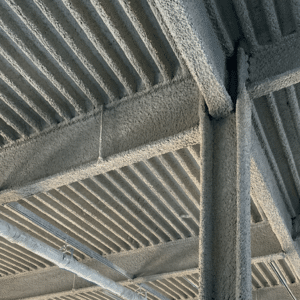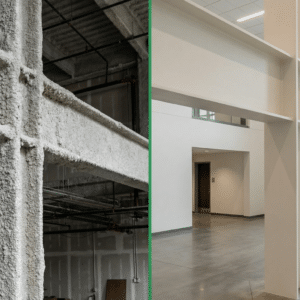
Whether your next project requires structural fireproofing is not determined by the steel itself. It is determined by a four-step code logic chain in the International Building Code that starts with how the building is used and ends with a specific hourly fire-resistance rating on your structural frame. If you are a building owner, general contractor, or facility manager trying to understand when spray-applied fireproofing is required, what triggers it, and what your responsibilities are throughout the process, this guide walks through every step of that code path and connects it to the decisions you actually control.
TLDR: Commercial fireproofing is required whenever IBC Table 601 mandates a fire-resistance rating for structural members based on the building’s assigned construction type. Type I-A, I-B, and II-A construction all require SFRM on structural steel. Type II-B, the most common warehouse construction type, requires no structural fireproofing. The path from your building’s use to its fireproofing requirement runs through occupancy classification, height and area limits, construction type, and Table 601.
The most common question I hear from building owners across Texas, Kansas, and Oklahoma is some version of: “Do I need fireproofing on this project?” The answer is never a guess. It is always the result of a specific code path. In 20-plus years of applying spray-applied fireproofing on commercial and industrial steel structures, I have seen projects where owners assumed they needed fireproofing and did not, and projects where owners assumed they were exempt and were not. Both mistakes are expensive. This guide exists so you can follow the same logic your design team uses and understand exactly where the requirement comes from.
What Triggers a Commercial Fireproofing Requirement?
Commercial fireproofing is required whenever IBC Table 601 mandates a fire-resistance rating for structural members based on the building’s assigned construction type. Type I-A, I-B, and II-A construction, which cover hospitals, high-rises, schools, and large commercial buildings, all require SFRM on structural steel. Type II-B, the most common construction type for single-story warehouses and big-box retail, requires no structural fireproofing at all.
The requirement is not triggered by building material. Steel buildings can require 3 hours of fire protection or zero hours depending entirely on classification. It is not triggered by building size alone, though size is a factor. And it is not eliminated by installing sprinklers, though sprinklers affect the calculation in important ways.
The trigger is a four-step code logic chain. Every commercial building in the United States runs through this chain, and understanding it gives you the ability to anticipate your fireproofing scope before the design is finalized.
Step 1: Occupancy Classification (IBC Chapter 3)
The IBC assigns every building an occupancy classification based on how it is used. There are 10 major occupancy groups, and the classification determines both the hazard level and the downstream height and area limits that feed into the construction type decision.
Assembly occupancies (Group A) include arenas, theaters, and restaurants. Business occupancies (Group B) cover offices and banks. Educational (Group E) covers schools. Factory occupancies (Group F) cover manufacturing. High Hazard (Group H) covers chemical plants, refineries, and facilities with jet fuel storage. Institutional (Group I) covers hospitals, nursing homes, and detention facilities. Mercantile (Group M) covers retail. Residential (Group R) covers hotels and apartments. Storage (Group S) covers warehouses and parking garages. Utility (Group U) covers miscellaneous structures.
Why this matters for fireproofing: the occupancy classification is the first input into IBC Chapter 5, which determines how large and tall your building can be under each construction type. A hospital (Group I) faces much more restrictive limits than a warehouse (Group S), which is why hospitals almost always require the highest levels of structural fire protection while many warehouses require none.
Step 2: Allowable Height and Area (IBC Chapter 5)
IBC Chapter 5, specifically Table 503, sets the maximum allowable building height (in feet and stories) and maximum floor area per story for each combination of occupancy group and construction type. This is the step where most fireproofing requirements are actually born.
Here is how it works. Your design team looks at the proposed building’s occupancy, total floor area, and height. They compare those numbers against the Table 503 limits for each construction type. The least restrictive construction type that can accommodate the building’s size becomes the assigned type. If the building fits within Type II-B limits, the structural frame requires 0 hours of fire resistance, and no SFRM is needed. If it exceeds those limits, the next step up is typically Type II-A, which requires 1 hour of fire resistance on the structural frame, and SFRM enters the scope.
The Sprinkler Trade-Off
Installing a full NFPA 13 automatic sprinkler system allows the building to increase in height by one story and increase in floor area by 200 to 300 percent over the unsprinklered allowable area. This means a project owner who wants a larger building can choose to sprinkler it and use a less fire-resistive construction type, which may reduce or eliminate the SFRM requirement.
This is where the most common misconception in commercial construction begins. Building owners sometimes believe that installing sprinklers eliminates the need for structural fireproofing. It does not. Sprinklers allow height and area increases in Chapter 5. They can reduce some fire barrier requirements in Chapter 7. But they do not substitute for the structural frame fire-resistance ratings mandated by Table 601 for the construction type that is ultimately assigned. Once the construction type is set, Table 601 ratings are mandatory regardless of sprinkler presence.
Step 3: Construction Type (IBC Chapter 6)
The IBC defines nine construction types across five families. Each type specifies whether structural materials must be noncombustible and what level of fire-resistance rating is required. The “A” and “B” designations within each family indicate “protected” and “unprotected” respectively.
Types I and II require noncombustible structural materials (steel, concrete, masonry). Type I-A requires a 3-hour structural frame rating, the highest in the code. Type I-B requires 2 hours. Type II-A requires 1 hour. Type II-B requires 0 hours, meaning bare structural steel is permitted with no fire-resistance coating.
Type III requires noncombustible exterior walls but permits combustible interior elements. Type III-A requires a 1-hour interior frame rating. Type III-B requires 0 hours on interior elements.
Type IV is Heavy Timber construction, where fire resistance is achieved through the mass charring behavior of large wood members. SFRM is not used in Type IV construction. The 2021 IBC introduced mass timber provisions that are increasingly relevant for commercial projects, but this remains outside the primary SFRM market.
Type V permits any structural material. Type V-A requires 1-hour fire-resistance ratings, typically achieved through fire-rated wood-frame assemblies. Type V-B requires 0 hours. SFRM is not applicable to Type V construction.
The key insight: SFRM is primarily required in Types I-A, I-B, and II-A construction. These are the noncombustible, protected types assigned to hospitals, high-rises, large schools, major commercial projects, and any building that exceeds the Type II-B height and area limits for its occupancy.
Step 4: IBC Table 601 Sets the Fire-Resistance Ratings
Once the construction type is assigned, IBC Table 601 specifies the minimum fire-resistance rating for each structural building element. The fire-resistance ratings in Table 601 are identical across the 2018, 2021, and 2024 editions of the IBC.
| Building Element | I-A | I-B | II-A | II-B | III-A | III-B | V-A | V-B |
|---|---|---|---|---|---|---|---|---|
| Structural Frame | 3 hr | 2 hr | 1 hr | 0 hr | 1 hr | 0 hr | 1 hr | 0 hr |
| Bearing Walls, Exterior | 3 hr | 2 hr | 1 hr | 0 hr | 2 hr | 2 hr | 1 hr | 0 hr |
| Bearing Walls, Interior | 3 hr | 2 hr | 1 hr | 0 hr | 1 hr | 0 hr | 1 hr | 0 hr |
| Floor Construction | 2 hr | 2 hr | 1 hr | 0 hr | 1 hr | 0 hr | 1 hr | 0 hr |
| Roof Construction | 1.5 hr | 1 hr | 1 hr | 0 hr | 1 hr | 0 hr | 1 hr | 0 hr |
Once Table 601 establishes a required rating for the structural frame and the frame is steel, SFRM (or another listed fire-resistance method such as intumescent coatings or concrete encasement) is the standard way to achieve that rating. For a detailed visual walkthrough of every row in this table, our guide on IBC Table 601 fire resistance ratings covers the complete table with worked examples and footnote explanations.
SFRM is not the only method. Intumescent coatings provide a smooth, paint-like alternative for architecturally exposed steel. Our cementitious vs. intumescent fireproofing guide in the Related Reading section below covers when each system makes sense.
Passive vs. Active Fire Protection: Why You Need Both
Building owners frequently confuse these two categories, and the confusion leads to the belief that one can substitute for the other. They cannot.
Passive fire protection (PFP) includes systems built into the structure that require no activation to function. SFRM, fire-rated walls, fire doors, and smoke barriers are all passive systems. They work continuously from the moment of installation without any trigger, power source, or human intervention.
Active fire protection (AFP) includes systems that must detect or activate to work. Sprinkler systems, fire alarms, smoke detectors, and fire suppression systems are all active systems. They require a trigger (heat, smoke, or manual action) to function.
The IBC requires both in most Type I and Type II buildings because they serve different roles. Sprinklers protect occupants during evacuation. SFRM protects the structural frame so the building does not collapse during the fire and so firefighters can enter safely. Sprinklers can fail due to mechanical issues, frozen pipes, inadequate water pressure, or tampering. SFRM provides protection even when the sprinkler system has not yet activated or has failed entirely.
Who Specifies Fireproofing on Your Project?
Building owners often do not understand who is responsible for what in the fireproofing specification process. Four parties are involved, and each has a distinct role.
The architect determines the occupancy classification, assigns the construction type, establishes the fire-resistance ratings required, and designates which assemblies require SFRM on the construction documents. UL fire-resistance design numbers are referenced to specify the exact product, thickness, and density for each rated assembly.
The structural engineer ensures the structural frame is protected in accordance with the fire-resistance ratings the architect specifies. The structural engineer may specify intumescent coatings when aesthetics require exposed steel or when tight clearances make SFRM impractical.
The Authority Having Jurisdiction (AHJ) is the entity that enforces the adopted building code. In Kansas, each city has its own AHJ (Wichita’s is MABCD, the Metropolitan Area Building and Construction Department). In Oklahoma, the OUBCC functions as the statewide code framework. In Texas, AHJs operate at the city level. The AHJ reviews structural drawings and fireproofing submittals during plan review and receives special inspection reports during construction.
The building owner is responsible for hiring a qualified special inspector, ensuring inspection reports are filed, and maintaining SFRM throughout the building’s life. The owner’s initial decisions about occupancy density, building size, and height are the primary driver of which construction type gets assigned, and therefore whether SFRM is required at all. The construction type decision is a cost lever that the owner influences before the design is finalized.
Special Inspections: What the IBC Requires
IBC Section 1705 mandates special inspections for all SFRM applications. The special inspector, who must hold ICC Fireproofing Certification or National Fireproofing Contractors Association (NFCA) Fireproofing Certification, verifies five elements during and after application.
First, condition of substrate: the steel surface must be clean, dry, and free of oil, grease, and loose scale before spray application. Second, thickness of application: verified by pin gauge testing per ASTM E605, the standard test method for SFRM thickness and density. Third, density: verified by weight in pounds per cubic foot per ASTM E605. Fourth, bond strength and adhesion/cohesion: tested per ASTM E736. Fifth, condition of finished application: visual inspection for complete coverage, voids, and delamination.
Special inspections must be performed after rough-in of MEP systems (mechanical, electrical, plumbing) and ceiling suspension systems, because MEP installation typically damages SFRM and repairs must be verified before concealment. This sequencing requirement is the most common source of fireproofing-related schedule delays. The most frequent failure mode is MEP damage to SFRM that was not repaired before the inspection.
Who pays for special inspections? The building owner. This is a direct project cost that should be included in the owner’s budget, not the fireproofing contractor’s scope. A failed inspection results in mandatory rework and re-inspection, adding both cost and time to the schedule.
High-Rise Buildings: Bond Strength Escalation
Buildings with any occupied floor more than 75 feet above the lowest level of fire department vehicle access are classified as high-rise buildings under IBC Chapter 4. High-rise classification triggers requirements beyond standard Table 601 ratings, including a tiered bond strength requirement for SFRM that was introduced after the September 11 attacks.
The NIST investigation into the World Trade Center collapse concluded that the impact caused SFRM to separate from structural steel columns, contributing to the loss of fire resistance and eventual collapse. In response, the IBC introduced a stepped bond strength requirement based on building height, tested per ASTM E736.
| Building Height | Minimum SFRM Bond Strength |
|---|---|
| Below 75 feet (non-high-rise) | 150 psf |
| Above 75 feet up to 420 feet (high-rise) | 430 psf |
| Over 420 feet (supertall) | 1,000 psf |
The 430 psf requirement for buildings between 75 and 420 feet drives product selection. Standard commercial-density SFRM products typically achieve 150 psf bond strength. High-rise projects require medium-density products or specially formulated commercial-density products that meet the 430 psf threshold. Understanding how SFRM density categories affect bond strength and product selection is essential for specifying the right product at each height tier.
One critical detail: the bond strength tier applies to every floor of the building, not just the floors above 75 feet. If a building qualifies as a high-rise, the elevated bond strength requirement applies throughout the entire structure.
What Gets Protected Under IBC Section 704?
IBC Section 704, which governs fire-resistance requirements for structural members, defines which steel requires SFRM and which does not.
The primary structural frame includes columns, girders, trusses, and beams that are part of the primary load-carrying system with direct connections to columns. All primary frame members require SFRM for the full length of the member, including connections, applied individually on all exposed sides. Protection cannot be achieved by simply embedding the member in a wall or ceiling assembly.
Secondary members, meaning floor beams and roof framing that are not part of the primary structural frame, must also be fire-resistance rated in Types I-A, I-B, and II-A construction. However, secondary members may be protected by a rated floor/ceiling assembly rather than individual encasement, which is often more economical than wrapping each member individually with SFRM.
Members exempt from SFRM include bottom flanges of lintels, shelf angles, and plates spanning not more than 6 feet 4 inches, as well as members outside the building envelope such as exterior balconies and fire escapes.
On large commercial and industrial projects, the distinction between primary and secondary frame members has real cost implications. Misclassifying all steel as primary frame overstates the SFRM scope and inflates the bid.
When Existing Buildings Require Fireproofing
New construction is not the only scenario that triggers SFRM requirements. Several renovation and retrofit conditions can require fireproofing on existing buildings.
A change of occupancy that moves the building to a more hazardous classification may trigger a higher construction type, requiring fire-resistance upgrades including SFRM on previously unprotected steel. An addition that pushes the building beyond the original allowable area may require a construction type upgrade with the same result.
When renovation work exposes existing SFRM, many jurisdictions require a special inspection of the exposed fireproofing before it is concealed again. SFRM is designed for the life of the structure, but physical damage from renovation work, MEP modifications, or impact requires repair and re-inspection.
For building owners planning major renovations in Bahl Fireproofing’s service area across Texas, Kansas, and Oklahoma, understanding whether the renovation triggers a construction type upgrade is one of the first questions to resolve with your design team.
Frequently Asked Questions
Q: When is fireproofing required in commercial construction?
Commercial fireproofing is required whenever IBC Table 601 mandates a fire-resistance rating for structural members based on the building’s assigned construction type. Types I-A, I-B, and II-A all require SFRM on structural steel. Type II-B, the most common warehouse and big-box retail construction type, requires no structural fireproofing.
Q: Does a sprinkler system replace fireproofing?
No. Sprinklers allow height and area increases under IBC Chapter 5, which may allow a less restrictive construction type. But once the construction type is assigned, the Table 601 fire-resistance ratings are mandatory regardless of whether sprinklers are installed. Sprinklers and SFRM serve different functions: sprinklers protect occupants during evacuation, and SFRM protects the structural frame from collapse.
Q: What does commercial fireproofing cost?
Commercial SFRM installed on structural steel typically costs $5 to $14 per square foot, depending on density category, project size, access conditions, and regional factors. Intumescent coatings for architecturally exposed steel range from $4 to $14 per square foot for thin-film products and $10 to $20 or more for epoxy thick-film systems. Every project is different. These ranges are directional guidance, not fixed pricing.
Q: What is IBC Table 601?
IBC Table 601 is the code table that sets minimum fire-resistance ratings for structural building elements by construction type. It specifies hourly ratings for the structural frame, bearing walls, floor construction, and roof construction across all nine IBC construction types. A 0-hour rating means no fire-resistance protection is required. Ratings of 1, 2, or 3 hours require SFRM or an equivalent fire-resistance method.
Q: Who is responsible for special inspections on fireproofing?
The building owner is responsible for hiring and paying the special inspector. The inspector must hold ICC Fireproofing Certification or NFCA Fireproofing Certification. The inspector verifies substrate condition, application thickness, density, bond strength, and finished condition. Inspection reports are filed with the AHJ.
Q: What is the difference between active and passive fire protection?
Passive fire protection (SFRM, fire-rated walls, fire doors) is built into the structure and works without activation. Active fire protection (sprinklers, alarms, detectors) requires a trigger to function. The IBC requires both in most Type I and II buildings because they serve complementary roles: active systems protect occupants during evacuation, and passive systems protect the structure from collapse.
Q: When is fireproofing required in existing buildings?
Existing buildings may require SFRM when a change of occupancy triggers a higher construction type, when an addition pushes the building beyond allowable area limits for its current type, or when renovation work exposes and damages existing SFRM that must be repaired and re-inspected before concealment.
Q: What happens if a building fails a fireproofing inspection?
Failed inspection results in mandatory rework. The fireproofing contractor must repair or reapply the SFRM to meet the specified thickness, density, and bond strength, followed by re-inspection. This is the most common cause of fireproofing-related schedule delays, and the most frequent trigger is MEP trade damage that was not repaired before the inspector arrived.
Key Takeaways
The Four-Step Code Path Drives Every Fireproofing Decision
- Occupancy classification (IBC Chapter 3) determines hazard level
- Height and area limits (IBC Chapter 5, Table 503) determine construction type options
- Construction type (IBC Chapter 6) determines fire-resistance rating requirements
- Table 601 specifies the exact hourly rating for every structural element
Sprinklers and SFRM Are Complementary, Not Substitutes
- Sprinklers allow larger buildings under less restrictive construction types
- Sprinklers do not eliminate Table 601 structural frame ratings once the construction type is assigned
- Both active and passive fire protection are required in most commercial buildings
The Building Owner Controls the Upstream Decisions
- Occupancy density, building size, and height ambitions drive the construction type
- Construction type determines whether SFRM is required and at what rating
- The construction type decision is a cost lever the owner influences before design is finalized
Special Inspections Are the Owner’s Responsibility
- IBC Section 1705 requires special inspections for all SFRM applications
- The building owner hires and pays the special inspector
- Inspections must occur after MEP rough-in, before concealment
- Failed inspections mean rework, re-inspection, and schedule delays
High-Rise Buildings Face Elevated Requirements
- Buildings over 75 feet trigger 430 psf bond strength for SFRM throughout the entire structure
- Buildings over 420 feet require 1,000 psf bond strength
- These post-9/11 code provisions drive product selection from commercial to medium-density SFRM
Related Reading
- For a complete visual walkthrough of Table 601, including footnote provisions and worked examples, our spray-applied fireproofing guide covers the full SFRM specification process from construction type through inspection.
- Choosing between cementitious SFRM and intumescent coatings? Our cementitious vs. intumescent comparison covers when each system makes sense based on exposure, aesthetics, and project conditions.
- Need to understand what inspectors verify during SFRM application? Our fireproofing inspection guide walks through all five elements of the special inspection process.
Understand Your Fireproofing Requirements Before You Start
If you are planning a commercial construction project and need to determine whether your building requires structural fireproofing, what construction type applies, or how the IBC code path affects your project scope and budget, I would like to hear about it. Bahl Fireproofing serves commercial construction projects throughout Texas, Kansas, and Oklahoma with 20-plus years of SFRM specification and application experience. Get in touch with our team to discuss your project at 512-387-2111 or email ross@bahlfireproofing.com.
This article provides general educational information about fireproofing and insulation services. It is not a substitute for professional engineering, architectural, or code-compliance advice. Fireproofing specifications, code requirements, and installation methods vary by project, jurisdiction, and building type. Always consult a licensed professional for project-specific guidance. Bahl Fireproofing is not responsible for decisions made based solely on the content of this article.