Commercial fireproofing installed on structural steel costs between $5 and $35 or more per square foot, depending on the product system, fire rating, steel complexity, and project conditions. That range is wide because the variables behind it are real, and every project lands in a different spot. If you are a general contractor, building owner, or facility manager trying to budget a fireproofing scope, this guide explains what actually determines where your project falls in that range, what a fireproofing estimate covers, and what cost factors most GCs underestimate.
TLDR: Standard cementitious SFRM for concealed steel costs $5 to $9 per square foot installed. Medium density SFRM for exposed or exterior steel runs $7 to $12. High density SFRM for UL 1709 hydrocarbon applications ranges from $10 to $22 or more. Intumescent coatings range from $6 to $35 or more depending on type. Six cost drivers determine where your project lands: product specification, fire rating hours, deck height, steel complexity, MEP sequencing, and climate.
The per-square-foot ranges you find online for fireproofing are all technically correct and completely useless for budgeting your specific project. A residential cost aggregator will tell you fireproofing costs $2 to $4 per square foot. That figure applies to small-scale residential spray, not commercial SFRM on structural steel. A general estimating site will say $5 to $20. That is closer, but without explaining why the number moves within that range, it gives you nothing to work with at bid time.
After 20-plus years of estimating and applying spray-applied fireproofing on commercial and industrial steel across Texas, Kansas, and Oklahoma, I can tell you that every fireproofing number comes down to six variables. Understand those six, and you can anticipate your project cost before you ever see a formal bid.
Why the Cost Range Is So Wide: Six Drivers That Determine Your Price
1. Product Specification: The Biggest Variable
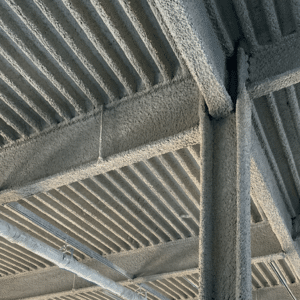
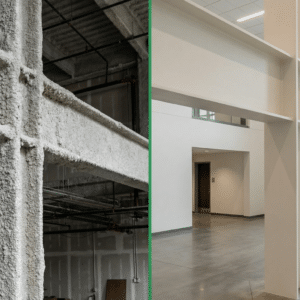
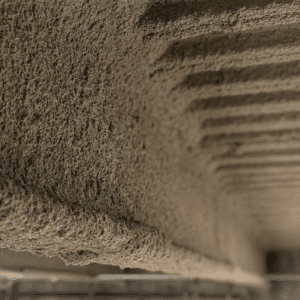
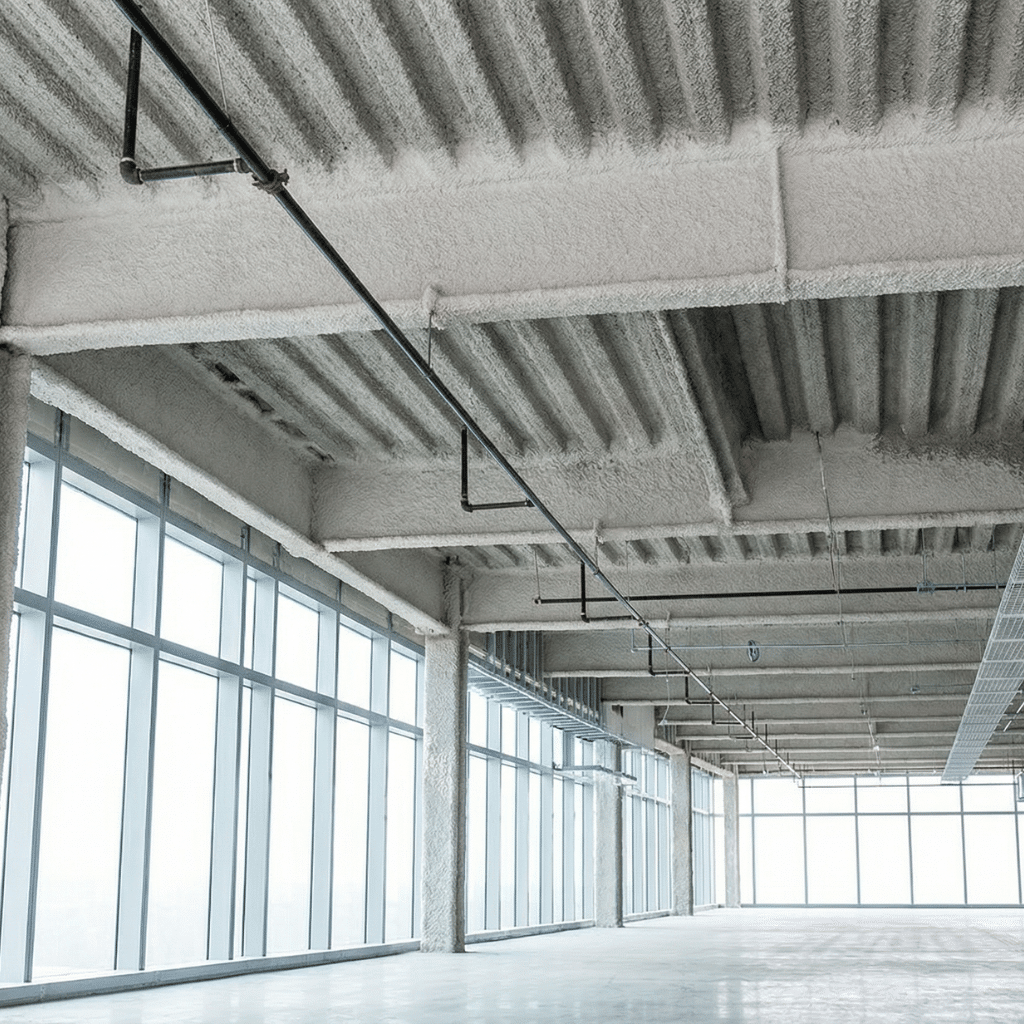
The product specified on your project is the single largest cost driver. Standard commercial-density cementitious SFRM (products like CAFCO 300 or CAFCO BLAZE-SHIELD II at 15 pcf) is the baseline product for concealed steel in standard commercial construction. High-density products for UL 1709 hydrocarbon fire ratings run at 40 to 55 pcf, requiring more material per unit area, thicker application, and more time. The product specification alone can move the installed cost by 2x or more.
This is not negotiable. The product is determined by the UL Design Assembly referenced in the construction documents, which is tied to the fire-resistance rating required by IBC Table 601 for the building’s construction type. Understanding how IBC Table 601 fire resistance ratings connect to your construction type is the first step in anticipating your fireproofing cost.
2. Fire Rating Required: Hours Equal Thickness, and Thickness Equals Cost
SFRM is applied to achieve a specific thickness, and that thickness is determined by the required fire rating and the steel section’s W/D ratio (weight-to-heated-perimeter ratio). A 1-hour rating on a given beam requires less thickness than a 3-hour rating on the same beam. More thickness means more material and more labor time.
For commercial applications, SFRM thickness ranges from approximately 0.75 inches for a 1-hour rating to over 2 inches for 3-hour assemblies, depending on the steel section. The spec drives the number. The estimator reads the UL design to calculate the actual thickness requirements per steel section.
3. Deck Height and Access Conditions
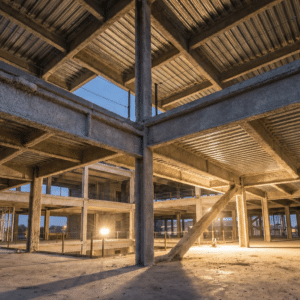
This is the single variable most GCs underestimate when reviewing fireproofing bids. Overhead spray at height is slower, harder on crews, and requires more setup than vertical application on accessible columns. As deck height increases, the gap between productive spraying time and repositioning time widens. A job at 20 to 40 feet with clear access is significantly more efficient than a job at 60 feet with obstructions.
At height, aerial lifts or scaffolding are required, which adds equipment cost and setup time. A project with the same square footage but different deck heights can price out 20 to 30 percent differently. If your project has high bays, budget accordingly.
4. Steel Complexity
Wide-flange beams in a regular grid are fast. Curved members, custom steel shapes, connection-heavy nodes, truss work, and hollow structural sections (HSS) are slow. Each shape change requires repositioning, masking, and careful application to maintain UL design requirements. A W12x26 beam and a W36x232 beam have different application requirements even for the same fire rating.
On projects with complex steel geometry, the labor component of the estimate increases relative to the material component. Simple, repetitive steel framing plans are the most cost-efficient to fireproof.
5. Site Conditions: Sequencing, MEP, and Rework
SFRM is applied after steel erection but before most MEP rough-in. In practice, the trades do not always sequence cleanly. Mechanical, electrical, and plumbing trades damage SFRM during their rough-in work by drilling through it, nicking it, or removing it to run pipes and conduit. Rework, meaning patching damaged fireproofing to restore the original fire rating, adds cost that is often not captured in initial bids.
On hospital and high-MEP-density projects, budgeting for rework patching as a standard line item rather than a contingency is how experienced fireproofing contractors handle it. We have learned to have the rework conversation with GCs before we ever start, not after. On a hospital, it is not a question of whether MEP will damage the fireproofing. It is a question of who is budgeting the repair.
6. Climate and Seasonal Factors (Zone 4A Markets)
The 40°F substrate temperature minimum for SFRM application applies everywhere, but the impact varies dramatically by market. In Houston or DFW, it is rarely a constraint. In Wichita (IECC Climate Zone 4A), it eliminates roughly December through February from the viable spray window without temporary heating and enclosure. OKC and Tulsa (Zone 3A) face shorter but real winter windows.
Temporary climate control, including propane or electric heating and temporary enclosures, adds a real cost adder. For mid-size projects in Zone 4A markets, the heating and enclosure premium runs approximately $2 to $5 per square foot on top of the base fireproofing cost, consistent with contractor-reported costs in cold-climate Zone 4 markets. Understanding the Zone 4A scheduling and cost impact for Wichita projects helps GCs anticipate this adder before it becomes a change order.
Cost by Product System
The following table shows installed cost ranges (material plus labor) for commercial new construction in the Texas, Kansas, and Oklahoma region. These ranges reflect the projects we bid and the market conditions we work in. Product specifications and density data are based on Isolatek International’s commercial SFRM product line, which covers the CAFCO product family across all three density categories.
| Product / System | Installed Cost ($/SF) | Density / Type | Best Application |
|---|---|---|---|
| Standard cementitious SFRM (CAFCO 300, BLAZE-SHIELD II) | $5 to $9 | 15 pcf commercial density | Concealed steel, standard commercial |
| Medium density SFRM (CAFCO BLAZE-SHIELD HP) | $7 to $12 | Medium density, exterior-rated | Exposed steel, exterior conditions, Zone 4A |
| High density SFRM (CAFCO FENDOLITE M-II) | $10 to $20+ | 40 to 44 pcf | UL 1709 aviation, industrial, refinery |
| High density SFRM (FENDOLITE M-II/P) | $12 to $22+ | 50 to 55 pcf | Maximum UL 1709 hydrocarbon applications |
| Water-based intumescent | $6 to $14 | Thin-film | Interior exposed architectural steel |
| Solvent-based intumescent | $8 to $16 | Thin-film | Semi-exposed, better moisture resistance |
| Epoxy intumescent (UL 1709 capable) | $18 to $35+ | Thick-film | Offshore, refinery, aviation environments |
For projects comparing cementitious SFRM against intumescent coatings, our intumescent vs. cementitious comparison guide in the Related Reading section below covers when each system makes sense based on exposure, aesthetics, and total installed cost.
Cost by Project Type
Different building types land in different cost bands because they trigger different product specifications, fire ratings, and site conditions. The following profiles reflect the range of projects we estimate across our service area in Texas, Kansas, and Oklahoma.
| Project Type | Typical System | Installed Range | Why |
|---|---|---|---|
| Standard commercial office or retail (concealed steel) | Commercial SFRM | $5 to $9/SF | Standard product, accessible geometry, regular steel |
| Healthcare or hospital | Commercial SFRM plus rework allowance | $7 to $12/SF | MEP density, sequencing complexity, rework budget |
| High-rise (above 75 ft up to 420 ft) | High-bond commercial SFRM | $8 to $14/SF | 430 psf bond strength per IBC |
| High-rise (over 420 ft) | 1,000 psf bond commercial SFRM | $10 to $16/SF | 1,000 psf bond strength per IBC |
| Aviation or industrial (UL 1709) | High density SFRM (40 to 55 pcf) | $12 to $22+/SF | High density product, UL 1709 specification |
| Exposed architectural steel (interior) | Water-based intumescent | $8 to $16/SF | Labor-intensive thin-film, topcoat coordination |
| Exposed steel (semi-exterior) | Solvent-based intumescent | $10 to $18/SF | Surface prep requirements, topcoat system |
| Exposed steel (refinery, aviation) | Epoxy intumescent | $20 to $40+/SF | SSPC-SP10 surface prep, multi-coat system |
| Zone 4A winter application (Wichita) | Any system plus heating/enclosure | Add $2 to $5/SF | Temporary climate control adder |
These ranges are directional guidance for budgeting. Every project is different. We provide specific pricing through our estimating process based on your actual drawings and specifications.
What a Fireproofing Estimate Actually Covers
A commercial fireproofing estimate is not just a material cost times a square footage. Understanding the line items helps you evaluate bids and ask the right questions.
A standard commercial fireproofing estimate includes material cost (SFRM product at the specified density, calculated by steel section and fire rating zone), labor (crew time for surface preparation, masking, application, and inspection coordination), equipment (mixing equipment, pumping equipment, spray rigs, aerial lifts or scaffolding for height access), surface preparation (priming for intumescent systems, cleaning, and substrate condition work), permits and special inspection coordination (required under IBC Section 1705 for thickness, density, and bond strength verification), material testing per ASTM E605 and ASTM E736, and rework allowance for high-MEP projects where patching is predictable rather than contingent.
On the material side alone, standard commercial-density SFRM runs approximately $1.20 to $3.60 per square foot before labor, equipment, and overhead. The gap between material cost and installed cost is where labor, equipment, access, and site conditions live, and that gap is where most of the project-to-project variation occurs.
The Rework Dimension: What Happens When MEP Damages Fireproofing
This is the cost dimension that rarely appears in competitor articles but shows up on every hospital and high-MEP-density project.
IBC Section 1705 requires special inspections at the time of SFRM application, and the fire rating must be maintained throughout the life of the building. When MEP trades drill through, nick, or remove SFRM to run pipes and conduit, the fire rating is technically compromised in those areas. Patching must use an approved material compatible with the original SFRM system. Using bulk SFRM from a broken bag is not permitted because it may not be compatible and could compromise the UL assembly.
Approved patching products include UFP (Universal Fireproofing Patch, manufactured by Vellrath Engineering Group), a UL-classified hand-applied patch compatible with both commercial and medium density cementitious and fibrous SFRMs from any manufacturer, and Monokote Patching Compound for specific MK-series products. These are products with specific UL classifications, not generic repair materials.
On hospital projects and high-MEP-density buildings, we budget rework patching as a standard line item. It is predictable work that occurs on every project of this type. GCs who treat it as a contingency rather than a budgeted scope item end up with change orders that could have been anticipated.
How Project Size Affects Cost
Fireproofing has significant fixed mobilization costs: crew travel, equipment setup, material delivery, and safety access systems. Those fixed costs spread across more square feet as project size grows.
Projects under 5,000 SF tend to land toward the high end of each product’s cost range because the fixed mobilization costs are concentrated across fewer square feet. Projects in the 5,000 to 20,000 SF range represent the typical commercial project band where the mid-range pricing applies. Projects above 50,000 SF can achieve the lower end of each product range because the scale economies on mobilization, material procurement, and crew efficiency become substantial.
The effect is real but should not be overstated. Product specification and fire rating still dominate the cost equation. A 100,000 SF project requiring high-density UL 1709 SFRM will cost more per square foot than a 10,000 SF project using standard commercial-density product, regardless of scale.
What Fireproofing Costs as a Share of Total Building Cost
For GCs and building owners trying to contextualize the fireproofing line item against the total project budget, peer-reviewed research from the Journal of Constructional Steel Research (2024) provides useful framing. In composite steel frame construction, passive fire protection costs for structural steelwork range from 0 to 1.2 percent of total construction cost. When total fire protection (including active systems like sprinklers and alarms) is included, the range is 4 to 12 percent of total construction cost.
That means structural fireproofing is typically one of the smaller specialty trade line items on the project, but one with zero tolerance for error. A failed special inspection or an incorrectly specified density category creates rework and schedule delays that cost far more than the original line item. For a deeper understanding of how fire-resistance ratings drive the specification in the first place, our guide on commercial fireproofing requirements walks through the full IBC code path from occupancy through Table 601.
Frequently Asked Questions
Q: How much does commercial fireproofing cost per square foot?
Standard cementitious SFRM for concealed structural steel costs $5 to $9 per square foot installed for commercial new construction. Medium density SFRM for exposed or exterior conditions runs $7 to $12. High density SFRM for UL 1709 hydrocarbon applications ranges from $10 to $22 or more. Intumescent coatings range from $6 to $35 or more depending on type and application environment.
Q: Why does fireproofing cost vary so much?
Six factors drive the variation: the product specified (commercial density vs. medium vs. high density vs. intumescent), the fire rating required (more hours means more thickness means more cost), deck height and access conditions, steel complexity, MEP sequencing and rework exposure, and climate constraints in cold-weather markets. Product specification and fire rating are the two largest variables.
Q: What is the difference in cost between cementitious and intumescent fireproofing?
Cementitious SFRM installed on concealed steel costs $5 to $9 per square foot. Water-based intumescent on exposed architectural steel costs $6 to $14 per square foot. However, the true comparison for exposed steel is intumescent versus SFRM plus an architectural enclosure and finishing, which can exceed the intumescent cost. The right comparison depends on whether the steel is concealed or exposed.
Q: How much does UL 1709 fireproofing cost?
High density cementitious SFRM for UL 1709 applications (CAFCO FENDOLITE M-II at 40 to 44 pcf) costs $10 to $20 or more per square foot installed. Epoxy intumescent with UL 1709 rating costs $18 to $35 or more per square foot. These are the most expensive fireproofing systems because they require specialized high-density or thick-film products designed for hydrocarbon pool fire exposure.
Q: Does project size affect fireproofing cost?
Yes. Fixed mobilization costs (crew travel, equipment setup, material delivery) spread across more square feet as the project grows. Projects under 5,000 SF tend toward the high end of each product’s cost range. Projects above 50,000 SF can achieve the lower end. Scale matters, but product specification and fire rating still dominate the equation.
Q: How much does winter fireproofing application add to cost?
In Zone 4A markets like Wichita, temporary heating and enclosure to maintain the 40°F substrate temperature adds approximately $2 to $5 per square foot on top of the base fireproofing cost. OKC and Tulsa face shorter winter windows with smaller adders. Houston and DFW are rarely affected.
Q: What does a fireproofing estimate include?
A commercial fireproofing estimate typically includes material cost by steel section and fire rating, labor for surface prep and application, equipment (spray rigs, aerial lifts, scaffolding), surface preparation and priming, permits and special inspection coordination under IBC Section 1705, material testing per ASTM E605 and ASTM E736, and a rework allowance for high-MEP projects.
Q: Is the $2 to $4 per square foot figure I see online accurate for commercial fireproofing?
No. That figure appears on residential cost aggregator sites and reflects small-scale residential spray applications, not commercial SFRM on structural steel. The correct commercial floor for standard cementitious SFRM is $5 to $9 per square foot installed. No qualified commercial fireproofing contractor bids structural steel work at $2 to $4 per square foot.
Key Takeaways
The Product Specification Drives the Cost More Than Anything Else
- Standard commercial-density SFRM (15 pcf) is the baseline at $5 to $9 per square foot
- Medium density for exposed or exterior conditions runs $7 to $12
- High density for UL 1709 runs $10 to $22 or more
- Epoxy intumescent for industrial UL 1709 runs $18 to $35 or more
Six Cost Drivers Determine Where You Land in the Range
- Product specification (density category and system type)
- Fire rating hours (more hours means more thickness means more cost)
- Deck height and access (the most underestimated variable)
- Steel complexity (regular grids are fast; custom shapes are slow)
- MEP sequencing and rework (budget it, do not contingency it)
- Climate constraints in Zone 4A markets ($2 to $5/SF winter adder)
Understand What the Estimate Covers
- Material, labor, equipment, surface prep, inspection, testing, and rework allowance
- The gap between material cost and installed cost is where project-specific variables live
- Ask your fireproofing contractor to break out the rework allowance on high-MEP projects
Fireproofing Is a Small Line Item with Zero Tolerance for Error
- Passive fire protection runs 0 to 1.2 percent of total construction cost
- A failed special inspection or incorrect density specification creates rework and delays
- Getting the specification right at bid time is the most cost-effective decision in the scope
Related Reading
- For a comprehensive overview of SFRM types, density categories, and the full specification process, our spray-applied fireproofing guide covers everything from product selection through inspection.
- Comparing cementitious SFRM against intumescent coatings for your project? Our intumescent vs. cementitious comparison covers when each system makes sense based on cost, aesthetics, and exposure conditions.
- Need to understand whether your building requires fireproofing at all and how the IBC code path works? Our commercial fireproofing requirements guide walks through the full decision chain from occupancy through Table 601.
Get an Accurate Bid for Your Project
If you are budgeting a fireproofing scope and want a number based on your actual drawings and specifications rather than generic online ranges, I would like to hear about it. Bahl Fireproofing estimates and applies both cementitious SFRM and intumescent coating systems on commercial projects throughout Texas, Kansas, and Oklahoma. Get in touch with our team to discuss your project at 512-387-2111 or email ross@bahlfireproofing.com.
This article provides general educational information about fireproofing and insulation services. It is not a substitute for professional engineering, architectural, or code-compliance advice. Fireproofing specifications, code requirements, and installation methods vary by project, jurisdiction, and building type. Always consult a licensed professional for project-specific guidance. Bahl Fireproofing is not responsible for decisions made based solely on the content of this article.