Warehouse Fireproofing: Protecting High-Bay Steel Structures
Warehouse fireproofing requirements catch many developers off guard during plan review. Type II-B construction appears to eliminate fire-resistance requirements, but warehouses storing combustible materials face mandatory fireproofing regardless of construction type. Understanding when warehouse fireproofing transitions from optional to legally required prevents costly mid-construction corrections and inspection failures.
This guide breaks down warehouse fireproofing code requirements, explains the high-piled storage trigger that many miss, compares spray-applied versus intumescent systems, and provides verified cost data for budget planning.
TLDR: Warehouse fireproofing requirements depend on occupancy classification and storage type, not just construction type. S-1 warehouses storing combustible materials require fireproofing even in Type II-B construction. Storage exceeding 12 feet triggers IFC Chapter 32 high-piled storage requirements. Spray-applied fireproofing typically costs $5 to $14 per square foot of steel surface installed. All systems must be verified against fire-rated assembly standards by a licensed professional.
The Type II-B Construction Misconception
Type II-B construction permits zero-hour fire-resistance ratings per building code construction type requirements, making it popular for warehouse development. For certain occupancies, fire protection of structural members is not required in Type II-B construction. However, this exception specifically EXCLUDES Group S-1 occupancies, meaning warehouses storing combustible materials still require fireproofing despite the Type II-B zero-hour baseline.
The critical exception appears in the building code fire-resistance rating requirements. Fire protection requirements apply to Group S-1 occupancies regardless of the zero-hour baseline. S-1 warehouses store moderate-hazard materials including combustible products, packaged goods, and typical e-commerce inventory. These facilities require structural steel fireproofing even when using Type II-B construction.
S-2 warehouses storing non-combustible materials may qualify for the fireproofing exception. Distribution centers handling exclusively non-combustible goods like metal parts, glass bottles, or ceramic products fall into S-2 classification. The distinction between S-1 and S-2 determines whether warehouse fireproofing is mandatory or optional.
High-Piled Storage Triggers Additional Requirements
Storage height creates the second critical warehouse fireproofing trigger that many projects miss. When storage of Class I through IV commodities exceeds 12 feet in height, or high-hazard commodities exceed 6 feet, IFC Chapter 32 high-piled combustible storage requirements take effect. This threshold applies in addition to IBC structural requirements.
High-piled storage does not prohibit tall racking systems. The 12-foot threshold triggers additional fire protection measures including special permits, fire protection engineer evaluation, and enhanced sprinkler system design per NFPA 13. Many modern warehouses operate with 25 to 40 foot clear heights and multi-level racking systems, placing them solidly in high-piled storage territory.
The combination of S-1 occupancy and high-piled storage creates the most stringent warehouse fireproofing scenario. Structural steel supporting these facilities requires one to two hour fire-resistance ratings depending on building area, height, and fire separation distance. A licensed professional must calculate required fire-resistance ratings based on applicable building code requirements, building dimensions, and fire separation distance criteria. These calculations are project-specific and cannot be generalized. Licensed professionals must coordinate structural design, fireproofing specifications, and sprinkler system design to achieve compliant installations.
Spray-Applied Fireproofing for Warehouse Applications
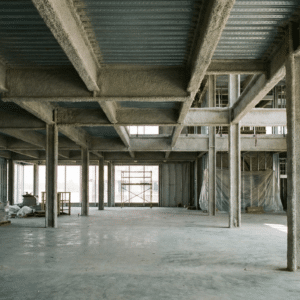
Spray-applied fire-resistive materials dominate warehouse fireproofing installations due to cost efficiency on large-scale projects. Cementitious SFRM applies directly to structural steel beams, columns, and roof deck, creating an insulating barrier that maintains steel temperatures below critical failure points during fire exposure.
Testing to building fire testing standards establishes fire-resistance ratings. According to ASTM E119 pass/fail criteria, steel temperatures must remain below 1,100°F average and 1,300°F maximum at any single point during the rated test duration. SFRM thickness varies based on steel section size, with smaller members requiring thicker application due to faster heat transfer.
Application requires specialized spray equipment and trained applicators. Surface preparation removes mill scale, oil, and contaminants that prevent proper bonding. Building codes mandate special inspections during construction, after rough installation, and before concealment. Bond strength testing per ASTM E736 verifies adhesion meets manufacturer-specified minimums, typically 150 psf or greater depending on application conditions and substrate type.
The rough, textured finish works well in warehouse environments where aesthetics matter less than protection and budget. SFRM remains the most cost-effective warehouse fireproofing solution for facilities with concealed or semi-exposed steel structures.
All warehouse fireproofing systems must comply with specific UL Fire Resistance Directory assemblies. Licensed professionals select assemblies based on steel member sizes, required fire ratings, and project conditions. Contractors cannot independently determine acceptable fireproofing systems—each installation must match a verified UL design applicable to the specific project configuration.
Intumescent Coatings for Architectural Warehouse Projects
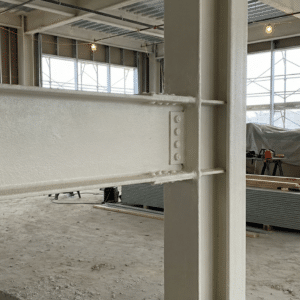
Intumescent coatings serve warehouse fireproofing needs when exposed steel requires finished appearance. Distribution centers with corporate offices, showroom areas, or high-visibility logistics operations benefit from the smooth, paintable finish that intumescent systems provide.
Water-based formulations suit interior warehouse applications with climate-controlled environments. Low VOC content supports LEED certification and green building requirements. Application requires multiple thin coats with 24 to 48 hour drying periods between layers. Total dry film thickness determines fire rating. Water-based thin-film systems typically require 20 to 80 mils for one-hour protection, while epoxy thick-film systems may require 100 to 350 mils depending on steel section size and UL assembly specifications.
Epoxy-based intumescent coatings handle harsher warehouse environments including cold storage facilities, chemical distribution centers, and facilities with temperature extremes. These systems cure faster and require fewer coats than water-based alternatives. Shop application to prefabricated steel sections eliminates weather concerns, improves quality control through factory conditions, and accelerates construction schedules by reducing on-site fireproofing duration.
Material costs run higher for intumescent warehouse fireproofing, but labor savings from faster application and fewer required coats narrow the installed cost gap. Projects allowing shop-applied systems achieve the greatest time and cost efficiency.
Warehouse Fireproofing Cost Planning
Material-only pricing for spray-applied fireproofing ranges from $1.20 to $3.60 per square foot of steel surface depending on required thickness and fire rating. Installed costs including labor typically run $5 to $14 per square foot of steel surface for standard warehouse applications. Project size, accessibility, and regional labor rates drive final pricing.
Intumescent coatings cost $4 to $12 per square foot of steel surface installed for water-based systems in typical commercial warehouse environments. Epoxy systems for specialized applications run $10 to $30 per square foot of steel surface. Higher material costs are offset by faster application and reduced project duration.
For budget planning purposes, consider a representative warehouse project with 60,000 square feet of structural steel requiring two-hour fire protection. Using industry-average installed costs, SFRM at $8 per square foot of steel surface estimates approximately $480,000, while intumescent systems at $10 per square foot estimate $600,000. Actual costs vary significantly by region, contractor, project complexity, and market conditions. Licensed professionals should obtain project-specific bids before finalizing budgets. Projects must balance upfront costs against aesthetic requirements, schedule constraints, and long-term maintenance considerations.
Special inspection costs add $3,000 to $10,000 depending on project size and testing frequency. Bond strength testing runs $150 to $300 per location, with minimum one test per 2,500 square feet of fireproofed steel surface required. These costs apply regardless of material type selected.
E-Commerce Fulfillment Center: Warehouse Fireproofing in Practice
The following representative scenario illustrates common warehouse fireproofing challenges:
Consider a representative 200,000 square foot e-commerce fulfillment center storing packaged consumer goods including cardboard boxes, plastic packaging, and general merchandise, qualifying as S-1 occupancy. Racking systems reach 30 feet in height, triggering high-piled storage requirements.
Type II-B construction was specified during initial design. The architect assumed zero-hour fire ratings eliminated structural steel fireproofing, reducing estimated construction costs by $800,000. Plan review identified the S-1 occupancy exception requiring two-hour fire protection on all structural steel.
The contractor specified cementitious SFRM at approximately 1.5 inches dry film thickness achieving two-hour rating per UL design specifications. With approximately 100,000 square feet of exposed structural steel requiring protection, total fireproofing cost reached $720,000 installed ($7.20 per square foot of steel surface area). The project also required ESFR (Early Suppression Fast Response) sprinkler system upgrades designed specifically for high-piled storage per NFPA 13 and additional fire protection engineer consultation, adding $150,000 to overall fire protection budget.
Early coordination between architect, structural engineer, fire protection engineer, and warehouse fireproofing contractor during design development would have prevented the budget impact and schedule delay. This scenario repeats frequently on warehouse projects where S-1 occupancy requirements are overlooked during initial planning.
Key Takeaways for Warehouse Fireproofing
- Type II-B construction does not eliminate warehouse fireproofing for S-1 occupancies storing combustible materials
- Storage height exceeding 12 feet triggers IFC Chapter 32 high-piled storage requirements in addition to IBC structural requirements
- Spray-applied fireproofing typically costs $5 to $14 per square foot of steel surface installed for standard warehouse applications
- S-1 warehouses require fireproofing regardless of construction type due to building code fire protection requirements
- Licensed professionals must verify all fireproofing systems against UL Fire Resistance Directory assemblies
- Early coordination during design prevents costly mid-construction corrections and inspection delays
If your warehouse project demands code-compliant fireproofing installed by professionals who understand high-bay steel protection requirements, our team serves distribution centers and logistics facilities throughout Texas, Kansas, and Oklahoma. Contact Bahl Fireproofing today to discuss your project requirements.
This article provides general educational information about fireproofing and insulation systems and does not constitute professional engineering advice or product specification. Code requirements vary by jurisdiction and may be based on different editions of applicable standards. System selection must be based on project-specific fire ratings, thermal requirements, acoustic performance needs, environmental conditions, substrate requirements, and budget constraints. Always consult with a licensed professional and verify UL or FM assembly listings before finalizing specifications.