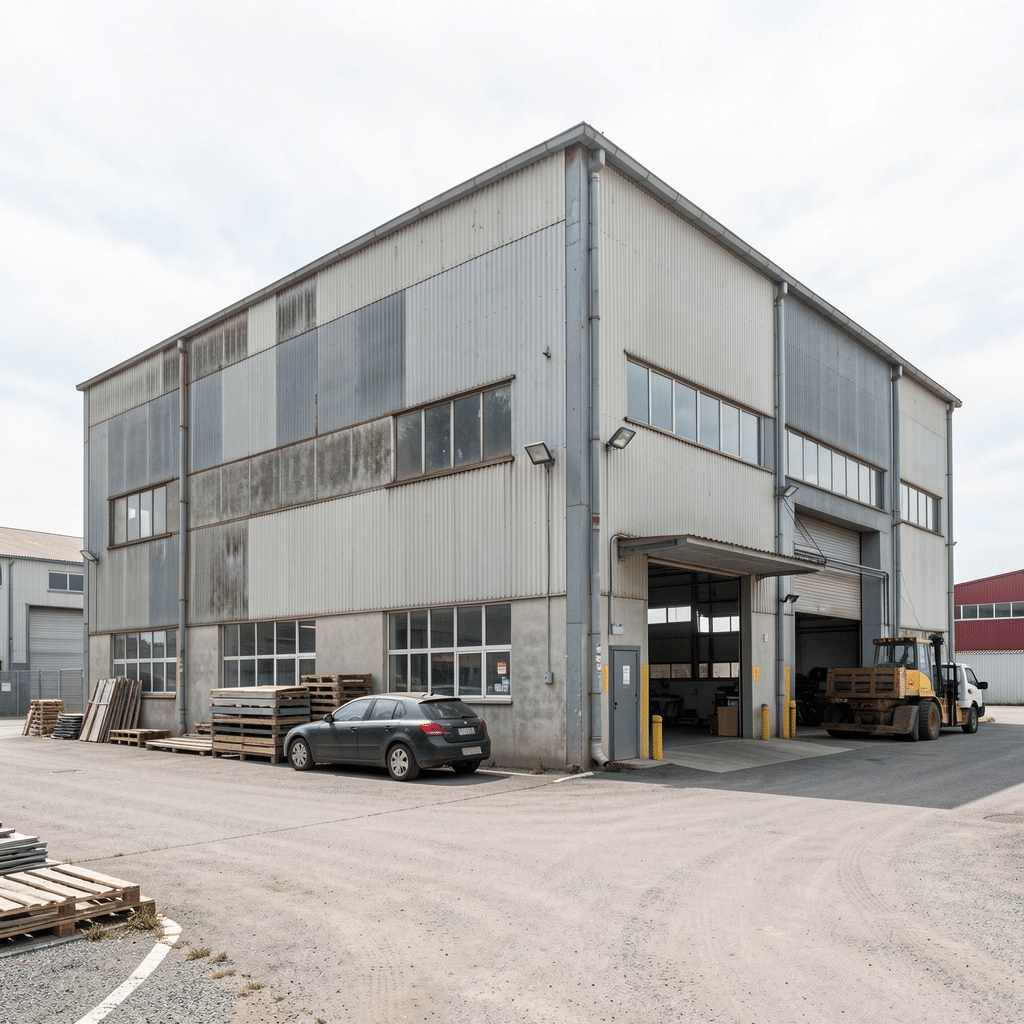
Air infiltration is the single largest source of energy waste in most manufacturing facilities. According to research from the National Institute of Standards and Technology (NIST), air infiltration accounts for 25 to 40 percent of total energy consumption in typical commercial buildings. In manufacturing plants with large bay doors, loading docks, high ceilings, and metal panel construction, that percentage climbs even higher. Every gap at a purlin connection, every unsealed penetration around conduit or piping, and every joint between metal panels bleeds conditioned air out and unconditioned air in. Industrial building insulation that combines thermal resistance with continuous air sealing addresses this problem at its source, and closed-cell spray polyurethane foam is the most effective system available for that purpose.
NIST research confirms the scale of the opportunity: reducing annual air infiltration rates by 83 percent in nonresidential buildings could save more than 40 percent on gas bills and up to 33 percent on electricity in heating-dominated climates. For a manufacturing facility spending six figures annually on heating and cooling, those numbers represent substantial operational savings. The question is not whether to insulate, but which industrial building insulation system delivers the best combination of thermal performance, air sealing, moisture control, and durability for your specific manufacturing environment.
TLDR
- Air infiltration accounts for 25 to 40 percent of commercial building energy consumption (NIST/DOE), and manufacturing facilities with bay doors, loading docks, and metal panel construction lose even more.
- Closed-cell spray foam provides R-6.0 to R-7.0 per inch (ASTM C 518) and creates a continuous air barrier at just 1 inch of thickness, eliminating thermal bridging at metal connections, purlins, girts, and penetrations.
- Spray foam insulation is combustible and does NOT provide structural fire protection. Manufacturing facilities requiring fire-rated structural steel must have separate SFRM or intumescent coating systems installed per IBC Table 601.
- IBC Section 2603 requires a 15-minute thermal barrier (typically 1/2-inch gypsum wallboard) over all foam plastics in occupied interior spaces.
- A licensed professional must specify all industrial building insulation and fire protection systems based on occupancy classification, local code requirements, and process-specific conditions.
Why Manufacturing Facilities Need Specialized Industrial Building Insulation
Standard industrial building insulation methods fall short in manufacturing environments. Fiberglass batts (R-2.9 to R-3.8 per inch) leave gaps at joints, sag over time, absorb moisture, and provide no air sealing capability. Rigid board insulation (R-4.5 to R-6.5 per inch) offers better thermal performance but cannot conform to irregular industrial surfaces, and joints between boards create air leakage paths. Neither system addresses the fundamental problem in manufacturing plants: air moves through every gap, seam, and penetration in the building envelope, and those gaps are everywhere in metal panel construction.
Manufacturing facilities face air sealing challenges that office buildings and retail spaces simply do not. Large bay doors and loading docks are opened and closed throughout the day, rapidly exchanging conditioned air with outside air. When those doors close, the building envelope must contain the conditioned volume, but metal panel walls and metal deck roofs have hundreds of connection points where air passes freely. Every purlin, girt, fastener penetration, electrical conduit pass-through, and mechanical piping run creates a pathway for air movement.
Spray foam solves this by expanding on contact to fill every gap, void, crack, and irregular surface it reaches. As the most effective industrial building insulation available, a single application of closed-cell spray foam at 1 inch of thickness creates both a thermal insulation layer (R-6.0 to R-7.0 per inch per ASTM C 518) and a continuous air barrier (air permeance less than 0.02 L/s per square meter at 75 Pa per ASTM E 2178). No other single insulation product delivers both functions simultaneously at that thickness.
For manufacturing plants with process heating (furnaces, ovens, dryers) or process cooling (refrigeration, climate-controlled production), the right industrial building insulation directly affects operational energy consumption. Spray foam eliminates thermal bridging at metal panel connections where steel conducts heat directly through the wall assembly, a problem that other industrial building insulation methods like fiberglass batts installed between girts cannot address because the girts themselves act as thermal bridges.
Closed-Cell vs. Open-Cell Spray Foam for Industrial Building Insulation
Two types of spray polyurethane foam are available for industrial applications, and the distinction matters for manufacturing environments.
Closed-cell spray foam (medium density, approximately 2.0 lb/ft3) is the primary recommendation for industrial building insulation. It delivers R-6.0 to R-7.0 per inch per ASTM C 518 and qualifies as an air barrier material at just 1 inch of thickness per SPFA guidelines. Its water vapor permeance is 1.0 perm or less at 1 inch (ASTM E 96), making it a Class II vapor retarder. Water absorption is less than 2 percent by volume per ASTM D 2842, meaning it will not absorb moisture in humid manufacturing conditions. Closed-cell foam also adds structural rigidity to substrates, which is beneficial in metal panel wall assemblies subject to wind loads and vibration. It carries a Class A fire classification per ASTM E 84 with a flame spread index of 25 or less and smoke developed index of 450 or less.
Open-cell spray foam (low density, approximately 0.5 lb/ft3) provides R-3.5 to R-4.0 per inch and requires 3.5 to 5.5 inches of thickness to qualify as an air barrier. It is not a vapor retarder (greater than 10 perms per ASTM E 96), absorbs moisture, and does not add structural rigidity. Open-cell foam costs less per board foot and offers somewhat better sound absorption than closed-cell due to its open cellular structure, but it is not suitable for moisture-critical industrial applications.
For most manufacturing environments, closed-cell spray foam is the recommended industrial building insulation because it provides thermal resistance, air sealing, and moisture control in a single application. Open-cell may be appropriate as a secondary option for interior partitions or budget-constrained industrial building insulation in dry, climate-controlled spaces, but it should not be used on exterior walls or roof assemblies in manufacturing facilities where moisture exposure is a concern.
Thermal Performance and Energy Savings with Industrial Building Insulation
The energy savings from spray foam as an industrial building insulation system come from two mechanisms working together: thermal resistance (R-value) and air sealing.
The DOE guide to building insulation types and energy performance estimates that approximately 40 percent of a building’s energy is lost to air infiltration through wall openings, penetrations, and gaps. HVAC systems account for up to 40 percent of total energy consumption in commercial properties. When air infiltration forces HVAC equipment to work harder and run longer to maintain setpoint temperatures, the compounding effect drives energy costs well beyond what the R-value of the insulation alone would suggest.
Closed-cell spray foam at 2 inches (R-12 to R-14 total) applied to a metal building wall assembly eliminates air infiltration through that assembly and provides continuous industrial building insulation without thermal bridging. Industry data shows 20 to 50 percent energy savings on heating and cooling with spray foam insulation, with closed-cell specifically delivering 30 to 50 percent savings in well-documented installations. HVAC runtime reductions of 15 to 25 percent during peak heating and cooling seasons are typical.
For manufacturing facilities in Texas, Kansas, and Oklahoma, where Bahl Fireproofing provides spray foam insulation services, the climate context matters. Texas Climate Zones 2 to 3 have significant cooling loads. Kansas Climate Zones 4 to 5 have substantial heating requirements. Oklahoma Climate Zones 3 to 4 face both heating and cooling demands. In all three states, air infiltration is the dominant energy loss mechanism in metal building manufacturing facilities, and spray foam is the most effective solution to address it.
ASHRAE 90.1 provides minimum insulation requirements for commercial and industrial building envelopes. The 2022 edition now recognizes thermal bridging as a factor in envelope performance calculations, which favors continuous insulation systems like spray foam over cavity-only insulation that is interrupted by steel framing members. A licensed professional should verify which ASHRAE 90.1 edition and local energy code apply to your specific project and jurisdiction.
Industrial Building Insulation Cost and ROI
Cost data for closed-cell spray foam in industrial applications varies by project scope, building height, access conditions, surface preparation, and geographic region.
Closed-cell spray foam material costs typically range from $1.00 to $2.50 per board foot (one board foot equals one square foot at one inch of thickness). Professional installation for industrial projects typically runs $1.50 to $3.50 per square foot at 1-inch thickness. For a standard 2-inch industrial application, installed costs generally fall in the $3.00 to $7.00 per square foot range, though complex projects with high ceilings, difficult access, or extensive surface preparation can exceed that range.
These costs must be evaluated against the energy savings that proper industrial building insulation delivers. With 20 to 50 percent reductions in heating and cooling costs documented across commercial and industrial installations, typical payback periods for industrial building insulation range from 3 to 7 years. After payback, the ongoing energy savings represent direct operational cost reductions for the remaining service life of the insulation.
Closed-cell spray foam has a typical service life of 25 to 35 years. It does not sag, settle, or degrade over time the way fiberglass batts do. For a manufacturing facility owner comparing lifecycle costs, an industrial building insulation system that maintains full performance for 25 to 35 years without maintenance or replacement delivers significantly better long-term value than a lower-cost system that degrades within 15 to 20 years.
Spray Foam Is NOT Structural Fireproofing: A Critical Distinction
This is the most important technical distinction when specifying industrial building insulation, and it carries direct liability implications for manufacturing facility owners and specifiers.
Spray polyurethane foam is a combustible material. It does NOT replace spray-applied fire-resistive materials (SFRM) or intumescent coatings for structural steel protection. Spray foam provides zero fire-resistance rating for structural elements such as columns, beams, and deck assemblies. The Spray Polyurethane Foam Alliance (SPFA) explicitly states that SPF must be separated from interior occupied spaces with a IBC Chapter 26 foam plastic requirements for commercial and industrial buildings.
A 15-minute thermal barrier (typically 1/2-inch gypsum wallboard) delays flame exposure to the foam. It does NOT provide 1-hour, 2-hour, or 3-hour structural fire-resistance ratings. These are fundamentally different levels of fire protection serving different purposes.
Manufacturing facilities classified as Group F-1, F-2, or Group H under the IBC require fire-resistance ratings for structural steel per IBC Table 601. Those fire ratings must be achieved through SFRM, intumescent coatings, or other listed fire-resistance assemblies applied by a qualified fireproofing contractor. Spray foam may be installed over properly applied fireproofing without impacting the fire rating (confirmed by manufacturer technical bulletins), but spray foam alone provides zero structural fire protection.
Additional IBC requirements for foam plastics in industrial buildings include NFPA 285 compliance for exterior walls containing foam plastics in Type I through IV construction, and Class A fire classification (flame spread index 25 or less, smoke developed index 450 or less) per ASTM E 84 for SPF installed at thicknesses greater than 4 inches.
A licensed professional must specify all fire protection and insulation systems for manufacturing facilities to ensure compliance with IBC occupancy requirements, Table 601 fire-resistance ratings, Section 2603 thermal barrier requirements, and local code amendments.
Industrial Building Insulation for Manufacturing-Specific Conditions
Manufacturing environments present conditions that affect insulation selection and performance in ways that standard commercial applications do not.
Bay doors and loading docks are the largest sources of air infiltration in manufacturing facilities. Each time a large bay door opens, conditioned air escapes rapidly and unconditioned air floods in. Spray foam applied to wall and roof junctions, penetrations, and dock perimeters creates a continuous air barrier that minimizes infiltration losses when doors are closed. While spray foam cannot prevent air exchange when doors are open, it ensures the building envelope performs at maximum efficiency between door cycles.
Condensation on metal surfaces is a persistent problem in manufacturing facilities, and effective industrial building insulation is the primary solution. When warm, humid interior air contacts cold metal wall panels or roof deck, condensation forms, leading to corrosion, mold, product contamination, and slip hazards on floors. One inch of closed-cell spray foam on metal building surfaces stops condensation by raising the surface temperature above the dew point and blocking moisture-laden air from reaching the metal substrate.
Chemical compatibility is a critical consideration for manufacturing plants handling aggressive chemicals. SPF components are reactive with certain chemicals during installation, including acids, inorganic bases, ammonia, amines, oxidizing agents, and metal salts. Once fully cured (typically 24 to 72 hours per manufacturer specifications), closed-cell spray foam is chemically stable and generally resistant to mild chemical exposure. However, spray foam is not rated for direct chemical immersion or splash in aggressive chemical environments. Manufacturing plants handling aggressive chemicals should verify compatibility with the SPF manufacturer before specification.
High-ceiling applications for industrial building insulation in manufacturing facilities (30 to 60 feet or higher) require specialized spray equipment and trained crews. Closed-cell foam is typically applied at a maximum of 2 inches per pass to prevent exothermic heat buildup during the curing reaction. Multiple passes may be needed for thicker applications. Isocyanate vapors generated during application require proper PPE and ventilation, with re-occupancy typically permitted after 24 hours. SPFA Professional Certification Program (PCP) credentials are recommended for quality installation in industrial environments.
Bahl Fireproofing serves manufacturing facilities throughout Texas, Kansas, and Oklahoma with both spray foam insulation and structural fireproofing services. Having a single contractor who understands both industrial building insulation and structural fireproofing ensures proper coordination between insulation and fire protection, which is essential for code compliance and long-term performance.
Code Compliance for Industrial Building Insulation
Several overlapping code requirements govern industrial building insulation in manufacturing facilities. A licensed professional must verify all applicable requirements for your specific project, occupancy classification, and jurisdiction.
IBC Section 2603 requires a 15-minute thermal barrier over all foam plastics in occupied interior spaces. The standard thermal barrier is 1/2-inch gypsum wallboard. Ignition barriers (lesser protection) are permitted only in limited-access attics and crawlspaces.
ASTM E 84 surface burning characteristics test for building insulation materials (Standard Test Method for Surface Burning Characteristics of Building Materials) establishes the flame spread and smoke development classification. Spray foam must achieve Class A rating (flame spread index 25 or less, smoke developed index 450 or less).
NFPA 285 (Standard Fire Test Method for Evaluation of Fire Propagation Characteristics of Exterior Wall Assemblies) applies to exterior walls containing foam plastics in Type I through IV construction. This test evaluates fire propagation in wall assemblies, not individual materials.
ASHRAE 90.1 establishes minimum insulation R-values and air barrier requirements for commercial building envelopes. Spray foam helps meet both continuous industrial building insulation requirements and air barrier mandates in a single application. Industrial portions of factory buildings may have some exclusions from full ASHRAE 90.1 envelope requirements depending on space conditioning classification (conditioned, semiheated, or unconditioned).
OSHA 29 CFR 1910.95 governs occupational noise exposure in manufacturing. Spray foam provides modest sound reduction but is not a primary acoustic solution. For facilities where noise control is required to meet OSHA’s 90 dBA permissible exposure limit or 85 dBA action level, dedicated acoustic treatments such as K-13 spray-applied insulation deliver significantly higher sound absorption (NRC 1.05 at 1.5 inches on 1.5-inch metal deck versus approximately NRC 0.70 for spray foam).
Texas adopted the 2021 IBC effective July 1, 2024. Kansas and Oklahoma follow IBC editions with local amendments. The local Authority Having Jurisdiction (AHJ) determines specific requirements in all three states.
Key Takeaways
- Air infiltration accounts for 25 to 40 percent of commercial building energy consumption (NIST/DOE), and manufacturing facilities with metal panel construction, bay doors, and loading docks are among the worst affected.
- Closed-cell spray foam (R-6.0 to R-7.0 per inch per ASTM C 518) is the recommended industrial building insulation for manufacturing because it provides thermal resistance, continuous air sealing, and moisture control in a single application.
- Spray foam insulation is combustible and does NOT provide structural fire protection. SFRM or intumescent coatings must be specified separately per IBC Table 601 for fire-rated structural steel.
- IBC Section 2603 requires a 15-minute thermal barrier over all foam plastics in occupied interior spaces. A thermal barrier is not a structural fire-resistance rating.
- Closed-cell spray foam costs approximately $3.00 to $7.00 per square foot installed at 2-inch thickness for industrial applications, with typical payback periods of 3 to 7 years through energy savings.
- Chemical compatibility must be verified with the SPF manufacturer for manufacturing plants handling aggressive chemicals.
- A licensed professional must specify all industrial building insulation and fire protection systems based on occupancy classification, IBC requirements, ASHRAE 90.1 compliance, and local code amendments in Texas, Kansas, and Oklahoma.
If your manufacturing facility is losing energy through an underperforming building envelope, the right industrial building insulation system can cut heating and cooling costs by 20 to 50 percent while solving condensation, moisture, and air infiltration problems. Contact Bahl Fireproofing today to schedule a consultation or request a bid.
This article provides general educational information about fireproofing and insulation systems and does not constitute professional engineering advice or product specification. System selection must be based on project-specific fire ratings, thermal requirements, acoustic performance needs, environmental conditions, substrate requirements, and budget constraints. Code requirements vary by jurisdiction and project type. Always consult with a licensed professional and verify UL or FM assembly listings before finalizing specifications.