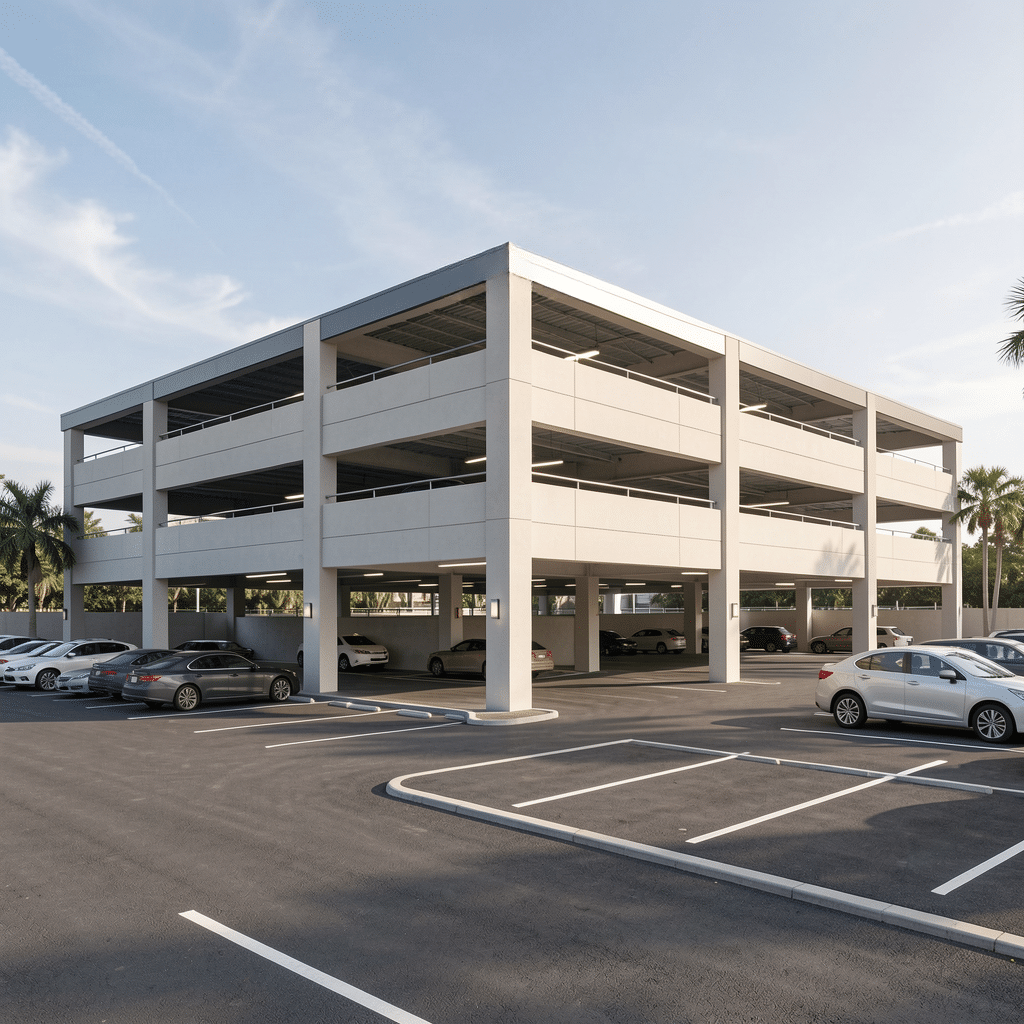
Parking garage insulation is one of the most overlooked specifications in multi-level construction, yet it solves three problems that architects and developers consistently underestimate: excessive noise reverberation, condensation on structural decks, and thermal transfer into occupied spaces above. If you have ever walked through a concrete parking structure and been startled by the amplified echo of a car door slamming three levels away, you have experienced what happens when hard, reflective surfaces bounce sound endlessly with nothing to absorb it. Now imagine residential tenants living directly above that environment. The acoustic, thermal, and moisture challenges in parking garages demand a targeted solution, and K-13 spray-applied cellulose insulation has become the industry standard for addressing all three in a single application.
TLDR: Parking garage insulation using K-13 spray-applied cellulose delivers R-3.7 per inch thermal resistance, NRC values up to 1.05 on metal deck substrates, and condensation control for multi-level structures. K-13 is rated for interior and covered exterior applications, making it suitable for the underside of covered parking decks but not for top decks exposed to weather and UV. K-13 does not replace structural fireproofing but is UL-listed for application over spray-applied fire-resistive materials (SFRM) in specific design assemblies, allowing parking garages to achieve both fire protection and thermal/acoustic performance in a single stack. IBC Section 1206 requires STC 50 and IIC 50 for assemblies separating dwelling units from adjacent spaces, though code requirements do not specifically address parking garage noise, making proper insulation specification even more critical in mixed-use developments.
Why Parking Garages Create Unique Acoustic and Thermal Challenges
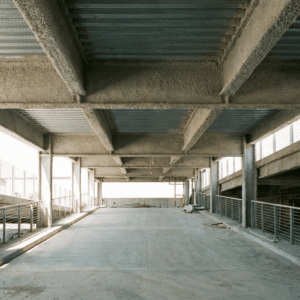
Parking garages are essentially concrete echo chambers. Every surface, including the floors, walls, columns, and deck ceilings, is a hard reflective material that bounces sound rather than absorbing it. The noise sources in a typical garage are both diverse and intense: tire squeal on polished concrete during turns, engine starts and acceleration bursts, door and trunk slams that generate impulsive structure-borne vibrations, horn blasts, and exhaust system noise. Each of these sounds reflects off multiple surfaces, amplifying perceived volume and extending reverberation time far beyond what occupants experience in treated spaces.
The thermal challenges are equally significant. In mixed-use buildings where residential or office space sits above parking levels, the garage deck becomes a thermal bridge. Heated interior space above creates a warm deck surface, while cold garage air below drops the underside temperature toward the dew point. The result is condensation forming on the underside of structural decks, particularly in cold-climate regions. Left unaddressed, this moisture accelerates corrosion on reinforcing steel, degrades finishes, and creates dripping that damages vehicles and makes the garage feel neglected. Parking garage insulation applied to the deck underside acts as a thermal break, keeping the surface temperature above the dew point and preventing condensation from forming.
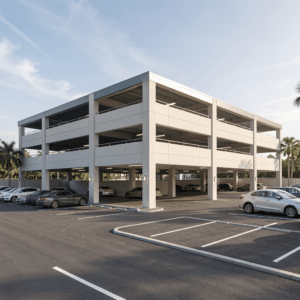
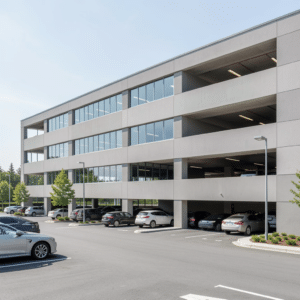
Open parking garages, as defined by IBC 2024 Section 406.5 open parking garage requirements, must have uniformly distributed openings on two or more sides, with opening area equal to at least 20 percent of the total perimeter wall area on each tier and opening length across at least 40 percent of the perimeter. These ventilation requirements help dissipate vehicle exhaust and heated gases, but they also mean the garage environment fluctuates with outdoor temperature and humidity conditions. Enclosed garages require mechanical ventilation per the International Mechanical Code and NFPA 13 sprinklers per IBC Section 903.2.10, creating a more controlled but still acoustically challenging environment.
K-13 Specifications for Parking Garage Insulation Applications
International Cellulose Corporation (ICC) publishes a dedicated parking garage specification guide (Section 07 21 29) specifically for K-13 applications in multi-level structures. This is not a general-purpose spec adapted for garages. It is a purpose-built specification with requirements tailored to the parking environment, and the fact that the manufacturer supports this application with a standalone document provides confidence for specifiers.
The core performance data for parking garage insulation using K-13 includes an R-value of 3.7 per inch as measured by ASTM C 518, a Class 1 and Class A fire rating per ASTM E 84 with a flame spread of 5 and smoke development of 5, bond strength greater than 150 pounds per square foot per ASTM E 736, and bond deflection performance verified per ASTM E 759 showing no spalling or delamination at six inches of deflection in a 10-foot span. The material is non-corrosive per ASTM C 739 and carries a reference service life of 75 years per its Environmental Product Declaration (EPD).
Standard K-13 applications reach up to five inches thick without mechanical support, delivering R-18.5 thermal resistance. For projects requiring higher performance, the K-13 High-R System uses mechanical fastening (stickpins and StructaLath III welded lath wiring) to support applications up to 10 inches thick, achieving R-37. In most parking garage applications, two to three inches provides the optimal balance of thermal resistance, acoustic absorption, and installed cost.
The parking garage spec defaults to Light Gray as the standard color, though K-13 is available in five standard colors (Black, Gray, Light Gray, White, and Tan) with custom color matching to Sherwin-Williams, Benjamin Moore, or RAL systems available at additional cost. The specification requires installation by licensed ICC applicators, with a mandatory 100-square-foot mock-up for architect and owner review prior to full-scale application. The material must cure with continuous natural or mechanical ventilation.
Acoustic Performance: How Parking Garage Insulation Controls Noise
The acoustic case for parking garage insulation is built on published NRC data tested per ASTM C 423 by NVLAP-accredited laboratories. NRC (Noise Reduction Coefficient) measures how effectively a material absorbs airborne sound on a scale from 0.00 (perfect reflection) to 1.00 (near-complete absorption). What makes K-13 particularly effective as parking garage insulation on metal deck substrates is how its acoustic performance increases compared to solid backing.
K-13 on Solid Backing (ASTM C 423)
| Thickness | 125 Hz | 250 Hz | 500 Hz | 1,000 Hz | 2,000 Hz | 4,000 Hz | NRC |
|---|---|---|---|---|---|---|---|
| 1.00 in. | 0.11 | 0.32 | 0.84 | 0.99 | 1.01 | 0.98 | 0.80 |
| 2.00 in. | 0.47 | 0.90 | 1.06 | 1.06 | 1.08 | 1.07 | 1.00 |
| 3.00 in. | 0.57 | 0.99 | 1.04 | 1.03 | 1.00 | 0.98 | 1.00 |
K-13 on Metal Deck Substrates (ASTM C 423)
| Substrate | Thickness | NRC |
|---|---|---|
| 1.5 in. Ribbed Metal Deck | 1.50 in. | 1.05 |
| 1.5 in. Ribbed Metal Deck | 3.00 in. | 1.05 |
| 2 in. Metal Deck | 1.00 in. | 0.90 |
| 2 in. Metal Deck | 2.00 in. | 1.05 |
| 3 in. Metal Deck | 1.50 in. | 1.00 |
| 3 in. Metal Deck | 2.75 in. | 1.05 |
The metal deck numbers tell the real story for parking garage insulation applications. On 1.5-inch ribbed metal deck, just 1.5 inches of K-13 achieves NRC 1.05, which represents near-perfect sound absorption. The metal deck cavity acts as an additional resonant absorber beneath the K-13 layer, boosting low-frequency absorption compared to solid backing applications. This means parking garage insulation on typical steel deck structures actually outperforms the same thickness on concrete, making K-13 ideally matched to the most common garage construction.
For context, untreated concrete has an NRC of approximately 0.02, meaning it reflects 98 percent of sound energy. Applying K-13 at just 1.5 inches on metal deck transforms the surface from near-total reflection to near-total absorption. That is the difference between a garage where every tire squeal echoes for seconds and one where sound dies quickly and speech remains intelligible at normal volume.
The Acoustic Code Gap: Why Parking Garage Insulation Matters Even More in Mixed-Use Buildings
IBC Section 1206 establishes sound transmission requirements for assemblies separating dwelling units and sleeping units from each other or from public and service areas. The minimum standards are STC 50 (Sound Transmission Class, measuring airborne sound blocking through an assembly per ASTM E 90) and IIC 50 (Impact Insulation Class, measuring structure-borne sound through floor-ceiling assemblies per ASTM E 492). Field-tested assemblies must achieve a Normalized Noise Isolation Class (NNIC) of not less than 45 per ASTM E 336.
Here is the critical gap that architects and developers need to understand: IBC Section 1206 applies specifically to dwelling units and sleeping units. It does not specifically regulate sound transmission from parking garages to residential spaces above. As acoustic engineers have documented, for the most part there are no building codes in place to adequately address the noise incompatibilities between commercial or parking spaces and residential occupancies within the same building. ICC Guideline G2-2010 suggests higher performance targets for acceptable occupant comfort: STC 55 and IIC 55 for “Acceptable” (Grade B) performance, and STC 60 and IIC 60 for “Preferred” (Grade A) performance.
This matters because the practical result of the code gap is that developers who design only to minimum IBC requirements may deliver residential units where occupants hear every car door, engine start, and tire squeal from the garage below. That leads to complaints, reputation damage, and in some cases litigation. Parking garage insulation addresses the airborne reverberation component by reducing the total sound energy within the garage itself, meaning less noise reaches the structural deck to transmit upward.
However, K-13 absorbs airborne sound. It does not block structure-borne noise transmission through concrete slabs. For mixed-use buildings with residential above parking, structure-borne isolation requires separate treatment: resilient channels and isolation hangers, floating floor systems, vibration isolation pads or bearings, and mass-airspace-mass assemblies with insulation in the cavity. The parking garage insulation and the structural isolation system work as complementary layers, not substitutes.
Parking Garage Insulation Over Structural Fireproofing: The Dual-Performance Stack
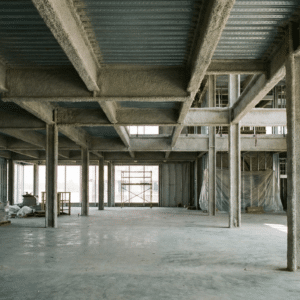
One of the most valuable aspects of parking garage insulation with K-13 is its ability to layer over spray-applied fire-resistive materials (SFRM) in listed UL design assemblies. K-13 is UL Approved and listed in multiple UL BXUV Guide Design Assemblies, including D779, D798, D925, D985, P725, P732, P753, D759, D858, D902, G801, G705, P719, P723, and P819. A Jensen Hughes engineering analysis of overlay materials over SFRM further supports this approach, confirming that approved overlay materials can be installed over SFRM without adversely impacting fire-resistance ratings, provided the SFRM is not at its maximum evaluated thickness.
This dual-performance stack is critical for parking garage insulation in multi-level buildings where structural steel requires fire-resistance ratings per IBC Table 601. Most standalone parking garages use Type IIA (one-hour structural frame) or Type IIB (zero-hour) construction. Multi-level garages attached to residential or office towers frequently use Type IA (three-hour structural frame) or Type IB (two-hour). In these higher-rated assemblies, the steel must receive SFRM or intumescent fireproofing to achieve the required fire-resistance rating, and then K-13 can be applied over the SFRM to add thermal resistance, acoustic absorption, and condensation control.
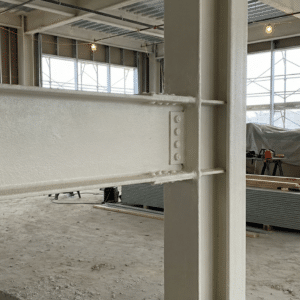
This approach is a crucial distinction that every specifier must understand: K-13 does not replace structural fireproofing. It is a thermal, acoustic, and insulation product. Where structural fire ratings are required, SFRM or intumescent coatings must be specified separately. The K-13 over SFRM stack delivers both fire protection and environmental performance in a coordinated system.
Factory Mutual (FM) approvals for K-13 further support this layered approach. FM Category I approves K-13 as an interior finish material of low fire hazard over noncombustible surfaces. FM Category IV approves K-13 as a protective coating for structural steel to supplement (not replace) sprinkler protection. These FM categories are important context, but they are not the same as a rated fire-resistive assembly per UL. The UL BXUV Design Assembly listings are the proper mechanism for combining K-13 with structural fire protection.
Condensation Control: How Parking Garage Insulation Creates a Thermal Break
Condensation is one of the most persistent and destructive problems in multi-level parking garages, and parking garage insulation serves as the primary defense in mixed-use buildings where conditioned space sits directly above. The mechanism is straightforward: when warm air from heated residential or office floors above meets the cold underside of the structural deck, the surface temperature drops below the dew point, and moisture forms on the concrete or steel surface.
International Cellulose Corporation documents this application directly, stating that for areas such as indoor pools and ice arenas, K-13 aids in condensation control, and that the proper combination of K-13 and ventilation prevents condensation on metal, concrete, and other surfaces. The same principle applies to parking garage thermal and acoustic applications where the deck underside faces an unconditioned or semi-conditioned environment. K-13 reduces ventilation requirements by maintaining surface temperatures above dew point, saving both ventilation equipment investment and operating costs.
This condensation control function makes parking garage insulation particularly relevant in the climate zones where Bahl Fireproofing operates. Winter temperatures in Kansas and the Oklahoma panhandle regularly drop well below freezing, creating significant temperature differentials between heated spaces above and open or semi-enclosed garage environments below. Even in central Texas, seasonal temperature swings and high humidity can create condensation conditions on parking deck undersides during transitional weather periods.
At R-3.7 per inch, a two-inch K-13 application delivers R-7.4 thermal resistance on the deck underside. This is typically sufficient to keep the surface above dew point in most climate conditions encountered in Texas, Kansas, and Oklahoma. For extreme cold climate zones or projects with high indoor humidity (such as indoor pool facilities above parking levels), the K-13 High-R System can extend coverage to R-18.5 at five inches or R-37 at 10 inches with mechanical support.
Where Parking Garage Insulation Works and Where It Does Not
K-13 is rated for interior and covered exterior applications. Understanding what this means in the context of parking garage insulation specification is essential for proper application and to avoid product failures.
Suitable Applications:
The underside of covered parking decks is the primary parking garage insulation application. In a multi-level garage, every deck except the top level has the deck above serving as weather protection. K-13 applied to these undersides is protected from direct rain, UV exposure, and freeze-thaw cycling. This is squarely within the manufacturer’s stated “covered exterior” use case and represents the vast majority of parking garage insulation installations.
Enclosed garage ceilings and soffits fall within the “interior” classification and are fully suitable. Stairwell and elevator lobby ceilings within the garage structure also qualify where acoustic treatment is desired.
Unsuitable Applications:
The top deck of any parking garage is exposed to direct weather, UV radiation, rain, and freeze-thaw cycling. K-13 is not UV stable and should not be used in areas exposed to direct sunlight unless protected. Standard K-13 is not appropriate for top deck applications without additional protective measures.
Perimeter areas near open walls where wind-driven rain can reach the deck underside require evaluation on a project-by-project basis. While the underside of an upper deck is technically “covered,” driving rain in open garages (which by code must have 20 percent of perimeter wall area open) can reach interior surfaces during severe weather events.
Areas subject to power washing must also be excluded. Parking garages are sometimes pressure-washed, and K-13 cannot withstand direct high-pressure water contact. Alternative cleaning methods must be specified for treated surfaces.
ICC’s published documentation also warns that K-13 should not be applied where combustible contaminants such as dust, oil, or similar materials exist, because accumulations of these contaminants provide a fuel source that will burn when ignited. In parking garages, automotive fluids such as oil, grease, and gasoline vapor are present, making this an important consideration. K-13 on the ceiling is separated from vehicle-level contaminants by height, but areas near maintenance bays, oil change stations, or mechanical rooms within the garage require specific evaluation.
The temperature limit of 150 degrees Fahrenheit (65 degrees Celsius) for continuous exposure is not typically a concern in standard parking garages but should be noted in the specification for completeness.
Practical Specification Considerations for Parking Garage Insulation Projects
Specifying parking garage insulation with K-13 involves several practical decisions beyond selecting a thickness. Here is what architects, engineers, and contractors should consider during the design and bidding process for parking garage insulation projects.
Thickness Selection: For most parking garage applications targeting acoustic control and condensation prevention, 1.5 to 2.5 inches of K-13 provides the optimal performance-to-cost ratio. At 1.5 inches on metal deck, you achieve NRC 1.00 to 1.05 (near-perfect absorption) and R-5.6 thermal resistance. At 2.5 inches, thermal resistance increases to R-9.25 with no meaningful acoustic improvement since NRC is already at maximum. Thickness selection should be driven primarily by the thermal resistance needed to prevent condensation, which depends on the temperature differential between the conditioned space above and the garage environment.
Color Selection: The parking garage spec defaults to Light Gray, which maximizes light reflectance and improves the overall brightness of the garage. White offers even higher reflectance at 84 percent or greater per ICC technical data, reducing artificial lighting requirements. Darker colors absorb more light and should be avoided unless architectural intent overrides practical performance. Custom colors are available but add cost.
Coordination With Fireproofing: If structural steel requires fire-resistance ratings, SFRM or intumescent coatings must be applied and inspected before parking garage insulation installation. The K-13 applicator coordinates with the fireproofing contractor to verify the SFRM is not at its maximum evaluated thickness for the specific UL design assembly. This sequencing is critical and should be addressed in the project schedule.
Mock-Up Requirement: Per ICC’s parking garage insulation specification, a 100-square-foot mock-up is required for architect and owner review before full-scale application proceeds. This ensures color, texture, thickness, and coverage meet expectations. Include this in the project schedule to avoid delays.
Installed Cost: Parking garage insulation with K-13 typically ranges from $1.50 to $3.00 per square foot installed for commercial projects, varying by thickness, color selection, accessibility, and project size. Custom colors and complex geometries (deep deck profiles, dense piping layouts, embedded conduit) increase costs. The K-13 High-R System with mechanical support carries additional material and labor costs for stickpins and lath installation.
Key Takeaways
- Parking garage insulation using K-13 delivers thermal resistance of R-3.7 per inch, NRC values up to 1.05 on metal deck substrates, and condensation control in a single spray-applied system with a 75-year reference service life.
- On metal deck (the typical parking garage ceiling substrate), K-13 achieves higher NRC values than on solid backing because the deck cavity acts as an additional resonant absorber, making 1.5 inches sufficient for near-perfect sound absorption.
- IBC Section 1206 does not specifically regulate sound transmission from parking garages to residential spaces above, creating a code gap that makes proper parking garage insulation specification essential for occupant satisfaction in mixed-use buildings.
- K-13 absorbs airborne sound (NRC) but does not block structure-borne transmission (STC/IIC). Mixed-use buildings with residential above parking require separate vibration isolation assemblies to complement parking garage insulation.
- K-13 is UL-listed over SFRM in specific design assemblies (D779, D798, D925, and others), enabling a dual-performance stack that delivers both fire protection and thermal/acoustic performance. K-13 does not replace structural fireproofing.
- K-13 is suitable for interior and covered exterior use only. The top deck of a parking garage, exposed perimeter areas subject to wind-driven rain, and surfaces requiring power washing are not appropriate for standard K-13 without evaluation.
- Typical installed cost ranges from $1.50 to $3.00 per square foot, with thickness selection of 1.5 to 2.5 inches providing the optimal performance-to-cost ratio for most parking garage applications.
Whether you are designing a standalone municipal parking structure or a mixed-use development with residential units above multi-level parking, getting the insulation specification right from the start prevents acoustic complaints, condensation damage, and costly retrofits. Our team has installed parking garage insulation systems on projects throughout Texas, Kansas, and Oklahoma and understands the coordination required between fireproofing, insulation, and structural systems. Contact Bahl Fireproofing to discuss your parking garage project and get a system recommendation matched to your structure, climate zone, and occupancy requirements.
This article provides general educational information about parking garage insulation and acoustic control systems and does not constitute professional engineering advice or product specification. System selection must be based on project-specific fire ratings, thermal requirements, acoustic performance needs, environmental conditions, substrate requirements, and budget constraints. K-13 is a thermal and acoustic insulation product and does not replace structural fireproofing where fire-resistance ratings are required by code. Code requirements vary by jurisdiction and project type. Always consult with a licensed professional and verify UL or FM assembly listings before finalizing specifications.