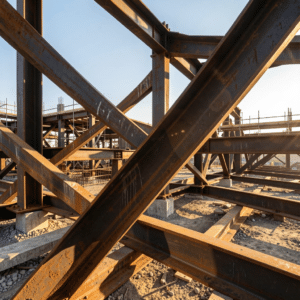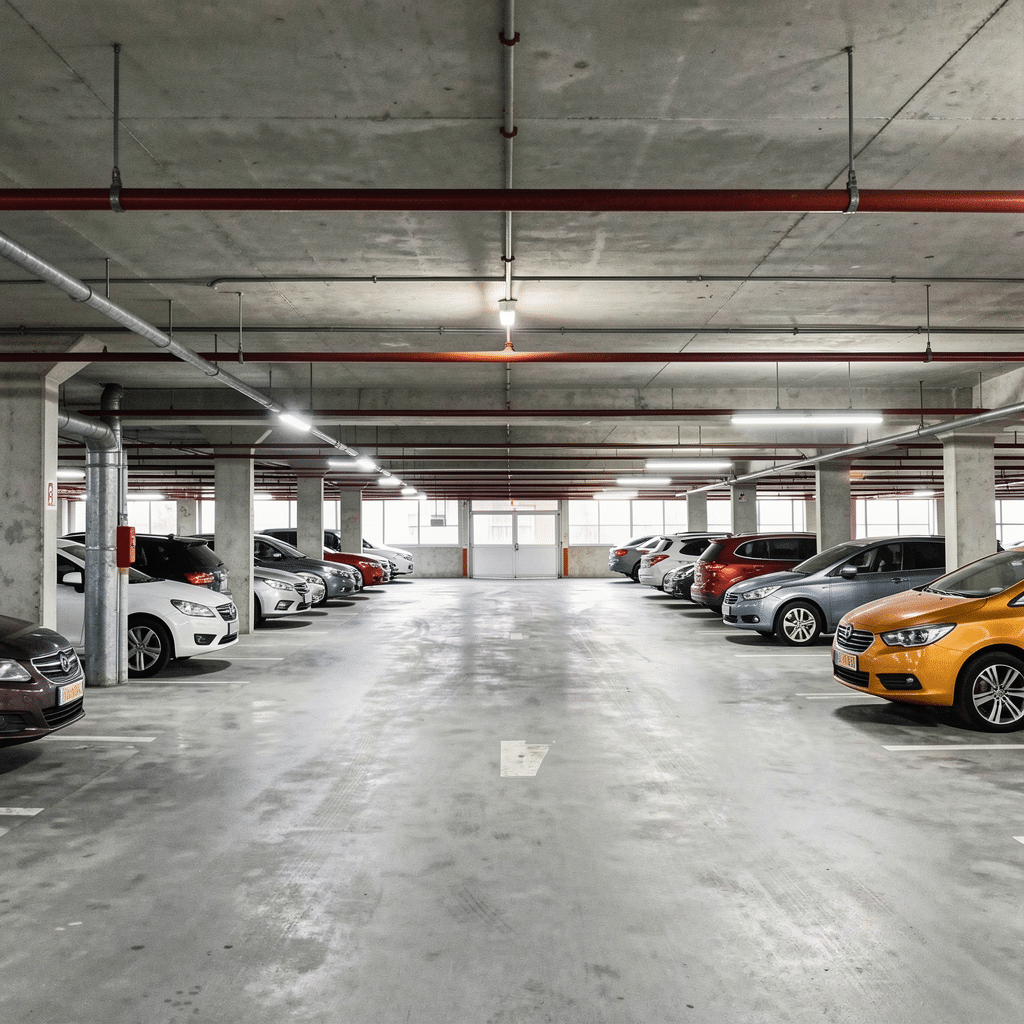
Parking garages put structural steel through conditions that most commercial buildings never see. Rain, road salt, freeze-thaw cycling, vehicle exhaust, UV exposure, and now the extreme heat risk from electric vehicle battery fires all combine to create one of the harshest environments for any coating system. If your garage’s steel requires fire protection, standard interior-grade intumescent coatings will not survive. Parking garage intumescent fireproofing demands weather-resistant systems built to handle years of environmental punishment while still performing in a fire.
This is not the same conversation as protecting exposed steel in a restaurant or retail store. The challenges are fundamentally different, and so are the solutions.
TLDR:
- Parking garages are classified Group S-2 under the IBC, with fire resistance requirements based on construction type (Type IIA = 1 hour, Type IIB = 0 hours)
- EV battery fires can reach 5,000°F, making structural steel protection in garages more critical than ever
- Water-based intumescent coatings are not suitable for parking garages due to moisture, salt, and UV exposure
- Solvent-based or epoxy intumescent systems are required, with a mandatory three-layer system (primer + intumescent + topcoat)
- Parking garage intumescent fireproofing requires ongoing maintenance: 2-year inspections and topcoat recoating every 10 to 15 years
Why Parking Garages Need Intumescent Fireproofing
Parking garages are classified as Group S-2 (low-hazard storage) under the International Building Code. The word “low-hazard” can be misleading. The US Fire Administration estimates approximately 650 parking garage fires occur annually in the United States, causing roughly $8 million in property damage and 15 injuries per year. That number is expected to climb as electric vehicles become more common.
Fire resistance requirements for parking garage steel depend on construction type, just like any other commercial building. IBC 2024 Table 601 sets the baseline:
| Construction Type | Structural Frame | Floor Assembly | Roof Assembly |
|---|---|---|---|
| Type IA | 3 hours | 2 hours | 1.5 hours |
| Type IB | 2 hours | 2 hours | 1 hour |
| Type IIA | 1 hour | 1 hour | 1 hour |
| Type IIB | 0 hours | 0 hours | 0 hours |
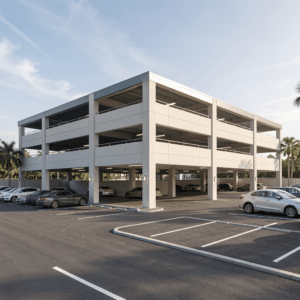
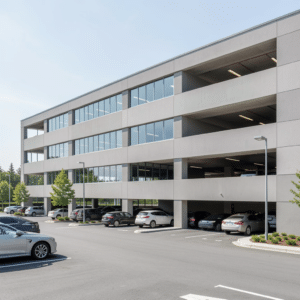
Most standalone open parking garages are Type IIA (1-hour fire rating on the structural frame) or Type IIB (no fireproofing required). Larger multi-story garages, especially those attached to hospitals, hotels, or mixed-use buildings, often require Type I construction with 2 to 3 hour fire ratings. Local code amendments can change these requirements, so always confirm with your local building official.
Open vs. Enclosed: Two Different Code Paths
The IBC draws a sharp line between open and enclosed parking garages, and the distinction matters for fire protection planning.
| Feature | Open Garage (IBC 406.5) | Enclosed Garage (IBC 406.6) |
|---|---|---|
| Ventilation | Natural, 40%+ perimeter open | Mechanical required |
| Construction Type | Limited to Type I, II, or IV | No limitation |
| Sprinklers | Required if over 48,000 sq ft or over 55 ft tall | Always required (NFPA 13) |
| Exterior Wall Rating | Not required if fire separation is 10 ft or more | Required per Table 602 |
| Stairway Enclosure | Not required | Required |
Open garages get certain code allowances because natural ventilation helps dissipate smoke and heat. But those open perimeters also expose structural steel to weather, which creates the central challenge this blog addresses.
2024 IBC Change: Sprinklers Now Required in Many Open Garages
One important code change affects fire protection strategy for new garages. Starting with the 2021 IBC (carried into the 2024 edition), sprinklers are now required in open parking garages where the fire area exceeds 48,000 square feet or the height exceeds 55 feet. Previous editions gave open garages a blanket exemption from sprinkler requirements.
NFPA 13 also reclassified parking garages from Ordinary Hazard 1 to Ordinary Hazard 2 in its 2022 edition, requiring higher sprinkler densities. FM Global went further, reclassifying garages to OH3 in 2021.
These changes reflect a reality the industry has recognized: parking garage fires are getting more intense, and the old assumptions about “low-hazard storage” no longer hold.
The EV Fire Factor: Why Intumescent Fireproofing Matters More Than Ever
Electric vehicle battery fires have changed the risk profile for parking garage structural steel. This is not a hypothetical concern.
According to NFPA research on parking garages and EVs, EV battery fires can reach temperatures of 5,000°F. For comparison, a typical gasoline vehicle fire reaches approximately 1,500°F. That is more than three times the heat intensity.
Lithium-ion battery fires also behave differently than conventional vehicle fires. Thermal runaway creates chain reactions across battery cells, and fires can reignite hours or even days after initial suppression. Up to 30 percent of EV battery fires occur during charging, which means the vehicle is often parked and stationary when the fire starts.
A 2024 parking garage EV fire in South Korea damaged hundreds of vehicles and forced building evacuations. The extreme heat caused concrete spalling and structural steel weakening in areas that were not adequately protected.
What does this mean for parking garage fireproofing? Structural steel in garages faces greater fire exposure than at any point in the past. Modern gasoline vehicles also carry significantly more plastics, rubber, and synthetic materials than older models, increasing overall fire loads even without the EV factor. Intumescent fireproofing on structural steel is more critical now, not less.
Weather Challenges: Why Parking Garages Are Different
Here is where parking garage intumescent fireproofing diverges sharply from interior commercial applications. A restaurant or office building provides a controlled indoor environment. A parking garage does not.
Sherwin-Williams specifically identifies open deck car parks and underground car parks as environments “where water, road salt and grit can cause conditions that are very severe” for intumescent coatings.
The specific threats include:
Water and moisture. Rain, snow, standing water on decks, condensation, and vehicle drip all attack intumescent coatings. Research shows water-based intumescent coatings can lose approximately 10 percent of fire-resistance properties over 800 days at 80 percent humidity due to leaching of key reactive ingredients.
Road salt and de-icing chemicals. Vehicles carry salt and chemical residue into garages throughout winter months. These are extremely corrosive to both steel and coating systems. In Texas, Kansas, and Oklahoma, winter road treatments combined with summer heat extremes create aggressive cycling conditions.
UV exposure. Open-top and partially open garages expose coatings to ultraviolet radiation, which degrades many coating chemistries over time. UV causes chalking, loss of film integrity, and eventual failure of the protective topcoat layer.
Temperature cycling. Freeze-thaw cycles in northern climates and even in the southern Plains states cause expansion and contraction that can crack rigid coatings. Kansas winters regularly produce freeze-thaw conditions that stress coating adhesion.
Abrasion and debris. Vehicular traffic kicks up grit, dirt, and debris that physically wears coating surfaces, especially on columns and low-level steel near drive aisles.
Vehicle exhaust and fuel vapors. Chemical exposure from exhaust gases and occasional fuel spills adds another layer of environmental stress.
ISO 12944: Matching the Coating to the Environment
ISO 12944 is the international standard for categorizing corrosive environments and selecting appropriate protective coating systems. It provides a simple framework for determining what level of protection a parking garage needs:
| Category | Corrosivity | Typical Environment | Parking Garage Application |
|---|---|---|---|
| C1 to C2 | Very Low to Low | Heated interiors, dry environments | Not applicable to parking garages |
| C3 | Medium | Urban/industrial, moderate pollution | Enclosed underground garages |
| C4 | High | Industrial zones, moderate coastal salinity | Open garages, semi-exposed structures |
| C5 | Very High | Heavy industrial, high coastal salinity | Open-deck garages, coastal locations |
Most parking garages fall in the C3 to C4 range. Open-deck garages near coastlines can reach C5. The corrosivity category determines what type of intumescent system and topcoat is required for long-term performance.
Choosing the Right Intumescent System for Parking Garages
Not all intumescent coatings are created equal, and the type that works beautifully in a restaurant will fail in a parking garage. There are three main categories, and parking garages eliminate one of them immediately.
Water-Based Intumescent: Not for Parking Garages
Water-based intumescent coatings offer the best finish quality, lowest VOC, and lowest odor. They are the preferred choice for interior commercial applications like restaurants, retail stores, offices, and lobbies.
But water-based formulations are sensitive to moisture and humidity. They are prone to weathering from humidity, rain, and UV exposure. In a parking garage environment with standing water, road salt, and temperature cycling, water-based intumescent coatings will degrade and lose fire-resistance performance. They are not suitable for parking garages or any semi-exposed condition.
Solvent-Based Intumescent: Best for Most Parking Garages
Solvent-based intumescent coatings are less sensitive to moisture, humidity, and inclement weather. They can be applied in semi-exposed conditions, at perimeter walls, and even during construction when the building envelope is not yet sealed.
Several solvent-based products carry UL exterior ratings, including the Carboline Nullifire S605 and Hilti CFP-SP AWHB. These products are tested and listed for exterior or semi-exposed applications. The Nullifire S605 achieves up to 2 hours of fire resistance with an approved topcoat system and carries a UL 1709 rating for hydrocarbon fire exposure.
Solvent-based intumescent produces a hard, durable finish that resists normal wear from the garage environment. For C3 to C4 environments (which covers most parking garages), solvent-based is the right choice.
Epoxy-Based Intumescent: For Severe Exposure Garages
Epoxy intumescent coatings offer the highest durability, fastest recoat times, and best performance in extreme environments. Formulated at 95 to 100 percent solids with negligible VOC, epoxy systems handle C5 corrosive environments and carry UL 1709 ratings for hydrocarbon fire curves.
Because epoxy formulations contain no water, they are not subject to freeze-thaw damage. This makes them the best choice for open-deck garages, coastal garages, and any structure facing severe corrosion exposure.
The tradeoff is cost. Epoxy intumescent runs approximately 3 to 5 times more than water-based systems. For most inland parking garages, solvent-based provides the right balance of durability and cost. Epoxy is reserved for the most demanding applications.
| Coating Type | Best For | Moisture Resistance | UV Resistance | Relative Cost |
|---|---|---|---|---|
| Water-based | Interior only (restaurants, offices) | Low | Low | Lowest |
| Solvent-based | Most parking garages (C3 to C4) | High | Moderate to High | Moderate |
| Epoxy-based | Severe exposure garages (C5) | Very High | Very High | Highest (3 to 5x water-based) |
The Three-Layer System: Why Skipping the Topcoat Is Not an Option
Interior intumescent applications sometimes skip the topcoat in conditioned spaces where the coating faces no environmental threats. In a parking garage, skipping the topcoat is a guaranteed path to premature failure and a voided UL listing.
Parking garage intumescent fireproofing requires a complete three-layer system:
Layer 1: Primer. The primer provides corrosion protection for the steel substrate and creates the adhesion base for the intumescent layer. The primer must be manufacturer-approved. Using a non-approved primer can void the UL listing for the entire assembly, meaning the system no longer has a recognized fire rating.
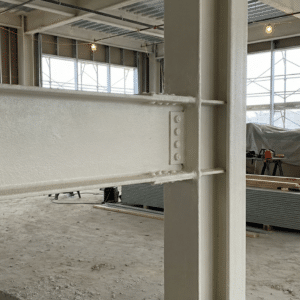
Layer 2: Intumescent base coat. This is the fire-protection layer that forms an insulating char when exposed to extreme heat. The required dry film thickness (DFT) depends on the fire rating needed and the W/D ratio (weight-to-heated-perimeter) of the steel section being protected.
Layer 3: Topcoat/sealer. In a parking garage, the topcoat is not optional. It protects the intumescent layer from moisture, UV, salt, chemicals, and physical abrasion. The topcoat must be fire-tested to ensure it allows the intumescent coating to expand properly during a fire event. A topcoat that restricts expansion compromises the fire rating.
For example, the exterior topcoat system for the Carboline Nullifire S605 specifies Carboguard 1340 as the primer/sealer plus Carbothane 133 HB as the finish topcoat. These products are tested together as a system. Substituting unapproved products breaks the tested assembly.
Offsite Shop Application: A Growing Trend for Parking Garages
A growing trend in the industry is applying intumescent coatings in a controlled shop environment rather than in the field. This is especially relevant for parking garages, where field application faces constant weather challenges.
Shop application offers several advantages. Temperature and humidity are controlled, which produces a better quality finish and more consistent dry film thickness. Project timelines are faster because there are no weather delays. Overall costs are often lower despite the logistics of transporting coated steel.
Sherwin-Williams notes that “stakeholders who have not yet made the shift are missing out on streamlined operations and lower overall costs.” Carboline promotes epoxy-based intumescent applied offsite in controlled environments as a best practice for exterior and semi-exposed steel.
For new construction garages, offsite application makes particular sense. The steel arrives on site already primed and coated. Field crews only need to handle touch-ups at connections, welds, and areas damaged during erection. This reduces the window where fresh steel sits exposed to weather.
A recent multi-story garage project in central Texas used this approach. Structural steel was shop-coated with solvent-based intumescent and shipped to the site with protective wrapping at connection points. Field application was limited to bolted connections, splice plates, and minor touch-ups. The project saved an estimated two weeks compared to full field application, and the coating quality was noticeably more consistent across all members.
Maintenance and Inspection: Not Optional in Parking Garages
Interior intumescent fireproofing in conditioned spaces is virtually maintenance-free for the life of the building. Parking garage intumescent fireproofing is not. The environmental exposure means coatings degrade over time, and a maintenance plan is essential.
Inspection Schedule
The general industry guideline is to inspect intumescent coatings at least every 2 years as part of building maintenance. Parking garages with high exposure conditions may need more frequent inspections. Factors affecting the schedule include the products used, the location of the steel within the structure, and the severity of the environment.
Properly applied intumescent can last the lifespan of the building in protected interior conditions. In semi-exposed environments like parking garages, expect a service life of 12 to 18 years with touch-ups around the 10-year mark. Exterior (Type X) systems carry a minimum 10-year lifetime with correct specification, application, and maintenance.
What to Look For
Parking garage inspections should check for cracking, peeling, or delamination from freeze-thaw cycling. Look for corrosion at the primer-to-steel interface, especially in areas exposed to road salt runoff. Assess the topcoat condition for UV degradation, chalking, and loss of gloss.
Damaged areas measuring 150 square millimeters (approximately 0.23 square inches) or larger are considered substantial and require immediate repair. Repairs must use matching manufacturer-approved materials applied by a qualified contractor.
Maintenance Budget Planning
Plan for topcoat recoating every 10 to 15 years in exposed environments. This is not a failure of the system. It is normal maintenance for any high-performance coating in a harsh environment, similar to repainting a bridge or an industrial facility.
The cost of periodic maintenance is significantly less than the cost of full system replacement. Catching degradation early through regular inspections extends the service life of the entire intumescent system.
Key Takeaways
- Parking garages are Group S-2 under IBC, with fire resistance based on construction type. Most standalone garages are Type IIA (1-hour) or Type IIB (0 hours).
- EV battery fires at 5,000°F have changed the risk profile for parking garage structural steel. Intumescent fireproofing is more critical than ever.
- Water-based intumescent coatings are not suitable for parking garages. Solvent-based systems work for most garages (C3 to C4). Epoxy systems handle severe exposure (C5).
- A complete three-layer system (primer + intumescent + topcoat) is mandatory. Skipping the topcoat voids the UL listing and leads to premature failure.
- Offsite shop application produces better quality, faster timelines, and lower overall costs for new construction.
- Parking garage intumescent requires ongoing maintenance: inspections every 2 years and topcoat recoating every 10 to 15 years.
- The 2024 IBC now requires sprinklers in open garages exceeding 48,000 sq ft or 55 ft tall, reflecting increased fire risk awareness.
Whether you are designing a new multi-story garage, retrofitting an existing structure, or evaluating coating systems for a mixed-use development, getting the intumescent specification right from the start prevents costly failures and keeps the structure code-compliant for years to come. Experience across hundreds of commercial fireproofing projects throughout Texas, Kansas, and Oklahoma has shown that parking garages demand a different conversation than interior applications. Contact Bahl Fireproofing today to discuss your parking garage project and get a system recommendation matched to your environment.
This article provides general educational information about fireproofing and insulation systems and does not constitute professional engineering advice or product specification. System selection must be based on project-specific fire ratings, thermal requirements, acoustic performance needs, environmental conditions, substrate requirements, and budget constraints. Code requirements vary by jurisdiction and project type. Always consult with a licensed professional and verify UL or FM assembly listings before finalizing specifications.