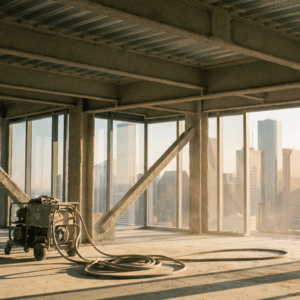
Houston’s commercial construction market is the most diverse fireproofing environment in the southern United States. From downtown high-rise office towers exceeding 1,000 feet to Ship Channel petrochemical facilities requiring hydrocarbon fire ratings, and from Texas Medical Center healthcare projects with complex MEP coordination to fast-track data center campuses in West Houston, every major building type in commercial construction is actively under construction in the Houston metro area. This guide covers what building owners, general contractors, architects, and specifiers need to know about commercial fire protection for Houston commercial projects.
TLDR: Houston’s $15 billion+ active construction pipeline spans high-rise offices, hospitals, data centers, petrochemical facilities, warehouses, and public assembly buildings, each with distinct fireproofing requirements. Houston adopted the 2021 IBC effective January 2, 2024. Bahl Fireproofing serves the Houston market with cementitious SFRM, intumescent coatings, K-13 insulation, and spray foam insulation.
Houston is the only market in our Texas service territory where I regularly work on every major building type within the same quarter: a downtown office tower requiring 430 psf bond strength SFRM, a Ship Channel refinery project requiring UL 1709 hydrocarbon fire ratings, a Texas Medical Center hospital expansion with the most complex MEP coordination of any building type, and a West Houston data center on a fast-track schedule that leaves zero margin for cure time delays.
That diversity is what makes Houston unique and what makes specification accuracy critical. The fireproofing system that works perfectly on a Type II-B warehouse in Katy is completely wrong for a Type I-A hospital in the Medical Center, and the cellulosic fire rating that protects a downtown office tower would be a code violation on a Ship Channel petrochemical facility. Over the past 20 years, Bahl Fireproofing has built the field experience to handle every one of those applications across the Houston metro area, from standard commercial density SFRM to high-density industrial coatings to architecturally exposed intumescent systems.
Houston’s Commercial Construction Landscape
Greater Houston currently has over $15 billion in commercial and industrial construction under way, creating sustained fireproofing demand across every building sector. Understanding the scale and type of construction activity helps building owners and contractors plan fireproofing scope, budget, and scheduling.
The George R. Brown Convention Center is undergoing a multi-billion-dollar transformation funded by an estimated $2 billion in incremental Hotel Occupancy Tax revenue, now under construction and managed by Houston First Corporation. Phase 1 (GRB South) includes 700,000 square feet of new building space slated for completion by 2028, featuring the largest ballroom in Texas. Projects of this scale require Type I-A construction with multi-hour fire-resistance ratings on large-span structural steel, applied from aerial lifts in high-bay environments.
Bush Intercontinental Airport’s Terminal B transformation is a $2.6 billion project adding a 765,000 square foot north concourse with 22 new gates and a 440,000+ square foot central processor, targeted for opening in 2026. Airport terminal construction requires strict fire-resistance ratings on structural steel in active operational environments with security-sensitive access requirements.
The Texas Medical Center, the world’s largest medical complex, has over $3 billion in active construction. Current projects include Helix Park’s next phase (hotel, conference center, and 300-unit residential tower) and the $2.5 billion Ben Taub Hospital expansion. Healthcare construction demands the highest fire-resistance ratings (Type I-A or I-B, 2 to 3 hour ratings) and the most complex MEP coordination of any building type.
Along the Houston Ship Channel, major petrochemical and refinery expansion projects drive sustained demand for industrial-grade fireproofing. The Marathon Petroleum Galveston Bay Refinery, one of the largest refineries in the United States by capacity, is among the facilities with ongoing capital improvement projects. These industrial projects require UL 1709 hydrocarbon fire ratings with high-density SFRM (40 to 55 pcf), a fundamentally different specification than standard commercial fireproofing.
In West Houston and Katy, data center campuses continue expanding. CyrusOne’s Houston West campus spans multiple facilities totaling hundreds of thousands of square feet of data center space. Data center fireproofing is typically commercial density SFRM at one-hour fire ratings, but the aggressive construction timelines demand precise cure time management.
Does Your Houston Building Need Commercial Fire Protection?
Whether a Houston commercial building requires fireproofing depends on its construction type under the International Building Code. Houston adopted the 2021 IBC effective January 2, 2024, with the Houston Fire Marshal’s Office serving as the Authority Having Jurisdiction (AHJ).
IBC Table 601 maps construction type to required fire-resistance ratings for the structural frame, bearing walls, floor construction, and roof construction. Here is a simplified version covering the construction types most common in Houston commercial steel projects:
| Construction Type | Structural Frame | Floor Construction | Roof Construction | Typical Houston Application |
|---|---|---|---|---|
| Type I-A | 3 hours | 2 hours | 1.5 hours | TMC hospitals, convention centers, high-rise offices |
| Type I-B | 2 hours | 2 hours | 1 hour | Mid-rise offices, healthcare, mixed-use |
| Type II-A | 1 hour | 1 hour | 1 hour | Low-rise commercial, some warehouses |
| Type II-B | 0 hours | 0 hours | 0 hours | Single-story warehouses, distribution centers |
Type II-B is the most common construction type for single-story steel warehouses in the Houston metro area, and it requires 0-hour fire-resistance ratings for the structural frame. This means many Houston warehouses do not require fireproofing at all. But the moment building height, occupant load, or occupancy classification triggers Type II-A or higher, fire-resistance-rated construction becomes mandatory.
For high-rise buildings in downtown Houston and the Galleria district, IBC Section 403.2.4 adds bond strength requirements that scale with building height. Buildings 75 to 420 feet require 430 psf minimum SFRM bond strength. Buildings exceeding 420 feet (like the JPMorgan Chase Tower at 1,002 feet, 75 stories) require 1,000 psf bond strength, the highest threshold in the code.
Fireproofing Services for Houston Commercial Projects
Bahl Fireproofing provides four core services across the Houston market, each specified for different applications and performance requirements.
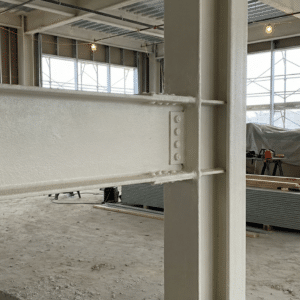
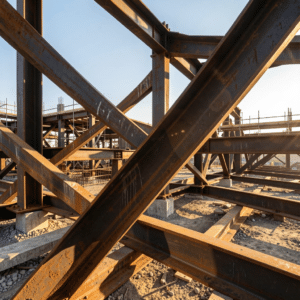
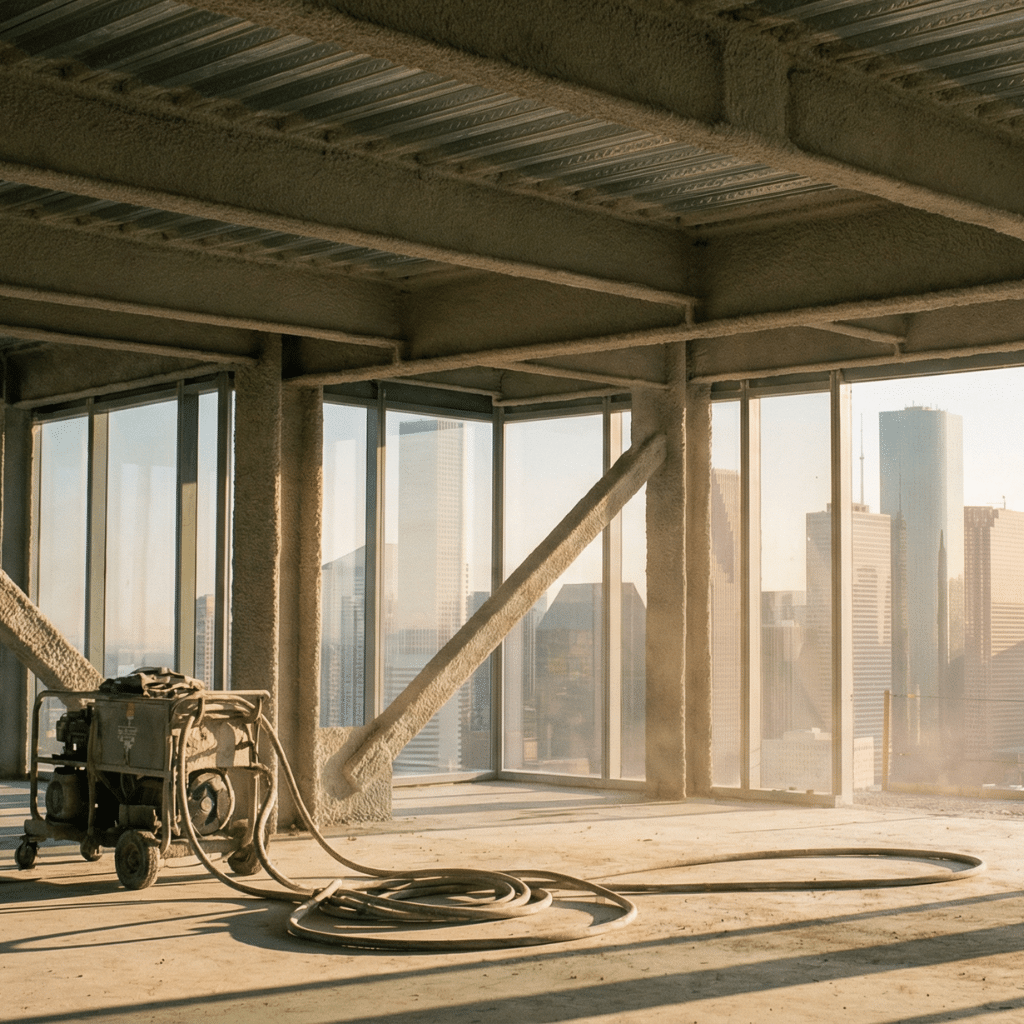
Spray-Applied Fire-Resistive Material (SFRM) is the primary passive fire protection system for concealed structural steel. SFRM is applied to columns, beams, and metal decking to achieve 1 to 4 hour fire-resistance ratings per ASTM E119 and UL 263. Three density categories serve different environments: commercial density (15 to 21 pcf) for concealed applications, medium density (22 to 39 pcf) for exposed conditions and high-rise bond strength requirements, and high density (40+ pcf) for industrial and petrochemical applications. For a deeper look at density selection, application methods, and special inspection requirements, see our complete guide to spray-applied commercial fireproofing.
Intumescent fireproofing coatings are thin-film coatings applied to architecturally exposed structural steel (AESS). When exposed to fire, intumescent coatings expand to form an insulating char that protects the steel beneath. Intumescent coatings achieve the same fire-resistance ratings as SFRM but at a significantly higher cost per square foot, making them the specification of choice only when the steel will be visible in the finished building. Downtown Houston office lobbies, Galleria retail atriums, and Energy Corridor corporate campuses frequently specify intumescent coatings for aesthetic steel.
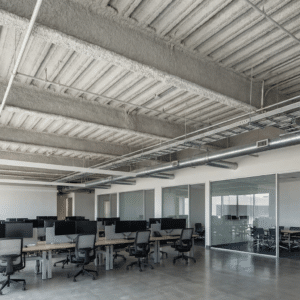
K-13 spray-applied insulation provides thermal and acoustic performance for exposed ceiling and wall applications. K-13 is frequently specified alongside SFRM on the same Houston project: SFRM on the structural steel for fire protection, and K-13 insulation on exposed ceilings for sound absorption and thermal control. Warehouse distribution centers, school gymnasiums, and convention spaces are common K-13 applications in the Houston market.
Spray foam insulation (closed-cell and open-cell) insulates the building envelope for thermal performance. In Houston’s Climate Zone 2A (hot-humid), closed-cell spray foam is the preferred choice for exterior wall assemblies because it provides R-6.0 to R-7.0 per inch while functioning as both an air barrier and a Class II vapor retarder, controlling inward moisture drive from Houston’s subtropical humidity.
Houston Building Types: District-by-District Fireproofing Guide
Houston’s commercial building types vary dramatically by district, and each presents distinct fireproofing challenges.
Downtown High-Rise Offices
Downtown Houston has over 30 buildings exceeding 300 feet in height. Construction types are I-A (3-hour structural frame) or I-B (2-hour), and bond strength requirements escalate with height per IBC Section 403.2.4. For buildings 75 to 420 feet, specifying CAFCO 300 HS (15 pcf, gypsum-based, bond strength exceeding 500 psf) achieves the 430 psf requirement at commercial density cost. Buildings exceeding 420 feet, like the JPMorgan Chase Tower, require 1,000 psf bond strength with products specifically evaluated and classified for high-rise fire protection under those thresholds.
Texas Medical Center Healthcare Facilities
The Texas Medical Center district, the world’s largest medical complex, presents the most complex fireproofing coordination challenge in commercial construction. Type I-A and I-B construction requires 2 to 3 hour fire-resistance ratings, meaning thicker SFRM application and longer cure times. The real challenge is MEP coordination: medical gas lines, IT infrastructure backbone, specialized HVAC with redundant systems, and nurse call systems all create beam clamp and penetration points through the SFRM. Our approach on TMC projects is to spray first, coordinate MEP attachment points with the mechanical contractor using the structural drawings, and then schedule a dedicated patching mobilization after MEP rough-in is complete. Budgeting for that patching scope from day one prevents change orders.
Houston Ship Channel Petrochemical Facilities
Petrochemical and refinery facilities along the Houston Ship Channel (Pasadena, La Porte, Deer Park) require UL 1709 hydrocarbon fire ratings, which simulate a rapid-onset pool fire reaching 2,000 degrees Fahrenheit within 5 minutes. This is a fundamentally different fire exposure than the standard ASTM E119 cellulosic curve used in commercial buildings (which reaches 1,000 degrees Fahrenheit at 5 minutes and 1,700 degrees Fahrenheit at 1 hour). High-density SFRM at 40 to 55 pcf is required, typically from the Carboline Pyrocrete product line. Specifying standard cellulosic-rated SFRM on a hydrocarbon-exposure project is a code violation and a life-safety failure.
Data Centers (Katy and West Houston)
Houston’s data center construction boom is concentrated in the Katy and West Houston corridor. CyrusOne’s Houston West campus spans multiple large-scale facilities serving enterprise and hyperscale clients. Data center fireproofing is typically commercial density SFRM (15 pcf) at one-hour fire ratings. The structural steel is concealed, so SFRM is standard over intumescent. The critical factor is schedule: data center construction timelines are aggressive, and SFRM cure time (14 to 28 days) must be factored into the fast-track sequence. On Houston data center projects, we coordinate with the general contractor to establish protected cure zones and apply SFRM sequentially across multiple floors so the overall schedule keeps moving while each section cures.
Warehouses and Distribution Centers
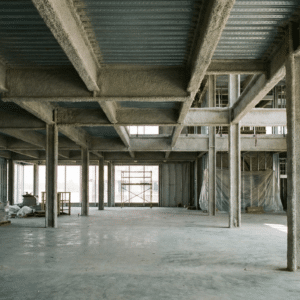
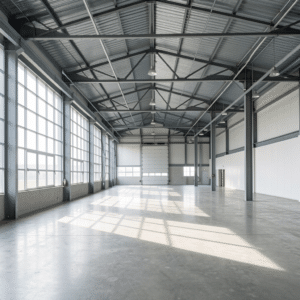
Warehouse and distribution center construction is the highest-volume SFRM application in the Houston market. Most single-story steel warehouses are Type II-B construction (0-hour structural frame), which means no fireproofing is required. When building height, occupancy load, or use classification triggers Type II-A or higher, commercial density SFRM at the minimum specified thickness is typically sufficient. These are cost-sensitive projects where commercial density (15 pcf) keeps the budget manageable.
Parking Garages
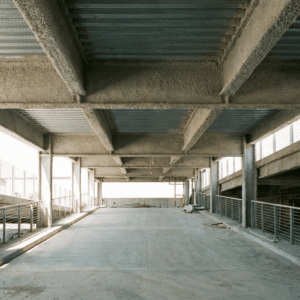
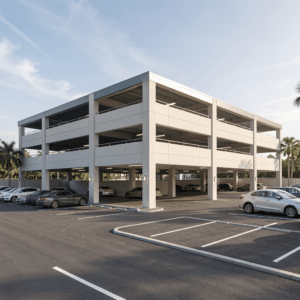
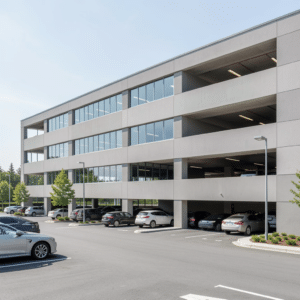
Parking garage steel is exposed to vehicle traffic, weather (in open-air structures), and regular physical contact from maintenance equipment. Commercial density SFRM will be damaged within months of occupancy if specified in this environment. Medium density (22 to 39 pcf) or high density (40+ pcf) SFRM is the correct specification for parking garages, providing the impact resistance and durability that the exposure conditions demand.
Convention Centers and Airport Terminals
The GRB Convention Center expansion and IAH Terminal B transformation represent Houston’s largest public assembly fireproofing projects. Both require Type I-A construction with multi-hour fire-resistance ratings on large-span structural steel. High-bay ceiling applications require aerial lifts for spray access. Airport terminals add the complexity of working within active operational environments with security-sensitive access protocols, while convention center renovation projects must coordinate around event schedules.
Houston-Specific Challenges Every Contractor Must Know
Houston’s climate, geography, and construction market create fireproofing challenges that do not exist in most other Texas cities.
Gulf Coast Humidity and Cure Times
Houston’s subtropical humidity routinely exceeds 80 percent, and gypsum-based SFRM products like CAFCO 300 (15 pcf) are particularly sensitive to high humidity during the initial cure phase. On Houston projects, we schedule spray application in morning hours when relative humidity is lower and ambient temperatures are more stable. Cure times can extend beyond the standard 14 to 28 day window during summer months (June through September), which must be factored into the construction schedule. Failing to account for this Houston-specific condition leads to scheduling conflicts with downstream trades.
Hurricane Season Exposure
Houston’s hurricane season runs June 1 through November 30. Partially enclosed structures during this period face wind-driven rain exposure that can damage uncured SFRM. When structural steel will be temporarily exposed to weather during construction, specify medium-density exterior-rated SFRM. CAFCO BLAZE-SHIELD HP (22 pcf, Portland cement binder) is the only medium-density product UL-classified for exterior use, making it the appropriate product for Houston projects where the building envelope is not yet closed during hurricane season.
UL 1709 vs. ASTM E119: The Ship Channel Distinction
This distinction is critical for Houston because both fire exposure types occur within the same metro area. Standard commercial buildings (offices, hospitals, data centers) are tested and rated under ASTM E119 / UL 263, which follows a cellulosic fire curve. Ship Channel petrochemical and refinery facilities require UL 1709 hydrocarbon fire ratings. The UL 1709 curve reaches 2,000 degrees Fahrenheit within 5 minutes, simulating a rapid-onset pool fire from ignited petroleum products. Standard commercial SFRM products are not tested or rated for this exposure. Only high-density products (40+ pcf) like the Carboline Pyrocrete line carry UL 1709 listings.
How Much Does Fireproofing Cost in Houston?
Fireproofing typically represents 1 to 3 percent of total Houston commercial construction costs. On a $50 million office project, fireproofing runs $500,000 to $1.5 million. That is a small percentage of total project cost, but it carries outsized risk if the specification is wrong, the installation is deficient, or the special inspection fails.
| Density Category | Installed Cost/SF | Typical Houston Application |
|---|---|---|
| Commercial (15 to 21 pcf) | $5 to $14 | Most commercial projects, data centers, concealed steel |
| Medium (22 to 39 pcf) | $7 to $16 | Exposed conditions, high-rise, hurricane-season exposure |
| High (40+ pcf) | $10 to $20+ | Ship Channel petrochemical, parking garages, mechanical rooms |
| Intumescent (comparison) | $10 to $30+ | Architecturally exposed steel (downtown lobbies, corporate offices) |
Houston-specific cost drivers include humidity-related scheduling adjustments (morning-only spray windows in summer), lift rental for high-bay warehouse and convention center applications, hurricane-season temporary protection costs for open structures, fast-track premiums for data center and healthcare schedules, and Ship Channel access requirements including safety training for petrochemical work environments.
Special Inspections: What Houston Building Owners Need to Know
Special inspections for spray-applied fireproofing are mandatory under IBC Chapter 17, Section 1705.15 (2021 IBC, as adopted by Houston effective January 2, 2024). The building owner, not the fireproofing contractor, is responsible for engaging an approved special inspection agency. The Houston Fire Marshal’s Office serves as the AHJ for code enforcement.
The special inspector verifies five items: substrate conditions prior to application, thickness of the applied SFRM (per ASTM E605), density of material samples (per ASTM E605), bond strength and adhesion (per ASTM E736), and finished condition (visual inspection for cracks, delamination, and voids). Testing frequency requires a minimum of one sample per 2,500 square feet of sprayed area.
On a 100,000 square foot Houston warehouse project, that means at least 40 sample locations. On a multi-story downtown office tower, sample counts multiply across every floor. Planning for inspection access across the full project from day one prevents the scheduling delays that occur when the special inspector needs access that was not anticipated.
The fireproofing inspection process involves coordination between the building owner, the special inspection agency, the fireproofing contractor, and the general contractor. Understanding the owner’s responsibility and the inspection sequence before construction starts eliminates the most common source of project delays.
Related Reading
Explore more fireproofing resources from Bahl Fireproofing:
- Choosing between cementitious SFRM and intumescent coatings for your Houston project? Read our comparison of intumescent and cementitious fireproofing systems.
- Need to understand the IBC code requirements that apply to your building? This guide covers commercial fireproofing requirements for building owners.
- Learn how Bahl Fireproofing serves commercial projects across our full Texas, Kansas, and Oklahoma service territory.
Frequently Asked Questions
Does My Houston Commercial Building Need Fireproofing?
It depends on your construction type under IBC Table 601. Type II-B buildings (most single-story steel warehouses) require 0-hour structural frame ratings and no fireproofing. Type II-A requires 1-hour ratings. Type I-A (hospitals, convention centers, high-rise offices) requires 3-hour structural frame protection. Houston adopted the 2021 IBC effective January 2, 2024. The Houston Fire Marshal’s Office is the Authority Having Jurisdiction for code enforcement.
What Building Code Does Houston Follow?
Houston follows the 2021 International Building Code (IBC), adopted effective January 2, 2024. Key IBC sections governing fireproofing include Table 601 (construction type fire-resistance ratings), Section 704 (fire-resistance rating of structural members), Section 403.2.4 (high-rise bond strength requirements), Section 1705.15 (mandatory special inspections for SFRM), and Section 2603 (foam plastic insulation requirements).
What Is the Difference Between UL 1709 and ASTM E119 Fire Ratings?
ASTM E119 (UL 263) tests fire resistance under a cellulosic fire curve that reaches approximately 1,000 degrees Fahrenheit at 5 minutes and 1,700 degrees Fahrenheit at 1 hour. This standard applies to commercial buildings. UL 1709 tests fire resistance under a hydrocarbon fire curve that reaches 2,000 degrees Fahrenheit within 5 minutes, simulating a rapid-onset pool fire. UL 1709 applies to Houston Ship Channel petrochemical and refinery facilities. Standard commercial SFRM products do not carry UL 1709 ratings.
How Much Does Commercial Fireproofing Cost in Houston?
Installed costs range from $5 to $14 per square foot for commercial density SFRM, $7 to $16 for medium density, $10 to $20+ for high density, and $10 to $30+ for intumescent coatings. Fireproofing typically represents 1 to 3 percent of total Houston commercial construction cost. Houston-specific factors that affect pricing include summer humidity scheduling adjustments, hurricane-season protection requirements, fast-track premiums, and Ship Channel access and safety training costs.
Who Is Responsible for Fireproofing Special Inspections in Houston?
The building owner is responsible for engaging an approved special inspection agency under IBC Section 1705.15. The fireproofing contractor does not hire the inspector. The special inspector tests substrate conditions, SFRM thickness, density, bond strength, and finished condition. Testing frequency requires one sample per 2,500 square feet of sprayed area. The Houston Fire Marshal’s Office enforces compliance.
Does Houston Require Higher Bond Strength for High-Rise Buildings?
Yes. Per IBC Section 403.2.4 (adopted by Houston under the 2021 IBC), buildings 75 to 420 feet require minimum SFRM bond strength of 430 psf. Buildings exceeding 420 feet require 1,000 psf. Standard commercial buildings under 75 feet require 150 psf. Downtown Houston has over 30 buildings exceeding 300 feet, and the JPMorgan Chase Tower at 1,002 feet exceeds the 420-foot super high-rise threshold.
What Types of Fireproofing Does Bahl Provide in Houston?
Bahl Fireproofing provides four services in the Houston market: cementitious spray-applied fireproofing (SFRM) for concealed structural steel, intumescent fireproofing coatings for architecturally exposed steel, K-13 spray-applied insulation for acoustic and thermal performance, and spray foam insulation for building envelope thermal control. This range of services allows Bahl to handle multiple scopes on a single Houston project, reducing mobilization costs and coordination complexity.
How Does Houston’s Humidity Affect Fireproofing Installation?
Houston’s subtropical humidity (routinely exceeding 80 percent) extends cure times for gypsum-based SFRM products beyond the standard 14 to 28 day window, particularly during summer months. Bahl schedules spray application during morning hours when humidity is lower and monitors ambient conditions throughout the application day. When steel is temporarily exposed during hurricane season (June through November), medium-density exterior-rated products like CAFCO BLAZE-SHIELD HP are specified to protect against wind-driven rain damage.
Key Takeaways
Houston Market Scale
- Greater Houston has over $15 billion in commercial and industrial construction under way, creating sustained multi-year fireproofing demand
- Major projects span every building type: convention centers, airport terminals, hospitals, data centers, petrochemical facilities, and warehouses
- Fireproofing represents 1 to 3 percent of total construction cost but carries outsized risk if specified or installed incorrectly
Code Requirements
- Houston adopted the 2021 IBC effective January 2, 2024, with the Houston Fire Marshal’s Office as AHJ
- IBC Table 601 determines fire-resistance ratings by construction type; many single-story warehouses (Type II-B) do not require fireproofing
- High-rise bond strength requirements per Section 403.2.4: 150 psf under 75 feet, 430 psf at 75 to 420 feet, 1,000 psf above 420 feet
Houston-Specific Challenges
- Gulf Coast humidity extends SFRM cure times, requiring morning application windows and schedule adjustments during summer months
- Hurricane season (June through November) demands medium-density exterior-rated products for temporarily exposed steel
- Ship Channel petrochemical facilities require UL 1709 hydrocarbon fire ratings (2,000 degrees Fahrenheit in 5 minutes), not standard ASTM E119 cellulosic ratings
Building-Type Selection
- Commercial density SFRM (15 pcf) serves most Houston commercial projects at the lowest installed cost
- Medium density (22 pcf+) is required for exposed conditions, high-rise bond strength, and hurricane-season exposure
- High density (40+ pcf) is mandatory for Ship Channel petrochemical and refinery applications
- Intumescent coatings serve architecturally exposed steel in downtown lobbies, Galleria retail, and corporate offices
Whether you are planning a new high-rise office tower in downtown Houston, expanding a healthcare facility in the Texas Medical Center, building a data center campus in Katy, or maintaining fire protection at a Ship Channel refinery, the right fireproofing specification and experienced application make the difference between a project that passes inspection and one that faces costly rework. Bahl Fireproofing serves the Houston market with over 20 years of commercial fireproofing experience across every building type in the metro area. Contact Bahl Fireproofing today at 512-387-2111 or email ross@bahlfireproofing.com to discuss your Houston project or request a detailed estimate.
This article provides general educational information about commercial fireproofing in the Houston, Texas market. It is not a substitute for project-specific engineering, design, or code analysis. Fire-resistance ratings, bond strength requirements, density specifications, and cost ranges referenced in this article are based on the 2021 International Building Code (as adopted by the City of Houston effective January 2, 2024), manufacturer-published data, standardized testing (ASTM, UL), and field experience as of early 2026. Building codes, fire ratings, and fireproofing requirements vary by jurisdiction, and local amendments may apply. The Houston Fire Marshal’s Office is the Authority Having Jurisdiction for commercial building fire code enforcement. Always consult a licensed professional engineer, architect, or code official for project-specific requirements. Bahl Fireproofing is a commercial fireproofing and insulation contractor, not an engineering or design firm.