Fire-resistance ratings, construction types, testing standards, and special inspections: commercial fireproofing code compliance involves multiple overlapping IBC requirements that determine what fire protection your building needs, how it must be tested, and how it gets verified. This guide walks through the entire code framework in practical terms so building owners, general contractors, architects, and engineers can navigate commercial fireproofing code compliance with confidence.
TLDR: The International Building Code (IBC) requires structural steel fire protection based on construction type (IBC Table 601), with ratings ranging from 0 to 3 hours. Fire-resistance ratings are verified through ASTM E119 or UL 263 testing and documented through UL Design Assemblies. Special inspections under IBC Chapter 17 (Section 1705.15) are mandatory and are the building owner’s responsibility. Texas, Kansas, and Oklahoma each adopt the IBC differently, and city-level variations matter. Read on for a plain-language code breakdown and the five most common compliance failures from 20 years of field experience.
Every fireproofing project I work on starts with the same question: what does the code require? It sounds simple, but the answer involves construction type, occupancy group, building height, testing standards, product selection, UL assembly documentation, and special inspection planning. Miss any one of those steps and the project faces rework, re-inspection, schedule delays, and cost overruns that dwarf the original fireproofing budget.
Over the past 20 years applying commercial fireproofing across Texas, Kansas, and Oklahoma, I have seen code compliance go wrong far more often than it should. The mistakes are almost never technical. They are planning and communication failures: the wrong UL assembly cited in submittals, special inspections not budgeted, primer substituted without checking the listing, or a GC who assumes “fireproofing” is a single line item that takes care of itself. This guide exists to prevent those mistakes by explaining what the code actually requires and how those requirements translate to real project decisions.
Why Fire-Resistance Ratings Exist for Commercial Buildings
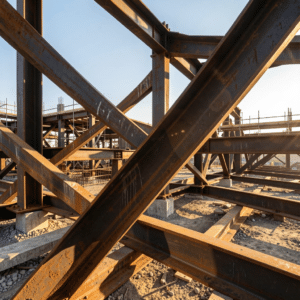
Structural steel is strong, but it loses load-bearing capacity rapidly when exposed to fire. At approximately 1,000 degrees Fahrenheit (538 degrees Celsius), steel retains only about 50 percent of its room-temperature yield strength. The ASTM E119 furnace curve reaches 1,000 degrees Fahrenheit at just 5 minutes, the same temperature at which unprotected steel loses approximately half its structural capacity. While the steel member heats more slowly than the furnace environment, unprotected structural steel can reach critical failure temperature within 15 to 20 minutes of a fully developed fire.
Fire-resistance ratings exist to buy time. A 2-hour rating means the structural assembly has been tested and demonstrated the ability to support its design load for 2 hours under the ASTM E119 fire curve. That time allows building occupants to evacuate, fire crews to respond, and the structure to remain standing long enough to prevent collapse during firefighting operations.
The code’s primary purpose is life safety, not property preservation. Every fire-resistance requirement in the IBC traces back to protecting human life through structural integrity, compartmentalization (containing fire spread), and maintaining egress paths. Understanding this principle helps explain why the code treats different building types so differently: a 3-story office building and a 15-story hospital present fundamentally different life safety risks.
IBC Fire-Resistance Requirements: The Code Framework
The International Building Code governs fire-resistance requirements for commercial buildings through several interconnected chapters. IBC Chapter 7 (Fire and Smoke Protection Features) establishes the fire-resistance rating requirements for structural members, fire barriers, shaft enclosures, and horizontal assemblies. IBC Section 703 sets the general rules for how fire resistance is determined, tested, and maintained.
But the starting point for any fireproofing specification is IBC Chapter 6 and Table 601, which define construction types and their required fire-resistance ratings.
Construction Types Explained
The IBC classifies buildings into five main construction types (Type I through Type V), each with subdivisions that specify the level of fire resistance required for structural elements. For commercial steel buildings in our service territory, four construction types account for the vast majority of projects.
Type I (Noncombustible, Highest Protection) includes Type I-A (3-hour structural frame) and Type I-B (2-hour structural frame). These are high-rise buildings, hospitals, large assembly occupancies, and other structures where building height, occupant load, or use demands maximum fire protection. Type I buildings are where fireproofing costs are highest and specifications are most critical.
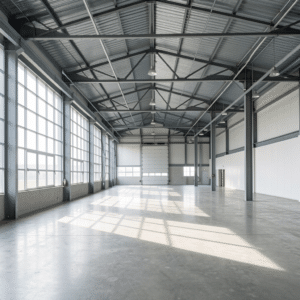
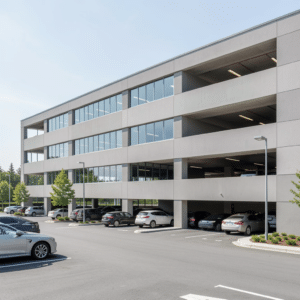
Type II (Noncombustible, Reduced Protection) includes Type II-A (1-hour structural frame) and Type II-B (0-hour structural frame). Most mid-rise commercial buildings, warehouses, retail centers, and office buildings in Texas fall into Type II. Type II-B is common for single-story steel warehouses where the code permits unprotected steel.
Type III (Exterior Noncombustible) requires noncombustible exterior walls but allows combustible interior construction. Type III-A requires 1-hour structural frame protection; Type III-B requires 0 hours.
Type IV was expanded in the IBC 2021 edition to include four subdivisions (IV-A, IV-B, IV-C, and IV-HT) to accommodate mass timber construction. Type IV-HT is the traditional heavy timber classification. The new IV-A, IV-B, and IV-C types carry fire-resistance ratings of 3, 2, and 2 hours respectively for the structural frame, with varying requirements for mass timber exposure.
Type V (Any Materials) allows any construction material. Type V-A requires 1-hour structural frame protection; Type V-B requires 0 hours.
IBC Table 601: Required Fire-Resistance Ratings
IBC Table 601 is the single most referenced table in fireproofing specification. It maps construction type to required fire-resistance ratings (in hours) for each building element. Here is a simplified version covering the construction types most common in commercial steel projects:
| Building Element | Type I-A | Type I-B | Type II-A | Type II-B | Type V-A | Type V-B |
|---|---|---|---|---|---|---|
| Structural frame | 3 | 2 | 1 | 0 | 1 | 0 |
| Bearing walls (exterior) | 3 | 2 | 1 | 0 | 1 | 0 |
| Bearing walls (interior) | 3 | 2 | 1 | 0 | 1 | 0 |
| Floor construction | 2 | 2 | 1 | 0 | 1 | 0 |
| Roof construction | 1.5 | 1 | 1 | 0 | 1 | 0 |
A “0” in the table means no fire-resistance rating is required for that element in that construction type. This is why single-story Type II-B steel warehouses often have unprotected structural steel: the code does not require it. But the moment the building use, height, or occupancy triggers a higher construction type, fire protection becomes mandatory.
Important note on bearing walls: Exterior bearing walls must also comply with IBC Table 602 based on fire separation distance, which may require higher ratings than those shown in Table 601 alone. The required rating for an exterior bearing wall is the greater of the Table 601 value and the Table 602 value for the applicable fire separation distance and occupancy group. Always reference the full IBC Table 601 including all footnotes for project-specific requirements.
For our visual guide to IBC Table 601 fire resistance ratings with practical examples for each construction type, we will be publishing a dedicated reference article in this cluster. The full IBC 2021 Table 601 includes Type III, Type IV (A, B, C, HT), and additional footnotes that allow rating reductions under specific conditions, such as roof members more than 20 feet above the floor.
Fire Testing Standards: ASTM E119, UL 263, and What They Mean
Fire-resistance ratings are not theoretical estimates. They are determined by subjecting loaded structural assemblies to a standardized fire in a test furnace and measuring how long the assembly maintains structural integrity and temperature limits.
ASTM E119 (Standard Test Methods for Fire Tests of Building Construction and Materials) is the primary North American fire resistance test standard. The test furnace follows a prescribed time-temperature curve that reaches approximately 1,000 degrees Fahrenheit at 5 minutes, 1,700 degrees Fahrenheit at 1 hour, 1,850 degrees Fahrenheit at 2 hours, and 2,000 degrees Fahrenheit at 4 hours. Research from the NIST Fire Research Division confirms that structural steel retains only about 50 percent of its yield strength at this critical threshold.
UL 263 (Standard for Fire Tests of Building Construction and Materials) is functionally equivalent to ASTM E119. UL 263 is the standard referenced in UL Fire Resistance Directory listings, which is where all approved fire-resistance-rated assemblies are documented. When you see a UL Design Assembly number (like D779 or X501), the assembly was tested per UL 263.
ASTM E84 (UL 723) measures surface burning characteristics (flame spread index and smoke development index) for interior finishes. This is NOT a fire-resistance test. Confusing ASTM E84 with ASTM E119 is one of the most common specification errors I encounter. ASTM E84 determines whether an interior finish meets IBC Chapter 8 requirements. ASTM E119 determines whether a structural assembly achieves its required fire-resistance rating. They test entirely different things. For a detailed breakdown of the differences between ASTM E119 and UL 263 testing standards, we will be publishing a dedicated comparison article.
UL 1709 is the rapid-temperature-rise (hydrocarbon fire) test, reaching 2,000 degrees Fahrenheit within 5 minutes. This applies to petrochemical and industrial facilities, not standard commercial construction. If your project is a refinery, chemical plant, or offshore platform, UL 1709 applies. For standard commercial buildings, UL 263 (ASTM E119) is the relevant standard.
How Fire Ratings Translate to Fireproofing Specifications
Understanding the code is one thing. Translating “IBC requires 2-hour column protection” into an actual fireproofing specification is where projects succeed or fail.
The bridge between the code requirement and the product specification is the UL Fire Resistance Directory. Every fire-resistance-rated assembly listed in the directory has a unique Design Assembly number that specifies the exact products, thicknesses, steel sizes, primer requirements, and restrained or unrestrained conditions under which the assembly achieved its rating.
The correct specification process follows a clear sequence. First, determine the construction type from IBC Table 601 and identify the required fire-resistance rating. Second, select the fireproofing system (SFRM or intumescent) based on whether the steel is concealed or exposed. Third, reference the specific UL Design Assembly number that matches the steel section, product, and rating. Fourth, specify the primer, topcoat (for intumescent), and substrate preparation requirements from the assembly listing.
Specifying a generic “2-hour fireproofing” without referencing a UL Design Assembly number is the single most common specification failure I see. It leaves the product selection, thickness determination, and primer compatibility to the applicator or GC, creating inspection risk and potential change orders when the inspector requires documentation that does not exist.
The steel section factor (W/D ratio: weight per lineal foot divided by fire-exposed perimeter) determines the required thickness for any given product and rating. Smaller, lighter steel sections require more fireproofing than larger, heavier sections because they heat up faster. This is why HSS columns are consistently more expensive to fireproof than wide-flange members at the same fire rating.
Fireproofing System Options Under Code
The IBC does not mandate a specific fireproofing system. It mandates a fire-resistance rating. The design team selects the system that achieves that rating based on project requirements.
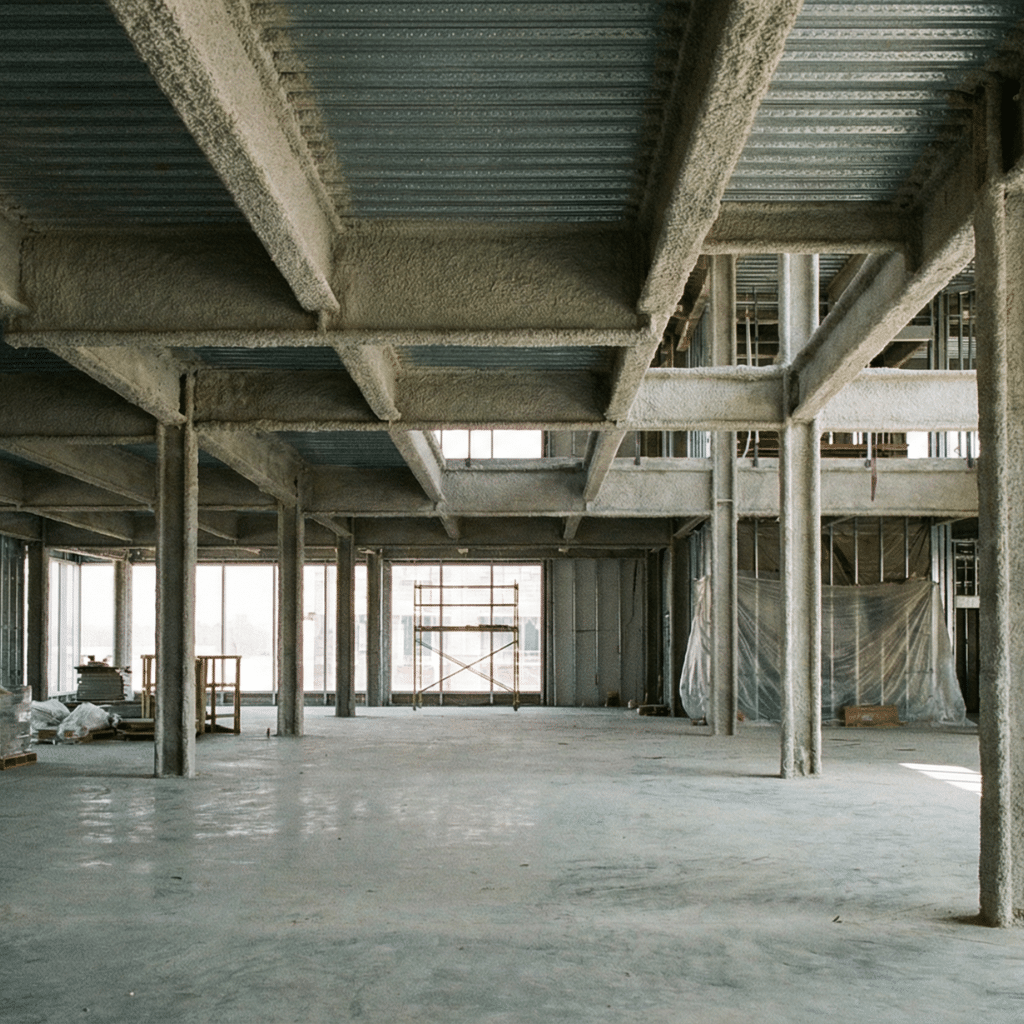
SFRM (Spray-Applied Fire-Resistive Material) is cementitious or calcium silicate fireproofing applied in inches. It provides a rough, textured finish and is the standard for concealed steel (behind walls, above ceilings, inside shafts). SFRM is faster to apply and lower cost than intumescent for large coverage areas. Installed cost ranges from $1.50 to $5.00 per square foot.
IFRM (Intumescent Fire-Resistive Material) is a reactive coating applied in mils that expands under heat to form an insulating char. It provides a smooth, paint-like finish suitable for Architecturally Exposed Structural Steel (AESS). Installed cost ranges from $2 to $12 per square foot depending on fire rating, steel section type, and scope size.
Both systems achieve fire-resistance ratings of 1 to 4 hours per UL 263. The decision between them is driven by visibility (will the steel be seen?), aesthetics, environment, and budget. Many projects use both: intumescent on exposed lobby columns and AESS connections, SFRM on all concealed steel above ceilings and inside stairwells.
Special Inspections: The IBC Chapter 17 Requirement
Special inspections for fireproofing are a code requirement that building owners frequently overlook during project planning. IBC Chapter 17 mandates third-party inspection of fire-resistive material installations, and the responsibility falls on the building owner, not the contractor.
In the IBC 2021 edition, Section 1705.15 governs special inspections for Sprayed Fire-Resistant Materials (SFRM), and Section 1705.16 covers Mastic and Intumescent Fire-Resistant Coatings (IFRM). Note that these section numbers shifted from the IBC 2018 edition (where SFRM was 1705.14 and IFRM was 1705.15) due to a new seismic testing section inserted at 1705.14 in the 2021 update. If your jurisdiction is still on the 2018 IBC, reference the earlier section numbers.
The special inspector must verify five specific items for SFRM installations: condition of substrates, thickness of application, density, bond strength (minimum 150 psf per ASTM E 736), and condition of the finished application. Thickness testing follows ASTM E 605, requiring not less than 4 measurements per 1,000 square feet for assemblies and not less than 25 percent of structural members per floor.
Per IBC Section 1704.2, the building owner or owner’s authorized agent must employ an approved agency to perform special inspections. The contractor is explicitly excluded from hiring the special inspector to maintain independence. This is the requirement that catches building owners off guard: they must budget for and schedule an independent inspection agency, and that agency reports to the owner, not to the GC or the fireproofing subcontractor.
For our dedicated guide to special inspections for spray fireproofing under IBC Chapter 17, including inspection checklists and scheduling guidance, we will be publishing a detailed cluster article.
Common Code Compliance Failures on Commercial Projects
In 20 years of commercial fireproofing across Texas, Kansas, and Oklahoma, I have seen the same fireproofing code compliance failures repeat. These are not obscure code technicalities. They are planning and communication breakdowns that cost real money to fix.
Wrong UL assembly cited in submittals. The architect specifies a generic fire rating. The GC passes a submittal package to the inspector that references the wrong UL Design Assembly for the actual steel sections on the project. The inspector rejects the submittal, and the project loses a week while the correct assembly is identified and documented. Always verify the UL Design Assembly number matches the actual steel sections, product, and rating before submitting.
DFT short of specification. For intumescent projects, the applicator builds dry film thickness to what looks right rather than measuring to the specification. The special inspector measures thickness per ASTM E 605 and finds areas below the required DFT. The fix is reapplication, which means another mobilization, more material, and schedule disruption. Continuous DFT measurement during application prevents this entirely.
Primer substituted without checking the listing. A GC or steel fabricator applies a shop primer that is not listed in the UL Design Assembly for the specified fireproofing product. The special inspector catches it. The entire primer must be removed and reapplied with the listed primer before fireproofing can begin. This is one of the most expensive field mistakes because it affects every piece of steel on the project.
Substrate contamination ignored. Oil, grease, loose mill scale, or dust on the steel surface prevents proper adhesion. The fireproofing may look fine initially but fails bond strength testing during special inspection. Proper surface preparation per the UL assembly listing is not optional.
Special inspection not scheduled or budgeted. The building owner does not know they are responsible for hiring the special inspector until the GC asks for inspection sign-off. The project stalls while an inspection agency is engaged, scheduled, and brought up to speed on the project specifications. Budget for special inspection during preconstruction, not during the fireproofing phase.
Code Compliance in Texas, Kansas, and Oklahoma
“The IBC requires X” is an oversimplification that creates real problems on commercial projects. Fireproofing code compliance is not a national standard with uniform enforcement. The IBC is a model code, and what your project must actually comply with depends on which IBC edition your local jurisdiction has adopted and what local amendments apply.
Texas does not have a mandatory statewide building code with uniform enforcement. The state sets a statutory minimum floor (currently the 2012 IBC per H.B. 738), but cities adopt and enforce later editions independently. As of early 2026, Houston, Dallas, Fort Worth, and El Paso enforce the 2021 IBC. Austin adopted the 2024 IBC effective July 2025, and San Antonio adopted the 2024 IBC effective May 2025. A contractor working across Texas cities must track which edition each jurisdiction enforces because the differences matter: the IBC 2021 edition restructured Type IV construction types and shifted special inspection section numbers from the 2018 edition.
Kansas does not have a mandatory statewide building code. Code adoption is entirely local. Wichita and Sedgwick County adopted the 2024 IBC in October 2024 with significant local amendments, while other Kansas cities remain on the 2018 IBC. The Kansas State Fire Marshal enforces fire codes for state-owned buildings only.
Oklahoma has the simplest compliance landscape of the three states. The Oklahoma Uniform Building Code Commission (OUBCC) adopted the 2018 IBC statewide, effective September 2021. All Oklahoma jurisdictions must enforce at least these minimums. Oklahoma City and Tulsa comply with the statewide 2018 IBC, with local amendments for flood hazards, accessibility, and storm shelters. The OUBCC is currently reviewing the 2021 and 2024 IBC editions, with code change proposals accepted through May 2026.
For Texas-specific fire code requirements for commercial construction, including city-by-city adoption details and local amendment summaries, we will be publishing a dedicated regional guide.
Related Reading
Explore more fireproofing code compliance topics from Bahl Fireproofing:
- Want to understand the inspection process step by step? See the fireproofing inspection process: a complete guide for building owners.
- Choosing between cementitious and intumescent systems? Our guide to choosing the right commercial fireproofing system covers all system types side by side.
Frequently Asked Questions
What Fire Rating Is Required for Commercial Steel Buildings?
Fire-resistance ratings for commercial steel buildings are determined by IBC Table 601 based on construction type. Type I-A buildings require 3-hour structural frame protection, while Type II-B and Type V-B buildings may require 0 hours. The specific rating depends on construction type, building height, occupancy group, and whether the building has an automatic sprinkler system. Always verify the required rating with the project’s registered design professional and the local authority having jurisdiction.
Do All Commercial Buildings Require Fireproofing?
No. Type II-B and Type V-B construction types require 0-hour fire-resistance ratings for most structural elements, meaning no fireproofing is mandatory. Many single-story steel warehouses in Texas fall into Type II-B. However, if building height, occupancy type, or occupant load triggers a higher construction type classification, fireproofing becomes required. The determination is project-specific based on IBC Chapter 5 (General Building Heights and Areas).
What Is IBC Table 601?
IBC Table 601 is the code table that maps construction type (Type I-A through Type V-B) to required fire-resistance ratings for each building element: structural frame, bearing walls, floor construction, and roof construction. Ratings range from 0 hours (no protection required) to 3 hours (maximum protection). It is the starting point for every commercial fireproofing specification.
What Is the Difference Between ASTM E119 and ASTM E84?
ASTM E119 tests fire resistance of structural assemblies (how long a loaded assembly maintains integrity under fire). ASTM E84 tests surface burning characteristics of interior finishes (flame spread and smoke development). They measure entirely different things. A structural column rated for 2 hours per ASTM E119 has been tested for structural fire endurance. A wall finish rated Class A per ASTM E84 has been tested for flame spread. Confusing these two standards is one of the most common specification errors in commercial construction.
Who Is Responsible for Fireproofing Special Inspections?
The building owner or owner’s authorized agent is responsible for engaging and paying for special inspections per IBC Section 1704.2. The contractor is explicitly excluded from hiring the special inspector to maintain independence. The registered design professional prepares a Statement of Special Inspections, and the owner employs an approved inspection agency to verify product compliance, thickness, density, bond strength, and application conditions.
Can Fireproofing Requirements Be Reduced With Sprinklers?
Automatic sprinkler systems can enable construction type trade-offs under IBC Section 504 (Allowable Building Heights and Stories) and Section 506 (Allowable Floor Area), which may indirectly reduce the construction type classification and therefore the fire-resistance rating required. However, sprinklers do not directly reduce the fire-resistance rating specified in Table 601 for a given construction type. The sprinkler benefit is in qualifying for a less restrictive construction type, not in reducing the rating within a type. Consult the project architect for the specific trade-off analysis.
What Happens if Fireproofing Fails Inspection?
Failed inspection triggers corrective action: the deficient areas must be repaired or reapplied to meet the specification, then re-inspected. For thickness deficiencies, additional material is applied. For bond strength failures, the affected fireproofing is removed and reapplied after proper substrate preparation. Re-inspection adds cost and schedule time. In our experience, re-inspection delays range from several days to two weeks depending on the scope of corrective work. The most cost-effective approach is always getting it right the first time.
How Do I Know Which Construction Type My Building Is?
Construction type is determined during the design phase by the architect based on the building’s intended use (occupancy group), height (number of stories), and floor area, cross-referenced against IBC Chapter 5. The construction type appears on the building permit documents, the approved plans, and the project specifications. If you are a building owner or GC and do not know the construction type, ask the architect of record. Every downstream fireproofing decision depends on this classification.
Key Takeaways
Fire-resistance ratings for structural steel are determined by IBC Table 601 based on construction type, with ratings ranging from 0 hours (Type II-B, no protection required) to 3 hours (Type I-A, maximum protection).
ASTM E119 and UL 263 are the testing standards that determine fire-resistance ratings. The furnace curve reaches 1,000 degrees Fahrenheit at just 5 minutes, and unprotected steel can reach critical failure temperature within 15 to 20 minutes. Do not confuse ASTM E119 (structural fire resistance) with ASTM E84 (surface flame spread).
Every fireproofing specification must reference a specific UL Design Assembly number that matches the product, steel section, and required rating. Generic specifications without assembly documentation create inspection failures.
Special inspections under IBC Section 1705.15 (SFRM) and 1705.16 (IFRM) are mandatory. The building owner is responsible for engaging the inspection agency, not the contractor. Budget for this during preconstruction.
Texas, Kansas, and Oklahoma each adopt the IBC differently. Texas cities adopt independently (Houston and Dallas on 2021 IBC; Austin and San Antonio on 2024 IBC). Kansas has no statewide code (Wichita on 2024 IBC). Oklahoma enforces 2018 IBC statewide. Always verify the specific edition enforced by your local jurisdiction.
The five most common fireproofing code compliance failures are wrong UL assembly in submittals, DFT short of specification, primer substitution, substrate contamination, and unplanned special inspections. All five are preventable through proper preconstruction planning.
Whether you are planning a new commercial construction project, navigating a code upgrade for an existing building, or trying to understand why your fireproofing specification needs a UL Design Assembly number, fireproofing code compliance starts with understanding what the IBC requires and how those requirements translate to products, thicknesses, and inspections. With over 20 years of commercial fireproofing code compliance experience across Texas, Kansas, and Oklahoma, Bahl Fireproofing helps building owners, GCs, and design teams get the specification right the first time. Contact Bahl Fireproofing today at 512-387-2111 or email ross@bahlfireproofing.com to discuss your project’s code requirements or request a detailed estimate.
This article provides general educational information about IBC fire-resistance requirements for commercial buildings. It is not a substitute for project-specific engineering, design, or code analysis. IBC section numbers, table data, and construction type requirements referenced in this article are based on the IBC 2021 edition unless otherwise noted. Local jurisdictions adopt different IBC editions and may enact amendments that modify requirements. Always verify current code adoption and local amendments with the authority having jurisdiction (AHJ) for your project location. Fire-resistance ratings, testing standards, and special inspection requirements vary by jurisdiction. Consult a licensed professional engineer, architect, or code official for project-specific requirements. Bahl Fireproofing is a commercial fireproofing and insulation contractor, not an engineering or design firm.