When you are specifying fire protection for structural steel in 2026, the choice between intumescent vs cementitious fireproofing affects everything: how your building looks, what it costs, whether it passes inspection, and ultimately whether occupants can evacuate safely in a fire.
Get this decision wrong and you face failed inspections, costly rework, and potential liability exposure. Get it right and you have a building that meets code, serves its occupants well, and performs when it matters most.
I have spent over 20 years applying both systems across commercial buildings, schools, hospitals, and industrial facilities in Texas, Kansas, and Oklahoma. This guide represents what I have learned about when to use each system, how they compare, and why final decisions must always involve a licensed professional working with current codes, UL assemblies, and manufacturer data.
Whether you are an architect designing a new hospital wing, an engineer specifying a school renovation, or a facility manager planning a retrofit, this guide gives you the foundation to make informed decisions about intumescent vs cementitious fireproofing for your structural steel.
TLDR: Key Takeaways on Intumescent vs Cementitious Fireproofing
- Intumescent fireproofing is typically the better choice for architecturally exposed structural steel (AESS) in lobbies, atriums, schools, hospitals, and open-ceiling designs where appearance matters.
- Cementitious fireproofing (SFRM) is usually more cost-effective for concealed steel in large commercial and industrial buildings where aesthetics are not a priority.
- Intumescent coatings expand 10 to 50 times their original thickness when exposed to heat, forming a protective insulating char.
- Cementitious SFRM provides immediate thick insulation but has a rough, textured finish that most owners want hidden.
- Both systems achieve fire ratings from 30 minutes to 4 hours when specified per UL-listed assemblies.
- Critical difference: Intumescent thicknesses cannot be safely extrapolated beyond tested designs; SFRM allows some extrapolation within UL rules.
- Final system selection and thickness must always be determined by a licensed professional using current IBC editions, ASTM E119 test data, and manufacturer documentation.
What Is Intumescent Fireproofing?
Intumescent fireproofing is a thin-film coating applied to structural steel that reacts chemically when exposed to fire. The word “intumescent” comes from Latin meaning “to swell,” which describes exactly how these coatings work.
At normal temperatures, intumescent coatings look and feel like regular paint. They are typically applied at thicknesses between 10 and 60 mils (roughly 0.25 to 1.5 mm), depending on the required fire rating and the specific steel member being protected. When temperatures reach approximately 200 to 250 degrees Celsius (about 400 to 480 degrees Fahrenheit), a chemical reaction begins.
The coating expands dramatically, swelling to approximately 10 to 50 times its original dry film thickness depending on the formulation. This expansion creates a low-density, insulating char layer that acts as a thermal barrier between the fire and the steel. The char slows heat transfer, giving the steel more time before it reaches critical failure temperature (typically around 1,000 to 1,100 degrees Fahrenheit for structural steel under load).
Types of Intumescent Fire-Resistive Materials (IFRM)
Manufacturers offer three main categories of intumescent coatings, each suited for different conditions:
Water-based intumescent coatings are the most common choice for interior commercial applications. They have low volatile organic compound (VOC) emissions, minimal odor during application, and produce a smooth, aesthetically pleasing finish. Hilti’s Fire Finish product line and similar products are tested to ASTM E119/UL 263 standards and certified for up to 4-hour fire ratings. Water-based products work best in conditioned interior environments and are the preferred choice for schools, hospitals, and occupied buildings where indoor air quality matters.
Solvent-based intumescent coatings dry faster and perform better in humid conditions or temperature extremes. They are often used for semi-exposed applications where the steel may encounter moisture during construction or service. Solvent-based products have higher VOC content and stronger odor, making them less suitable for occupied spaces during application.
Epoxy-based intumescent coatings are the most durable option, originally developed for offshore oil platforms and harsh industrial environments. Products like Carboline’s A/D Firefilm III provide excellent resistance to impact, chemicals, and corrosion. Epoxy systems typically cost more and require thicker applications but deliver superior durability in demanding conditions.
Where Intumescent Fireproofing Is Commonly Used
You will find intumescent fireproofing solutions specified for:
- Architecturally exposed structural steel (AESS) in building lobbies, atriums, and public spaces
- School gymnasiums, cafeterias, and common areas with open ceilings
- Hospital corridors, waiting rooms, and patient areas
- Modern office buildings featuring exposed structure as a design element
- Retail spaces with open-ceiling concepts
- Retrofit projects in occupied buildings where clean, low-odor application is essential
The thin profile and smooth finish make intumescent coatings the go-to choice whenever the steel will be visible in the finished building.
What Is Cementitious (SFRM) Fireproofing?
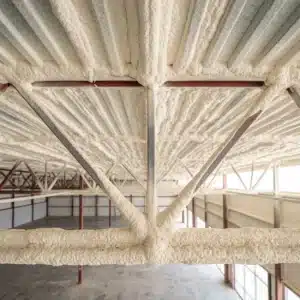
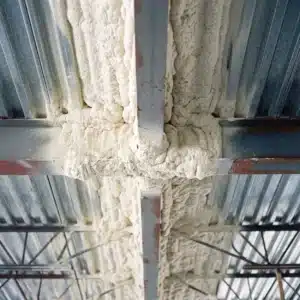
Cementitious fireproofing, formally called spray-applied fire-resistive material (SFRM), is the traditional workhorse of commercial fire protection. It has been protecting structural steel in buildings for decades and remains the most widely used method for concealed applications.
SFRM is typically made from gypsum or Portland cement mixed with lightweight aggregates such as vermiculite, perlite, or mineral fiber. The material arrives on site as dry powder, gets mixed with water, and is spray-applied directly to steel beams, columns, and metal decking.
Unlike intumescent coatings that react chemically to heat, cementitious fireproofing provides immediate thermal insulation through its thick, porous structure. The material simply slows heat transfer from a fire to the steel without needing to expand or change chemically. SFRM typically gets applied at thicknesses ranging from 3/8 inch to 3 inches (10 to 76 mm), depending on the required fire rating and the size of the steel being protected.
Density Categories for SFRM
Cementitious fireproofing comes in three density categories, each suited for different environments and performance requirements:
Low-density SFRM (15 to 21 pounds per cubic foot) uses gypsum as the primary binder. These products provide higher yields and faster coverage rates, making them economical for large projects. However, low-density SFRM can flake, dust, or deteriorate if disturbed. It should only be used in concealed spaces behind ceilings and walls where it will not be contacted.
Medium-density SFRM (22 to 39 pounds per cubic foot) typically uses a cement or cement-gypsum blend as the binder. These products are more stable than low-density materials and can handle air movement and minor contact. Medium-density SFRM is appropriate for many commercial applications where the fireproofing will be enclosed but may occasionally be accessed for maintenance.
High-density SFRM (40+ pounds per cubic foot) uses Portland cement as the binder, producing the hardest and most durable product. High-density materials resist moisture, impact damage, and temperature extremes. You will find them specified for parking garages, mechanical rooms, industrial facilities, and other demanding environments.
Where Cementitious Fireproofing Is Commonly Used
Commercial fireproofing services using SFRM are typically specified for:
- Large office buildings with dropped ceilings where steel is concealed
- Warehouses, distribution centers, and industrial facilities
- Manufacturing plants where aesthetics are not a priority
- Steel framing behind drywall and architectural finishes
- Metal deck floor and roof assemblies
- Projects where budget across large square footages is a primary driver
For most commercial construction where the steel will be hidden, cementitious SFRM remains the default choice because of its lower installed cost.
Intumescent vs Cementitious Fireproofing: Side-by-Side Comparison
Understanding how intumescent vs cementitious fireproofing compare across key factors helps you make the right choice for your specific project conditions.
| Factor | Intumescent (IFRM) | Cementitious (SFRM) |
|---|---|---|
| Appearance | Smooth, paint-like finish; can be topcoated in any color | Rough, textured surface; difficult to finish attractively |
| Typical thickness | 10 to 60 mils (0.25 to 1.5 mm) | 0.375 to 3 inches (10 to 76 mm) |
| Weight added | Approximately 5 to 10 lbs per square foot | Approximately 15 to 40+ lbs per square foot |
| Fire rating range | 30 minutes to 4 hours (per tested assemblies) | 30 minutes to 4 hours (per tested assemblies) |
| Installed cost (typical) | $4 to $12 per square foot | $2 to $5 per square foot |
| Durability | Good to excellent depending on type; resists cracking | Varies by density; low-density products can dust and flake |
| Corrosion protection | Good chemical resistance; does not trap moisture | Can absorb moisture and promote corrosion |
| Exposed steel suitability | Excellent | Poor (appearance issues) |
| Concealed steel suitability | Works well but may be overkill | Excellent and cost-effective |
| Shop application | Well-suited; steel can arrive pre-coated | Less practical; products damage in transport |
| Thickness extrapolation | Not permitted per UL policy | Permitted within certain UL guidelines |
Key Differences in Practice
The most obvious difference is appearance. Intumescent coatings produce a smooth, uniform finish that accepts topcoats in any color. Cementitious SFRM has a rough, cottage-cheese texture that most building owners want concealed behind architectural finishes.
Thickness represents another significant difference. Intumescent coatings are measured in mils (thousandths of an inch), while SFRM is measured in fractions of inches. A two-hour intumescent assembly might require 40 to 60 mils of coating. A two-hour SFRM assembly might require 1.5 to 2 inches of material. This affects column and beam dimensions in tight spaces.
Weight matters for structural calculations. Intumescent coatings add minimal weight to the structure. SFRM, especially at higher densities, adds substantial weight that the structural engineer may need to account for.
Application method differs as well. Intumescent coatings can be shop-applied, meaning steel arrives at the job site already fireproofed. This improves quality control and shortens the construction schedule. SFRM is almost always field-applied because the material does not transport well once installed.
When Intumescent Fireproofing Is Usually the Better Fit
Certain project conditions strongly favor intumescent coatings in the intumescent vs cementitious fireproofing decision:
Architecturally Exposed Structural Steel (AESS)
When the steel is part of the architectural design, intumescent is almost always the right choice. Modern buildings frequently feature exposed structure in lobbies, atriums, and gathering spaces. The thin, smooth finish of intumescent coatings preserves the steel’s geometry and allows it to be painted in any color.
Example scenario: A new corporate headquarters features a dramatic five-story atrium with exposed steel columns and cross-bracing as design elements. The architect specified water-based intumescent fireproofing to achieve the required two-hour rating while allowing the steel to be finished in the company’s brand colors. The smooth finish and custom topcoat would be impossible to achieve with cementitious SFRM.
Schools and Educational Facilities
Schools have specific requirements that favor intumescent coatings. Open-ceiling designs are common in modern educational spaces for both aesthetic and acoustic reasons. Gymnasiums, cafeterias, libraries, and corridors often feature exposed structure.
Beyond appearance, schools need products with low VOC emissions that support healthy indoor air quality. Water-based intumescent coatings meet these requirements. The cleaner application process also means less disruption during summer renovations when staff may still be present.
Healthcare Facilities
Hospitals and healthcare buildings face strict requirements for cleanliness, infection control, and indoor air quality. Cementitious SFRM can dust and shed particles over time, which is problematic in patient care areas, surgical suites, and sterile environments.
Intumescent fireproofing provides a sealed, cleanable surface that resists dusting. Low-VOC water-based products are safer to apply in or near patient care areas. For renovations in occupied hospitals, the low-odor application minimizes disruption to patients and staff.
Example scenario: A regional hospital is constructing a new patient tower with exposed steel structure in the main lobby and connector corridors. The design team specified water-based intumescent fireproofing because it produces no harmful odors during application, leaves a surface that can be easily cleaned, and will not shed particles into patient care areas during the building’s service life.
Retrofit Projects in Occupied Buildings
Renovation work in occupied buildings creates unique challenges that favor intumescent coatings. SFRM requires mixing water and powder on site, which creates dust and mess. The application process produces overspray that can contaminate adjacent finished spaces.
Intumescent coatings apply more like paint. The process is cleaner and easier to contain. Low-VOC, low-odor products allow work to proceed without evacuating the building or disrupting operations. For renovation projects in active offices, schools, or hospitals, this can be the deciding factor.
When Cementitious Fireproofing Is Usually the Better Fit
Despite the advantages of intumescent coatings, cementitious SFRM remains the standard choice for many project types:
Large Commercial Buildings with Concealed Steel
In typical office buildings, retail centers, and commercial structures, the structural steel is hidden behind dropped ceilings and wall finishes. Nobody sees the fireproofing, so appearance does not matter.
SFRM covers large areas quickly and economically. A skilled crew can apply thousands of square feet per day. When fireproofing a 200,000 square foot office building, the cost difference between SFRM and intumescent can reach hundreds of thousands of dollars.
Example scenario: A developer is constructing a new 15-story office tower with steel framing. All structural steel will be concealed behind architectural finishes. The project team specified medium-density cementitious SFRM to achieve the required two-hour fire rating. The rough texture is invisible behind the ceilings, and the cost savings allowed budget allocation to other building systems.
Industrial and Warehouse Buildings
Industrial facilities typically prioritize function over form. Warehouses, manufacturing plants, and distribution centers often have exposed steel, but appearance is not a concern. The rough texture of SFRM is acceptable in these work environments.
High-density cementitious products work well in industrial settings because they resist bumps, scrapes, and environmental exposure. They also handle temperature variations and humidity better than low-density products.
Projects Requiring Very High Fire Ratings
When fire ratings of three or four hours are required, SFRM is often the practical choice for concealed applications. Achieving very high fire ratings with intumescent coatings requires thick applications that become expensive.
For concealed steel requiring three-hour or four-hour ratings, SFRM typically provides the most cost-effective solution. The thickness can be increased without aesthetic concerns.
Cost, Scheduling, and Practical Considerations in 2026
Understanding real-world costs of intumescent vs cementitious fireproofing requires looking beyond material price per square foot.
Installed Cost Ranges
Current market pricing for typical commercial projects shows these approximate ranges:
| System | Installed Cost (Typical) |
|---|---|
| Cementitious SFRM (low/medium density) | $2 to $7 per square foot |
| Cementitious SFRM (high density) | $5 to $10 per square foot |
| Intumescent (water-based) | $4 to $12 per square foot |
| Intumescent (solvent-based) | $6 to $14 per square foot |
| Intumescent (epoxy) | $10 to $25 per square foot |
These ranges are approximate and vary significantly based on fire rating requirements, steel complexity, access conditions, project size, geographic region, and contractor availability. Only a project-specific bid from a qualified contractor, based on stamped drawings and specifications, can determine actual pricing.
Factors That Drive Cost
Several factors push costs toward the high or low end of these ranges:
Fire rating requirements directly affect thickness and labor. Higher ratings require more material and more coats, especially for intumescent systems.
Steel size and complexity influences application time. Small, intricate steel sections require more care than large, simple shapes. HSS (hollow structural section) columns often require significantly higher intumescent DFT than wide-flange columns of similar size.
Access conditions add time and equipment costs. Scaffolding, lifts, and difficult access increase labor expense.
Surface preparation varies by existing conditions. Existing coatings, rust, or contamination must be addressed before fireproofing, adding cost.
Project size creates economies of scale. Larger projects typically achieve lower per-square-foot costs.
Occupied building constraints increase costs when working around tenants, during nights and weekends, or in sensitive environments like hospitals.
Our team at Bahl Fireproofing works with licensed architects and engineers to provide accurate estimates based on specific project conditions. We review steel schedules and site conditions to identify potential cost factors before bidding.
Scheduling Considerations
Shop-applied intumescent coatings offer scheduling advantages. Steel can be coated in a controlled environment before delivery to the site, reducing on-site time and weather dependencies. This approach is increasingly popular for projects with tight schedules.
Field-applied systems require coordination with other trades. SFRM must dry before adjacent work can proceed, and water from mixing can interfere with other activities. Intumescent coatings generally create less mess and disruption on active job sites.
Code Compliance, UL Assemblies, and Why You Cannot Wing It
The International Building Code (IBC) establishes fire-resistance requirements for structural members based on building type, height, area, and occupancy. Current IBC editions reference ASTM E119 and UL 263 as the standard test methods for fire resistance.
How Fire Ratings Work
Fire-resistance ratings indicate how long an assembly can resist fire exposure under standardized test conditions. A two-hour rating means the assembly maintained structural integrity and limited temperature rise for at least two hours during controlled furnace testing.
Both intumescent and cementitious fireproofing are tested as part of complete assemblies, not in isolation. The test includes the steel member, the fireproofing material, and sometimes other components. The tested assembly defines the specific thickness required for each steel section size and configuration.
This is why you cannot simply specify “two-hour fireproofing” without identifying a specific tested assembly from the UL Fire Resistance Directory. The thickness requirements vary by steel size, orientation (beam vs. column vs. HSS section), and the specific product.
The Critical Difference: Extrapolation
Here is where intumescent vs cementitious fireproofing differs in a critically important way.
For cementitious SFRM, UL allows some extrapolation of thicknesses for steel sections not specifically listed in the design guides. Established formulas allow calculating SFRM thickness for steel sizes between those specifically tested.
For intumescent coatings, extrapolation is explicitly prohibited. The UL BXUV guide states that “extrapolation of member size and/or material thickness shown in the individual designs has not been investigated and would be considered to void the existing certified assembly.”
This prohibition exists because the intumescent reaction is complex. If the coating is too thin, it will not provide adequate protection. If the coating is too thick, the expanded char can become too heavy to remain adhered to the steel, potentially falling off and leaving the structure exposed.
If your project includes steel sections not covered by existing UL-listed intumescent designs, you have limited options: select a different steel section that is covered, work with the manufacturer to obtain additional test data, or use cementitious SFRM for those specific members.
This critical point means specifying intumescent fireproofing requires careful coordination between the structural engineer, architect, and fireproofing contractor early in the design process.
NFPA and Other Standards
The National Fire Protection Association (NFPA) publishes additional standards that may apply to your project. Always verify which codes and standards apply to your specific project and jurisdiction, as local amendments can modify base code requirements.
Installation Considerations and Common Mistakes
Proper installation is critical for both intumescent and cementitious fireproofing. Poor application compromises fire protection and leads to failed inspections.
Surface Preparation Differences
Steel must be properly prepared before fireproofing application. For intumescent coatings, surface preparation is especially critical because the product must bond directly to the steel. Most intumescent systems require a compatible primer. Using the wrong primer or skipping this step can cause adhesion failure during a fire.
SFRM also requires clean steel but is generally more tolerant of surface conditions. However, mill scale, rust, oil, and existing coatings must still be addressed per manufacturer requirements.
Achieving Required Thickness
Cementitious SFRM thickness is measured with pins or gauges during and after application. The rough texture makes measurement straightforward.
Intumescent coatings require careful dry film thickness (DFT) measurement using calibrated electronic gauges. The required DFT is specified in mils for each steel section per the UL design. Under-application leaves the steel underprotected. Over-application can cause adhesion problems and char weight issues during a fire.
Multiple thin coats are typically required for intumescent coatings, with each coat allowed to dry before the next is applied. Maximum thickness per coat is specified by the manufacturer and must be followed.
Common Problems Inspectors Flag
Issues that frequently cause inspection failures include:
- Insufficient thickness, especially at edges, corners, and connection areas
- Intumescent coatings applied without compatible primer
- Using interior products in semi-exposed locations
- Fireproofing damaged by other trades during construction
- SFRM exposed to water before fully cured
- Missing coverage at penetrations, connections, or difficult access areas
Working in Schools and Hospitals
Fireproofing work in occupied schools and hospitals requires extra planning. Low-VOC, low-odor products minimize disruption. Work may need to be scheduled during breaks, weekends, or nights. Containment and ventilation may be required. Coordination with facility operations is essential.
How Architects, GCs, and Owners Should Think About the Decision
Choosing between intumescent vs cementitious fireproofing involves answering several key questions:
Is the steel exposed or concealed? If visible in the finished building, intumescent is usually the right choice. If hidden, either system can work, but SFRM is typically more economical.
What fire rating is required? Check your code analysis for required ratings. Both systems achieve 30 minutes to 4 hours when properly specified.
What are the appearance and cleanliness expectations? Schools, hospitals, clean rooms, and similar environments may favor intumescent for clean application and non-dusting surface.
Is this new construction or retrofit? Retrofit work in occupied buildings often favors intumescent because of cleaner application.
Is the building occupied during work? Occupied buildings may require low-VOC, low-odor products and off-hours work.
Working With Your Team
The best results come from early collaboration. Involve the fireproofing contractor during design development. We can review steel schedules, identify potential issues with UL listings, and provide realistic cost information before the project goes out to bid.
At Bahl Fireproofing, we work with design teams and licensed professionals on projects throughout Texas, Oklahoma, Kansas, Nebraska, Minnesota, and Wisconsin. We help implement the chosen system correctly, ensuring the fireproofing meets code requirements and performs as intended.
Important Distinctions
It is worth noting that structural fireproofing is different from other building systems with similar-sounding names. Spray foam insulation provides thermal insulation but does not provide structural fire protection for steel. K-13 sprayed fiber insulation provides acoustic and thermal performance, but is not a substitute for rated fireproofing on structural steel.
Fireproofing protects the structure. Insulation controls temperature and sound. Make sure your specifications clearly distinguish between these different systems.
Key Takeaways
After reviewing all aspects of intumescent vs cementitious fireproofing, here are the most important points:
- Intumescent fireproofing is typically the best choice for exposed structural steel, schools, hospitals, and retrofit projects where appearance, cleanliness, or indoor air quality matter.
- Cementitious SFRM is typically the most cost-effective choice for concealed steel in large commercial and industrial buildings.
- Both systems achieve fire ratings from 30 minutes to 4 hours when properly specified per tested UL assemblies.
- Intumescent coating thicknesses must never be extrapolated beyond tested UL designs. SFRM allows some extrapolation within established rules.
- Always specify fireproofing using UL-listed assemblies tested per ASTM E119.
- Surface preparation and proper application technique are critical for both systems.
- Final system selection must always be made by a licensed professional using current codes, UL data, and manufacturer documentation.
Let Us Help With Your Next Project
If your next project involves structural steel fireproofing, whether it is a new school, hospital expansion, office building, or industrial facility, we are here to help. At Bahl Fireproofing, we have extensive experience with both intumescent and cementitious systems to help you make the right choice.
We work with architects, engineers, general contractors, and building owners to provide code-compliant fireproofing that meets your project requirements. From design assistance through final inspection, we focus on getting it right the first time.
Contact Bahl Fireproofing today to discuss your project, request a bid, or schedule a consultation. We serve commercial, educational, and healthcare projects throughout Texas, Oklahoma, Kansas, Nebraska, Minnesota, and Wisconsin.
This article provides general educational information about fireproofing and insulation systems and does not constitute professional engineering advice or product specification. System selection must be based on project-specific fire ratings, thermal requirements, acoustic performance needs, environmental conditions, substrate requirements, and budget constraints. Code requirements vary by jurisdiction and project type. Always consult with a licensed professional and verify UL or FM assembly listings before finalizing specifications.