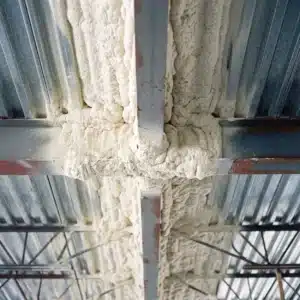
K-13 insulation for cold storage facilities operating between negative 30 degrees Fahrenheit and 70 degrees Fahrenheit provides specialized thermal resistance and acoustic control, addressing refrigeration challenges. The spray-applied cellulose material delivers R-3.7 per inch thermal performance alongside superior sound absorption achieving Noise Reduction Coefficient ratings up to 1.00. Refrigerated warehouses benefit from K-13’s dual functionality, reducing heat transfer through building envelopes while controlling compressor noise ranging from 32 to 47 decibels during normal operation.
TLDR: K-13 spray-applied cellulose insulation delivers thermal resistance R-3.7 per inch and acoustic absorption NRC 0.85 to 1.00 for cold storage applications. Standard applications reach five inches thick providing R-18.5 thermal performance without mechanical support while High-R Systems achieve ten inches thick delivering R-37 with mechanical fastening. K-13 thermal and acoustic insulation supplements primary refrigeration insulation and does not replace structural fireproofing or Class I vapor retarders required for cold storage envelope design. A licensed architect or engineer determines the envelope assembly, taking envelope minimums from the adopted energy code, either ANSI/ASHRAE/IES Standard 90.1 Section 5.5 or IECC Section C402, for the project’s climate zone. Application requires substrate temperatures between 40 and 80 degrees Fahrenheit preventing installation during cold storage operations. International Cellulose Corporation licensed contractors apply K-13 using approved equipment and procedures maintaining quality standards.
Thermal Resistance for Temperature Control
Cold storage facilities holding 32 to 55 degrees Fahrenheit are commonly designed to roughly R-30 roof insulation as cold storage design practice, above the envelope minimum the adopted energy code sets for the climate zone. Freezer warehouses operating between negative 20 degrees and 25 degrees demand minimum R-45 roof assemblies preventing excessive heat gain. K-13 spray-applied cellulose insulation provides R-3.7 per inch thermal resistance tested per ASTM C 518 methodology establishing standardized measurement protocols.
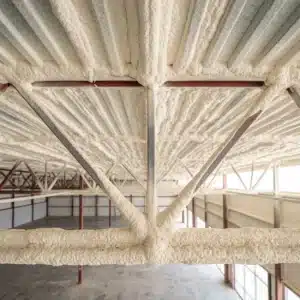
Standard K-13 applications reach five inches maximum thickness without mechanical support delivering R-18.5 total thermal resistance when adhering directly to structural substrates including concrete, metal deck, gypsum board, or existing insulation systems. High-R System installations utilize mechanical fastening supporting K-13 applications up to ten inches thick achieving R-37 thermal performance through specialized fasteners penetrating the insulation layer and anchoring to structural substrates maintaining proper adhesion under gravitational loads.
K-13’s thermal resistance relies on dead air spaces between and within hollow cellulose fibers creating thermal barriers impeding conductive heat transfer. The spray application produces a monolithic coating filling voids and gaps in building envelope assemblies reducing air infiltration contributing to heat gain. Cold storage facilities lose thermal efficiency through uncontrolled air infiltration at penetrations, joints, and material transitions. K-13 applications seal these discontinuities improving overall envelope performance beyond the material’s R-value alone.
Primary refrigeration insulation systems in cold storage typically employ insulated metal panels with polyisocyanurate cores achieving R-31 at four inches thickness or rock wool cores providing 60 to 240 minute fire-resistance ratings. K-13 functions as supplemental insulation applied over primary systems rather than replacing them. Licensed mechanical engineers evaluate complete building envelope assemblies determining whether K-13 supplemental insulation provides sufficient additional thermal resistance meeting total R-value requirements.
ANSI/ASHRAE/IES Standard 90.1 Section 5.5 sets envelope minimums by climate zone and assembly, while cold storage roofs are commonly designed to R-25 to R-45 based on interior temperature, which is a design decision rather than a code minimum. The IECC sets equivalent envelope minimums in Section C402, in whichever edition the jurisdiction has adopted. Across our service area that ranges from the 2006 IECC to the 2024 IECC, and Minnesota enforces ASHRAE 90.1 rather than an IECC at all. Metal Building Manufacturers Association energy guidelines recommend comprehensive envelope design considering thermal bridging at structural supports, joint details, and material transitions. K-13 applications over structural steel members and metal deck reduce thermal bridging effects improving overall assembly performance.
Temperature differential between cold storage interiors and ambient conditions drives heat transfer requiring continuous insulation coverage. A freezer maintaining negative 20 degrees Fahrenheit interior temperature experiences 90 to 110 degree differential during summer months creating substantial heat gain. Each Btu of heat entering the refrigerated space requires compressor work removing it maintaining design temperatures. Supplemental insulation reducing heat gain lowers refrigeration equipment runtime decreasing energy consumption and operating costs.
Acoustic Absorption for Compressor Noise
Refrigeration compressors in cold storage facilities generate noise levels ranging from 32 to 47 decibels during normal operation with some units exceeding 60 decibels. Multiple compressor banks operating simultaneously create cumulative noise affecting worker comfort and communication. K-13 spray-applied cellulose insulation provides superior acoustic absorption with Noise Reduction Coefficient ratings from 0.85 to 1.00 depending on thickness and substrate tested per ASTM C 423 sound absorption standards.
Two-inch K-13 applications over solid backing achieve NRC 1.00 representing maximum theoretical sound absorption across measured frequency ranges. This rating indicates the material absorbs 100 percent of incident sound energy rather than reflecting it back into occupied spaces. Three-inch K-13 applications consistently deliver NRC 1.00 with full frequency absorption from 125 Hz to 4000 Hz covering the range of compressor noise signatures.
K-13’s acoustic mechanism absorbs sound energy through friction as sound waves penetrate the porous cellulose fiber matrix. The irregular fiber structure and air spaces within the material convert acoustic energy to minimal heat through viscous and thermal losses. This absorption process differs fundamentally from sound reflection where hard surfaces bounce sound waves creating reverberation and extended decay times.
Cold storage facilities with concrete tilt-up walls, metal deck ceilings, and smooth insulated panel surfaces create highly reflective acoustic environments. Sound waves bounce between parallel surfaces generating standing waves and extended reverberation times degrading speech intelligibility. K-13 ceiling applications transform reflective surfaces into absorptive ones controlling reverberation and reducing overall noise levels. Open-plan cold storage warehouses with high ceilings amplify acoustic issues through multiple sound reflections. Forklift operation, pallet movement, conveyor systems, and refrigeration equipment create overlapping noise sources. K-13 applications to ceiling assemblies above refrigerated spaces absorb sound energy reducing background noise levels and improving acoustic comfort for workers spending extended periods in temperature-controlled environments.
Acoustic performance testing per ASTM C 423 measures sound absorption coefficients at octave band center frequencies from 125 Hz to 4000 Hz. Three-inch K-13 thickness achieves absorption coefficient 0.77 at 125 Hz, 0.99 at 250 Hz, 1.09 at 500 Hz, 1.01 at 1000 Hz, 0.97 at 2000 Hz, and 0.99 at 4000 Hz demonstrating consistent high performance across all frequencies. A licensed acoustical consultant models sound propagation to determine treatment, with K-13 supporting compliance with the 90 dBA permissible exposure limit and 85 dBA action level in 29 CFR 1910.95.
Moisture Resistance and Condensation Control
Cold storage facilities operating below 40 degrees Fahrenheit require Class I vapor retarders with permeance ratings below 0.1 perms preventing moisture migration into insulation systems. Vapor barriers installed on the exterior warm side of insulation assemblies block water vapor driven by temperature and pressure differentials from reaching cold surfaces where condensation occurs. K-13 spray-applied cellulose insulation aids condensation control but does not replace vapor retarders required by building codes and industry standards.
Moisture ingress into insulation systems dramatically reduces thermal performance with four percent moisture content by weight causing 70 percent effectiveness loss. Water conducts heat approximately 20 times more effectively than air eliminating the thermal resistance provided by air spaces within insulation materials. Wet insulation increases refrigeration equipment runtime and energy consumption while promoting mold growth and material degradation.
K-13 applications create monolithic coatings filling gaps and voids in building envelope assemblies reducing uncontrolled air infiltration carrying moisture into cold storage spaces. Air leakage represents a primary moisture transport mechanism introducing humid outdoor air into refrigerated environments. Each pound of infiltrating air at 90 degrees Fahrenheit and 60 percent relative humidity contains approximately 0.015 pounds of water vapor requiring removal through refrigeration equipment.
Building Science Corporation research documents condensation control strategies emphasizing continuous vapor retarders, air barriers, and proper insulation placement. Vapor pressure drives moisture through permeable materials from high concentration areas toward low concentration zones. Warm humid exterior air maintains higher vapor pressure than cold dry interior air creating continuous moisture drive inward through building envelopes. Vapor retarders on exterior surfaces block this migration preventing moisture accumulation at cold interior surfaces.
K-13 installed over primary refrigeration insulation and vapor barriers provides additional thermal resistance and air sealing improving overall system performance. The cellulose fiber matrix allows limited vapor transmission making K-13 inappropriate as the primary vapor barrier in cold storage applications. Licensed building envelope consultants specify complete moisture management systems including vapor retarders, air barriers, thermal insulation, and proper detailing at penetrations and transitions.
Cold storage facilities require continuous vapor barrier coverage with laps, penetrations, and material interfaces properly sealed preventing moisture bypass. Common failure points include roof-to-wall transitions, door frames, piping penetrations, and structural support connections. Freezer applications operating below 32 degrees Fahrenheit present extreme condensation risk with any moisture reaching below-freezing surfaces forming ice. Ice accumulation damages insulation systems, structural components, and finishes requiring expensive remediation.
Application Over Insulated Metal Panels and Fireproofing
Cold storage facilities commonly employ insulated metal panels with polyisocyanurate or rock wool cores providing primary thermal insulation and structural support. K-13 spray-applied cellulose insulation applies directly over interior panel surfaces delivering supplemental thermal resistance and acoustic absorption. This layered approach combines the structural efficiency and moisture control of insulated panels with K-13’s superior acoustic performance and air sealing capabilities.
Insulated metal panel assemblies achieve R-31 at four inches thickness with polyisocyanurate cores or provide 60 to 240 minute fire-resistance ratings with rock wool cores depending on density and thickness. Panel joints at horizontal and vertical connections create thermal bridges where metal facings conduct heat. K-13 applications over panel interiors reduce thermal bridging effects by coating fasteners and joint details with continuous insulation coverage.
Structural steel fireproofing in cold storage protects load-bearing members from fire exposure per building code requirements. Spray-applied fire-resistive materials provide one to four hour fire-resistance ratings tested per ASTM E119 standard fire test methodology. K-13 holds Underwriters Laboratories BXUV approval for application over fireproofing in 15 tested assemblies combining fire protection with thermal and acoustic performance. This approval enables K-13 installation over fire-protected steel maintaining required fire-resistance ratings while adding supplemental insulation and sound absorption.
K-13 provides ASTM E-84 Class A surface burning characteristics with Flame Spread Index 5 and Smoke Developed Index 5 representing excellent fire performance for interior finishes. This Class A rating indicates low flame spread and smoke generation during standardized tunnel test procedures. However, ASTM E-84 surface burning tests differ fundamentally from ASTM E119 fire-resistance rating tests. K-13 does not provide structural fire protection and does not replace fire-rated construction assemblies required by building codes.
Application substrate temperature requirements limit K-13 installation timing in cold storage projects. The material requires substrate temperatures between 40 and 80 degrees Fahrenheit for proper adhesion and curing. Cold storage facilities operating at negative 30 to negative 90 degrees cannot receive K-13 applications during normal operations. Contractors must apply K-13 during construction before refrigeration equipment startup or during planned shutdown periods when facilities reach acceptable temperatures.
Environmental conditions affect K-13 application quality with relative humidity, air movement, and ambient temperature influencing material performance. International Cellulose Corporation licensed contractors receive training on proper application techniques, equipment operation, and quality control procedures. Licensed contractors use approved spray equipment delivering consistent material density and coverage meeting performance specifications. K-13 applications to metal deck ceilings over cold storage spaces provide continuous insulation coverage eliminating gaps at deck seams and structural supports reducing conductive heat transfer.
Quality control during K-13 application includes thickness verification, density testing, and visual inspection. Contractors measure installed thickness using depth gauges at multiple locations ensuring specified coverage. Density testing through core sampling verifies proper material application meeting manufacturer specifications. Cold storage insulation systems across Texas, Oklahoma, Kansas, Nebraska, Minnesota, and Wisconsin integrate K-13 applications with primary refrigeration insulation, structural fireproofing, and vapor barriers creating complete building envelope assemblies coordinated by licensed mechanical engineers, fire protection engineers, and building envelope consultants.
Key Takeaways
Cold storage facilities require specialized insulation addressing thermal resistance, acoustic control, and moisture management in refrigerated environments operating from negative 30 to 70 degrees Fahrenheit.
K-13 spray-applied cellulose insulation delivers R-3.7 per inch thermal resistance with standard applications reaching five inches thick providing R-18.5 and High-R Systems achieving ten inches thick delivering R-37 with mechanical fastening support.
Acoustic performance achieves Noise Reduction Coefficient ratings from 0.85 to 1.00 tested per ASTM C423, controlling compressor noise ranging from 32 to 47 decibels and improving worker comfort in refrigerated warehouse environments.
K-13 functions as supplemental insulation over primary refrigeration systems and does not replace insulated metal panels requiring R-30 to R-45 thermal resistance or structural fireproofing providing ASTM E119 fire-resistance ratings.
Application requires substrate temperatures between 40 and 80 degrees Fahrenheit preventing installation during cold storage operations and necessitating construction phase timing or planned shutdown periods.
Moisture management demands Class I vapor retarders with permeance below 0.1 perms on exterior warm sides of insulation assemblies with K-13 aiding condensation control but not replacing code-required vapor barriers.
International Cellulose Corporation licensed contractors apply K-13 using approved equipment and procedures maintaining ASTM E-84 Class A fire ratings, Factory Mutual Approval, and Underwriters Laboratories BXUV certification over fireproofing assemblies.
If your cold storage facility requires supplemental thermal and acoustic insulation improving energy efficiency while controlling compressor noise, our team provides K-13 spray-applied cellulose installation meeting building code requirements and manufacturer specifications. Contact Bahl Fireproofing for cold storage K-13 insulation solutions enhancing refrigerated warehouse performance through professional application and quality control.
Disclaimer: This article provides general educational information about K-13 insulation for cold storage applications and does not constitute professional mechanical engineering advice, building envelope design consultation, or acoustic engineering services. K-13 spray-applied cellulose insulation functions as supplemental thermal and acoustic insulation and does not replace primary refrigeration insulation systems, structural fireproofing, or Class I vapor retarders required by building codes. Licensed mechanical engineer, fire protection engineer, building envelope consultant, and acoustic consultant evaluation determines appropriate insulation systems, fire protection assemblies, moisture management strategies, and acoustic treatments for cold storage facilities. K-13 provides ASTM E-84 Class A surface burning characteristics with Flame Spread Index 5 and Smoke Developed Index 5 but does not provide ASTM E119 fire-resistance ratings and does not replace structural fire protection required for load-bearing steel members. Application requires substrate temperatures between 40 and 80 degrees Fahrenheit for proper adhesion and curing preventing installation during cold storage operations at negative 30 to negative 90 degrees Fahrenheit. K-13 approved for interior and covered exterior applications only and not suitable for direct weathering exposure or prolonged moisture contact. International Cellulose Corporation licensed contractors required for proper application using approved equipment, materials, and procedures maintaining quality standards. K-13 aids condensation control through air sealing but does not replace Class I vapor retarders below 0.1 perms on the warm side of cold storage assemblies, which are set by the adopted building code and by the project’s envelope design criteria. Envelope minimums vary by climate zone and assembly, set by the adopted energy code, either ANSI/ASHRAE/IES Standard 90.1 Section 5.5 or IECC Section C402, while refrigerated facilities are typically designed to R-30 to R-45 as an owner criterion. Moisture ingress of four percent by weight causes 70 percent thermal effectiveness loss requiring comprehensive moisture management systems including vapor barriers, air barriers, proper insulation placement, and sealed penetrations designed by licensed building envelope consultants. Performance varies by application thickness, substrate type, installation quality, environmental conditions, and system integration with primary refrigeration insulation and structural assemblies. Cost varies by project area, thickness requirements, substrate preparation needs, mechanical support systems, and site accessibility. Always consult licensed mechanical engineer, fire protection engineer, building envelope consultant, and acoustic consultant to verify building code requirements, energy standards compliance, fire protection specifications, moisture management strategies, and complete insulation system design for cold storage applications.