K-13 insulation for data centers addresses acoustic and thermal challenges where HVAC systems generate 70 to 90 decibels during continuous operation while server racks produce 60 to 80 decibels depending on equipment density and cooling fan configurations. Combined noise exposure approaches the 85 dBA action level in 29 CFR 1910.95, the point at which hearing protectors must be made available and a hearing conservation program applies. Required use of hearing protection begins at the 90 dBA permissible exposure limit. Staff working in equipment rooms and mechanical spaces are the ones affected. K-13 sprayed cellulose insulation provides acoustic control with Noise Reduction Coefficient 0.80 on solid backing at one-inch thickness absorbing 80 percent of sound energy and improving speech intelligibility in occupied areas. Thermal performance delivers R-3.7 per inch creating a monolithic air seal preventing condensation on cold surfaces within the 64.4 to 80.6 degree Fahrenheit recommended envelope in ASHRAE Datacom Series Book 1, 5th Edition.
TLDR: K-13 insulation provides acoustic control reducing data center noise from HVAC systems and server equipment while delivering thermal stability preventing condensation on cold surfaces. NRC 0.80 acoustic performance at one-inch thickness absorbs sound better than rigid alternatives improving ambient conditions for operations staff. K-13 sprayed fiber insulation delivers R-3.7 per inch thermal resistance creating seamless barrier filling voids and penetrations. K-13 carries a Class A surface burning classification with an ASTM E84 flame spread index of 5 and smoke developed index of 5 but does not replace structural steel fireproofing or fire suppression systems required by NFPA 75.
Noise Reduction from HVAC and Server Equipment
HVAC systems represent single main source of data center noise operating continuously at 70 to 90 decibels. Server racks contribute 60 to 80 decibels with some high-density configurations reaching 96 decibels within rack enclosures. Combined noise levels approach the 85 dBA action level in 29 CFR 1910.95(c), at which hearing protectors must be made available, and that is where acoustic treatment starts protecting operations staff.
K-13 cellulose absorbs sound waves better than rigid alternatives providing NRC 0.80 on solid backing meaning 80 percent of sound absorbed. Absorptive ceiling treatment with NRC 0.80 or higher can reduce reverberant noise levels by 10 decibels improving ambient sound quality per acoustic design principles for commercial spaces. Reduced reverberation improves speech intelligibility enabling clear communication during equipment troubleshooting.
Mechanical rooms housing HVAC equipment and electrical switchgear benefit from K-13 acoustic treatment applied to ceilings and walls. Equipment rooms containing server racks require acoustic control enabling staff to hear alarm notifications. K-13 application directly to metal deck, concrete, or gypsum creates finished ceiling providing continuous acoustic absorption.
Thermal Stability and Condensation Control
K-13 provides R-3.7 per inch thermal resistance preventing heat transfer through building envelope. Standard application thickness ranges from three-quarters inch to five inches achieving R-2.8 to R-18.5. K-13 High-R System supports applications up to 10 inches thick delivering R-37. Monolithic application fills all voids and penetrations creating continuous insulation layer without thermal bridging.
ASHRAE Datacom Series Book 1, Thermal Guidelines for Data Processing Environments, 5th Edition (TC 9.9), gives a recommended envelope of 64.4 to 80.6 degrees Fahrenheit with dew point between 41.9 and 59 degrees Fahrenheit and a 60 percent relative humidity ceiling. Insulation must keep surface temperature above dew point avoiding moisture accumulation threatening equipment reliability.
Cold spots on uninsulated surfaces create condensation risks when surface temperature drops below dew point. K-13 seamless application eliminates gaps preventing localized cold surface formation. Cellulose fibers do not lose thermal efficiency over time maintaining consistent R-value throughout 75-year service life supporting HVAC efficiency.
Class A Surface Burning Characteristics
K-13 achieves a Class A flame spread rating per ASTM E-84 and UL-723, with a flame spread index of 5 and a smoke developed index of 5. Older data sheets also list NFPA-255, which was withdrawn in 2009 and whose content moved into ASTM E84 and UL 723 representing highest surface classification available. Cellulose fibers combined with natural fire retardants limit surface burning characteristics. Class A rating indicates minimal flame spread and low smoke production during fire exposure.
K-13 is UL approved and listed in six UL BXUV Guide Design Assemblies for application over spray-applied fire-resistive materials. This represents additive application supplementing automatic sprinkler protection not replacement of structural steel fireproofing. Structural fireproofing provides fire-resistance ratings protecting load-bearing capacity as covered in data center fireproofing requirements per ASTM E119 fire-resistance testing standards.
Licensed fire protection engineer determines structural fireproofing requirements and fire suppression system specifications per NFPA 75. K-13 provides Class A surface burning characteristics but does not constitute fire-resistance rating for structural steel supporting equipment loads. Data centers require three levels of fire protection including building-level passive fireproofing, room-level clean agent suppression, and rack-level targeted protection.
Application to Metal Deck and Exposed Structures
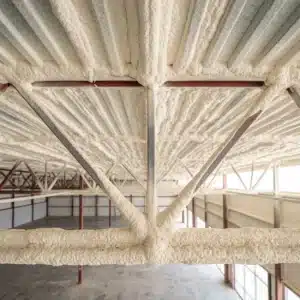
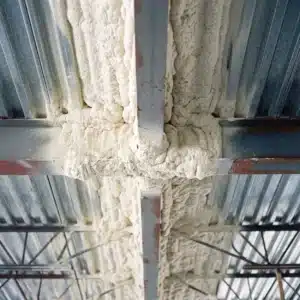
K-13 typically serves as exposed ceiling finish requiring no additional barriers beyond sprayed application. Material adheres to metal deck, concrete, gypsum, wood, and glass substrates creating finished surface in single application. Available in standard white and custom colors maintaining natural cellulose texture.
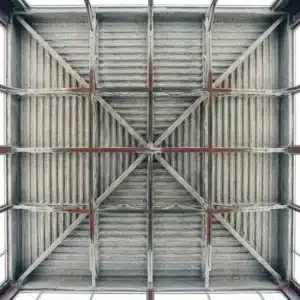
Data hall ceilings benefit from K-13 acoustic and thermal performance applied directly to structural deck. Mechanical rooms housing HVAC equipment receive K-13 treatment controlling noise transmission to adjacent spaces. Exposed structural elements receive finished appearance while supporting acoustic and thermal functions.
Application thickness varies by performance requirements with minimum three-quarters inch for acoustic control and maximum 10 inches for thermal resistance using High-R System. Licensed contractor evaluates substrate condition and application specifications ensuring proper adhesion. Bahl Fireproofing installs K-13 throughout Texas, Oklahoma, Kansas, Nebraska, Minnesota, and Wisconsin data center facilities.
Sustainability and Indoor Air Quality
K-13 contains 80 percent pre-consumer recycled content supporting LEED v4 Low-Emitting Materials credit. UL GREENGUARD Gold certification verifies low VOC emissions appropriate for occupied facilities housing operations staff and sensitive electronic equipment. Material remains carbon neutral with low embodied energy and recyclable composition.
Cellulose fibers provide natural moisture buffering capacity moderating interior conditions. Unlike foam insulation products, K-13 does not off-gas volatile compounds degrading indoor air quality. GREENGUARD Gold certification ensures compliance with stringent chemical emissions testing protecting equipment from contamination and staff from respiratory irritants.
75-year service life eliminates maintenance requirements and replacement costs. Material maintains acoustic performance, thermal resistance, and fire-resistance surface characteristics throughout decades of continuous operation. No compression or settling preserves original R-value and acoustic absorption without performance degradation.
Key Takeaways
- Data center HVAC systems generate 70 to 90 decibels while server racks produce 60 to 80 decibels, approaching the 85 dBA action level in 29 CFR 1910.95(c) at which hearing protectors must be made available
- K-13 provides NRC 0.80 acoustic performance at one-inch thickness absorbing 80 percent of sound energy and improving speech intelligibility for operations staff
- R-3.7 per inch thermal resistance creates a monolithic air seal preventing condensation when surface temperature remains above dew point within the Datacom Series Book 1 recommended envelope
- A Class A surface burning classification, ASTM E84 flame spread 5 and smoke developed 5, which is an interior finish rating and not a fire-resistance rating but do not replace structural steel fireproofing or fire suppression systems
- K-13 is UL listed over spray-applied fire-resistive materials in six BXUV assemblies as additive application supplementing not replacing structural fire protection
- Licensed fire protection engineer determines structural fireproofing, fire suppression specifications, and K-13 suitability based on equipment value and operational criticality per NFPA 75
- Contains 80 percent pre-consumer recycled content with UL GREENGUARD Gold certification supporting LEED v4 compliance and 75-year service life
If your data center requires acoustic control and thermal stability supporting operations staff while maintaining equipment reliability, our team installs K-13 insulation meeting performance specifications. Contact Bahl Fireproofing to discuss K-13 application complementing structural fireproofing and fire suppression systems protecting critical infrastructure.
Disclaimer: This article provides general educational information about K-13 insulation for data centers and does not constitute professional fire protection engineering advice or acoustic design certification. K-13 provides acoustic control with NRC 0.80 on solid backing at one-inch thickness, thermal resistance of R-3.7 per inch, and a Class A surface burning classification per ASTM E84 with flame spread 5 and smoke developed 5. Class A is an interior finish rating under ASTM E84 and is not a fire-resistance rating under ASTM E119. K-13 does not replace structural steel fireproofing or fire suppression systems required by NFPA 75. Licensed fire protection engineer must determine structural fireproofing requirements and fire suppression system specifications based on equipment value and operational criticality. K-13 is UL listed over spray-applied fire-resistive materials in six BXUV assemblies as additive application supplementing automatic sprinkler protection not replacement of structural fire protection. Class A rating indicates surface burning characteristics not fire-resistance rating for structural steel. Data centers require three levels of fire protection including building-level passive fireproofing and active sprinkler systems, room-level clean agent suppression, and rack-level targeted protection. Acoustic performance varies by substrate material and application thickness per ASTM C 423. Thermal performance depends on thickness and dew point management against the recommended envelope in ASHRAE Datacom Series Book 1, 5th Edition, which is guidance for equipment reliability and not a code requirement. NRC 0.80 applies to solid backing installations. Application surfaces require proper preparation. Cost varies by thickness, application area, substrate complexity, and site accessibility. Always consult licensed fire protection engineer and acoustic consultant to verify code requirements and system specifications.