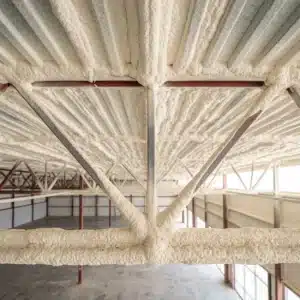
Medical building insulation is in increasing demand. Medical buildings consume 2.5 times more energy per square foot than typical commercial structures due to 24-hour operations, intensive HVAC requirements, and high air change rates for infection prevention. HVAC systems represent 50 to 70 percent of total hospital energy use. Closed-cell spray foam insulation provides R-6 to R-7 per inch thermal resistance while creating airtight building envelope reducing air leakage by up to 85 percent enabling precise pressure relationships critical for infection control.
TLDR: Medical building insulation using closed-cell spray foam achieves 20 to 40 percent reduction in energy bills through superior air sealing preventing uncontrolled infiltration compromising HVAC performance and infection control. Spray foam insulation with GREENGUARD Gold certification provides low VOC emissions protecting immunocompromised patients while maintaining precise temperature control for pharmaceutical storage and operating room environments. Spray foam does not provide structural fire protection and requires thermal barrier separation from interior spaces per International Building Code. NFPA 101 Life Safety Code prohibits spray foam as firestop material in healthcare facilities.
Air Sealing for HVAC Efficiency and Infection Control
Air leakage causes approximately 20 percent of building energy waste according to Energy Star with healthcare facilities experiencing severe consequences from uncontrolled infiltration. Spray foam expands to fill cracks and penetrations creating monolithic air barrier. Nemours Children’s Clinic achieved 85 percent reduction in air duct leakage improving HVAC performance while reducing hospital-acquired infection risk through enhanced pressure control per healthcare facility air sealing case studies.
Operating rooms require positive pressure maintaining minimum 0.01 inch water gauge differential while airborne infection isolation rooms require negative pressure preventing pathogen spread. Single pressure reversal caused by envelope leakage exposes staff and patients to contaminants. Closed-cell spray foam maintains precise pressure relationships by eliminating air leakage paths compromising infection control protocols.
Environmental Protection Agency studies demonstrate up to 20 percent reduction in heating and cooling costs through air sealing and insulation. Healthcare applications realize additional benefits through reduced HVAC runtime extending equipment service life. Average annual savings of $1,200 in residential applications translates to substantially higher savings in large medical facilities with intensive 24-hour HVAC demands.
Closed-Cell Spray Foam Performance
Closed-cell spray polyurethane foam provides R-6.0 to R-7.0 thermal resistance per inch thickness substantially exceeding open-cell formulations rated R-3.5 to R-3.7 per inch. High density closed-cell structure creates continuous vapor barrier preventing moisture migration eliminating need for separate vapor retarder installation. Vapor barrier properties prove critical for healthcare facilities requiring precise humidity control preventing mold growth threatening immunocompromised populations.
Open-cell spray foam remains unsuitable for healthcare moisture control due to breathable structure allowing moisture absorption. Closed-cell formulations provide superior mold prevention through inherent moisture resistance combined with seamless application eliminating joints where moisture accumulation occurs. Healthcare facilities housing oncology patients, transplant recipients, and post-surgical recovery areas require materials preventing biological contamination.
Energy savings of 20 to 40 percent typical for properly air-sealed buildings. HVAC system runtime reductions averaging 35 percent extend equipment service life while reducing maintenance costs. Some installations enable HVAC equipment downsizing by up to 35 percent reducing initial capital costs.
Low-VOC Formulations for Immunocompromised Patients
GREENGUARD Gold certified spray foam products meet rigorous volatile organic compound emissions standards appropriate for schools and healthcare facilities. Certification requires testing for more than 15,000 VOCs with emissions meeting California Department of Public Health CDPH Section 01350 criteria. Products achieving GREENGUARD Gold status include Fomo Products, GENYK Elite 2.0, Icynene water-blown systems, and Owens Corning Natural-Therm per GREENGUARD Gold certified insulation products.
Hydrofluoroolefin blowing agent technology reduces global warming potential to approximately 1 compared to legacy formulations with GWP values exceeding 1,000. Modern HFO-based products demonstrate 99.9 percent lower environmental impact while some manufacturers incorporate up to 20 percent bio-based polyols.
Healthcare applications require extended post-installation ventilation allowing residual emissions dissipation before patient occupancy. Certified applicators must maintain continuous mechanical ventilation for minimum 24 to 48 hours with some protocols requiring multi-day purge periods. Immunocompromised patients demonstrate heightened sensitivity requiring stringent material selection and installation protocols.
Temperature Stability for Critical Environments
Operating rooms require 68 to 75 degrees Fahrenheit with 20 to 60 percent relative humidity per ANSI/ASHRAE/ASHE Standard 170, Ventilation of Health Care Facilities, Table 7-1, in the edition the AHJ and the FGI Guidelines reference. Minimum 20 air changes per hour combined with positive pressure creates substantial HVAC load requiring superior envelope performance. Spray foam stabilizes interior temperatures reducing fluctuations compromising surgical team comfort.
Pharmaceutical storage requires 59 to 77 degrees Fahrenheit with USP Controlled Room Temperature specifying 68 to 77 degrees Fahrenheit. Study of 27 facilities documented storage temperatures from 13.8 to 42 degrees Celsius far exceeding acceptable ranges with 52 percent recording mean kinetic temperatures above 25 degrees Celsius.
Sterile supply storage maintains 72 to 78 degrees Fahrenheit maximum 60 percent relative humidity per Joint Commission requirements. Temperature excursions compromise sterilization validation requiring product disposal. Spray foam prevents external temperature impacts maintaining stable conditions.
Critical Fire Safety Requirements and Limitations
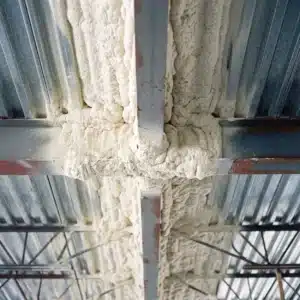
Spray polyurethane foam constitutes combustible material that will ignite and burn when exposed to significant heat or continuous flame. Spray foam does not provide structural fire protection for steel framing and cannot substitute for spray-applied fire-resistive materials achieving hourly fire-resistance ratings. All foam plastic insulation requires thermal or ignition barrier separating material from interior spaces per International Building Code plastic insulation requirements typically consisting of minimum one-half inch gypsum drywall.
Thermal barrier slows fire spread providing occupants additional evacuation time. Commercial construction including healthcare facilities mandates thermal barrier installation with limited exceptions for specific applications meeting stringent testing requirements. Failure to install required thermal barriers creates code violations and life safety hazards particularly critical in healthcare occupancies housing patients with mobility limitations.
NFPA 101 Life Safety Code specifically prohibits spray foam sealants as firestop materials in penetrations through fire-rated walls and floor assemblies in healthcare facilities. Healthcare facilities must specify firestop systems passing ASTM E-814 or UL 1479 tests. Spray foam installation over existing spray-applied fire-resistive materials on structural steel remains acceptable without adversely impacting fire-resistance ratings. Licensed professional engineers must specify complete building systems including all fire-rated assemblies.
Moisture Control and Installation Requirements
Spray foam application over damp substrates traps moisture creating conditions for unseen mold growth. All moisture intrusion sources require identification and repair before insulation application with substrates requiring complete drying. Existing mold contamination requires professional remediation following EPA and CDC guidelines before covering with any insulation system.
Closed-cell spray foam functions as vapor barrier preventing moisture migration when properly installed over dry substrates. Moisture control benefits extend to infection prevention through elimination of conditions supporting mold and bacterial growth. Healthcare facilities require heightened attention to moisture control due to patient vulnerability and regulatory requirements for environmental infection control.
Installation requires certified applicators trained in proper mixing, application techniques, and safety protocols. Personal protective equipment including respiratory protection mandatory during application. Post-installation ventilation requirements exceed standard construction with extended purge periods necessary before patient occupancy. Some jurisdictions require third-party inspection verifying complete cure and acceptable indoor air quality.
Energy Savings and Return on Investment
Medical building insulation projects achieve 20 to 40 percent reduction in energy costs through combined thermal resistance and air sealing. HVAC runtime reductions averaging 35 percent decrease maintenance and extend equipment life. Typical payback periods range from 3 to 5 years.
Additional air changes per hour beyond minimum requirements cost $5,000 to $10,000 annually per operating room. One hospital reduced ACH by 5 during unoccupied periods saving more than $1 million annually demonstrating envelope performance impact.
LEED for Healthcare projects achieve credits for enhanced energy performance and low-emitting materials when specifying GREENGUARD Gold certified products.
Hospital Envelopes and the NFPA 285 Exterior Wall Requirement
Health care buildings are built to be noncombustible, which places them squarely inside this provision. IBC (2021) Section 2603.5 reaches exterior walls containing foam plastic insulation in buildings of Type I, II, III or IV construction, of any height, and multi-story cold storage buildings required to be of noncombustible construction. Because most hospitals, surgery centers and medical office buildings are Type I or Type II, foam plastic in the exterior wall brings IBC (2021) Section 2603.5.5 with it, requiring that the exterior wall assembly be tested in accordance with and comply with the acceptance criteria of NFPA 285.
Code note: unless otherwise stated, code references on this page are to the 2021 International Building Code. Code adoption is state and local. Across the states we serve, adopted IBC editions currently range from the 2012 edition to the 2024 edition, some states have no statewide commercial building code, and several enforce NFPA 1 or NFPA 101 rather than the International Fire Code. Minnesota and Wisconsin publish state-amended code books whose numbering and requirements differ from the model code. This is general technical information, not a code determination for your project. Confirm the adopted edition and any local amendments with your authority having jurisdiction.
One Wall, Qualified as One Thing
NFPA 285 is the Standard Fire Test Method for Evaluation of Fire Propagation Characteristics of Exterior Wall Assemblies Containing Combustible Components, current edition 2025. The tested subject is the entire wall, from cladding through the air and water-resistive barrier, the foam, the framing and the window head detail. That is what makes it an assembly test rather than a product test. Foam by itself never holds NFPA 285 compliance, and removing one component from a listed build-up can end the listing for that wall.
Two things make this harder on medical work. Hospital envelopes carry an unusual density of penetrations and specialty details, from medical gas and generator louvers to imaging suite shielding, and phased renovation means a single facade can be several vintages of construction at once. Both raise the odds that the wall as built departs from any published assembly. When it does, the paths forward are testing the assembly as built, or obtaining an engineering judgment from a fire protection engineer qualified to give one.
The Adjacent Requirements
IBC (2021) Section 2603.3 sets the general limits at a flame spread index of 75 or less and a smoke-developed index of 450 or less. IBC (2021) Section 2603.5.4 is stricter on Type I through IV exterior walls, at 25 or less flame spread with smoke developed still 450 or less, tested at the thickness intended for use up to 4 inches under ASTM E84 or UL 723. IBC (2021) Section 2603.4 asks separately for the interior thermal barrier: 1/2-inch gypsum wallboard, heavy timber complying with IBC (2021) Section 602.4, or a material meeting the acceptance criteria of both the Temperature Transmission Fire Test and the Integrity Fire Test of NFPA 275.
The Limits of the Section
- Exterior walls of Type V construction are exempt and comply only with IBC (2021) Sections 2603.2, 2603.3 and 2603.4. A freestanding clinic is occasionally Type V; an acute care facility essentially never is.
- Exception 1. One-story buildings complying with IBC (2021) Section 2603.4.1.4.
- Exception 2. Foam plastic covered on each face by not less than 1 inch of masonry or concrete, with either no airspace, or a flame spread index of 25 or less and an airspace not more than 1 inch.
On a licensed facility a state health department review can run alongside the building department review, so confirm the assembly with the architect of record and with every authority having jurisdiction before the wall is purchased.
Key Takeaways
- Medical buildings consume 2.5 times more energy than typical commercial structures with HVAC systems representing 50 to 70 percent of total energy use
- Closed-cell spray foam achieves R-6 to R-7 per inch thermal resistance while providing vapor barrier preventing moisture migration critical for infection control
- Air sealing reduces energy consumption by up to 20 percent while maintaining precise pressure relationships preventing pathogen migration between healthcare spaces
- GREENGUARD Gold certified products limit VOC emissions protecting immunocompromised patients in oncology, transplant, and post-surgical recovery areas
- Operating rooms require 68 to 75 degrees Fahrenheit with minimum 20 air changes per hour while pharmaceutical storage demands 59 to 77 degrees Fahrenheit
- Spray foam does not provide structural fire protection and requires thermal barrier separation from interior spaces per International Building Code
- NFPA 101 Life Safety Code prohibits spray foam as firestop material in fire-rated assemblies in healthcare facilities requiring ASTM E-814 or UL 1479 tested systems
If your medical building requires energy-efficient insulation maintaining infection control protocols while protecting temperature-sensitive pharmaceuticals and medical equipment, our team specifies and installs spray foam insulation systems meeting healthcare facility requirements. Contact Bahl Fireproofing to discuss medical building insulation before design decisions affect long-term energy performance and patient safety. We work on commercial projects across our service area in Texas, Oklahoma, Kansas, Nebraska, Minnesota, and Wisconsin.
Disclaimer: This article provides general educational information about spray foam insulation for medical buildings and does not constitute professional engineering advice or code compliance certification. Performance varies significantly by climate zone, building design, and application methodology. Healthcare facility requirements vary by jurisdiction and include the adopted International Building Code, NFPA 101 Life Safety Code, ANSI/ASHRAE/ASHE Standard 170, and the Facility Guidelines Institute Guidelines, each in the edition the AHJ enforces. Spray foam insulation does not provide structural fire protection and cannot substitute for spray-applied fire-resistive materials achieving hourly fire-resistance ratings. Thermal barrier consisting of minimum one-half inch gypsum drywall required to separate foam from interior spaces per IBC Chapter 26. NFPA 101 prohibits spray foam as firestop materials in fire-rated assemblies in healthcare facilities. All moisture sources must be repaired and substrates dried before application as spray foam can trap moisture enabling mold growth. Installation requires certified applicators with extended post-installation ventilation before patient occupancy. GREENGUARD Gold certification recommended for healthcare but not all products achieve low-VOC certification. Always consult a licensed mechanical engineer, fire protection engineer, and infection control professional to verify Standard 170 Table 7-1 compliance, pressure relationship requirements, and fire-rated assembly specifications. Cost estimates are representative and vary by project parameters.