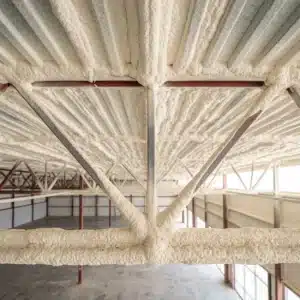
Distribution centers without Spray Foam Insulation in the warehouse operating 24/7 with high ceilings and extensive roof areas face energy bills of $400,000 to $800,000 annually. Metal building construction provides minimal thermal resistance while loading docks create air infiltration. Spray polyurethane foam addresses both insulation and air sealing through single-application systems achieving R-30 to R-40 performance.
TLDR: Distribution center insulation using spray foam delivers R-6 to R-7.5 per inch with closed-cell formulations and air sealing reducing HVAC energy by 25 to 50 percent. Material can be specified to meet the opaque envelope minimums in IECC Section C402 for the project’s climate zone, in the adopted edition, while sealing loading dock perimeters and penetrations. Spray foam provides thermal insulation but does NOT provide structural fire protection. Licensed professionals must specify appropriate spray foam insulation services based on building type and code requirements.
Why Distribution Centers Need High-Performance Insulation
Distribution centers spanning 100,000 to 1,000,000 square feet with 30 to 50 foot clear heights create massive conditioned air volumes in metal buildings conducting heat through steel framing. Temperature-controlled zones maintain 35 to 77 degrees Fahrenheit consuming 40 to 60 percent of facility energy. Loading docks represent 15 to 25 percent of energy loss through overhead doors with gaps allowing unconditioned air infiltration. Representative facilities consume $400,000 to $800,000 annually making insulation improvements economically significant.
Closed-Cell vs Open-Cell Spray Foam for Different Zones
Closed-cell spray foam delivers R-6.0 to R-7.5 per inch at 2.0 pounds per cubic foot providing vapor barrier at 1.5 to 2 inches with rigid surface adding structural strength. Applications include roof deck, cold storage zones, and loading dock perimeters. Open-cell spray foam provides R-3.5 to R-3.8 per inch with flexible texture for sound absorption at $1.50 to $3.00 per square foot per inch versus closed-cell at $3.00 to $5.00.
Climate-controlled distribution centers use closed-cell on roof deck and exterior walls for vapor control while interior walls use open-cell for cost-effective sound control. Cold storage facilities require closed-cell R-30 to R-40 with vapor barriers preventing moisture migration.
Air Sealing Loading Docks and Large Openings
Loading dock overhead doors create equivalent openings of 24 square inches per 1/4 inch gap when weather-stripping deteriorates. Spray foam applied to interior dock walls fills voids between steel framing creating continuous air barrier reducing infiltration from 2.0 air changes per hour down to 0.3 to 0.7 air changes per hour. Two to three inches closed-cell foam seals door jamb penetrations, electrical conduits, and pipes where traditional caulking fails.
Meeting IECC Energy Code Requirements
IECC Section C402 sets minimum envelope R-values by climate zone and assembly, and the value for a distribution center roof should be read from the opaque envelope table in the edition the jurisdiction adopted, which is the 2015 IECC in Texas and 2006 IECC references in Oklahoma and Kansas. Closed-cell spray foam achieves code-required R-values with 4 to 6 inches of application thickness. Wall assemblies requiring cavity plus continuous insulation benefit from spray foam providing both functions through single application eliminating thermal bridging that reduces batt insulation effectiveness by 30 to 50 percent in metal building construction.
Spray Foam Fire Ratings and Building Code Compliance
Spray foam provides thermal insulation and air sealing but does NOT provide structural fire protection for fire-resistance ratings. Fire-rated assemblies require separate fireproofing systems applied to structural steel or gypsum board thermal barriers separating foam from occupied spaces per International Building Code IBC (2021) Section 2603. Most spray foam products achieve Class A fire rating with flame spread index below 25 when tested per surface burning characteristics standards but this surface rating differs from fire-resistance ratings protecting steel structures.
Code note: unless otherwise stated, code references on this page are to the 2021 International Building Code. Code adoption is state and local. Across the states we serve, adopted IBC editions currently range from the 2012 edition to the 2024 edition, some states have no statewide commercial building code, and several enforce NFPA 1 or NFPA 101 rather than the International Fire Code. Minnesota and Wisconsin publish state-amended code books whose numbering and requirements differ from the model code. This is general technical information, not a code determination for your project. Confirm the adopted edition and any local amendments with your authority having jurisdiction.
IBC (2021) Section 2603.4 requires foam plastic to be separated from interior spaces by a thermal barrier of one-half inch gypsum wallboard, heavy timber per IBC (2021) Section 602.4, or a material meeting the acceptance criteria of both the Temperature Transmission Fire Test and the Integrity Fire Test of NFPA 275. One-half inch gypsum wallboard is the common choice for foam in occupied spaces. Metal buildings may use certain approved products for exposed application meeting NFPA 286 room corner fire test requirements. UL-listed fire-rated assemblies include spray foam as insulation component combined with fire-rated gypsum board and steel framing tested as complete systems per foam plastic code requirements.
Distribution centers commonly use spray foam products meeting NFPA 286 room corner fire test requirements allowing exposed application to metal roof decks without thermal barriers up to manufacturer-specified thickness limits typically 4 to 5 inches. These products achieve Class A surface burning characteristics while eliminating gypsum board costs in open warehouse areas. Loading dock walls, cold storage perimeters, and high-traffic zones may still incorporate gypsum board thermal barriers for impact resistance and ease of repair regardless of code requirements.
Energy Savings and ROI at Scale
Representative 200,000 square foot distribution center with minimal insulation consumes 6.0 kilowatt-hours per square foot annually at $144,000 energy cost. Upgrading to closed-cell spray foam at R-30 roof with air sealing reduces consumption to 3.7 kilowatt-hours per square foot saving $55,200 annually. Spray foam installation costs $700,000 to $1,000,000 creating 15-year simple payback.
Utility rebates at $0.10 to $0.50 per square foot reduce net costs while HVAC equipment downsizing from 40 percent load reduction saves $80,000 to $120,000. Combined incentives improve payback to 11 to 15 years with positive return over building lifespan.
Tilt-Up Panels and the Concrete Exception in NFPA 285
Distribution centers are usually concrete, which changes where this requirement lands. IBC (2021) Section 2603.5 applies to exterior walls containing foam plastic insulation in buildings of Type I, II, III or IV construction, of any height, and to multi-story cold storage buildings required to be of noncombustible construction. Where it applies, IBC (2021) Section 2603.5.5 requires that the exterior wall assembly be tested in accordance with and comply with the acceptance criteria of NFPA 285.
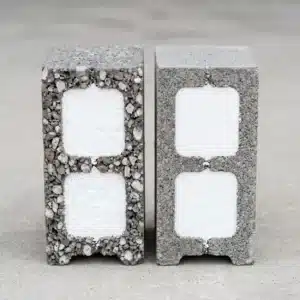
One of the two exceptions was written for something very like this construction. It exempts foam plastic covered on each face by not less than 1 inch of masonry or concrete, with either no airspace, or a flame spread index of 25 or less and an airspace not more than 1 inch. A sandwich tilt-up panel, foam cast between two concrete wythes, can meet that description. A single-wythe tilt-up panel with foam sprayed on its inside face cannot, because the foam is covered on one face only. Those two walls look alike on a site plan and land on opposite sides of the requirement.
The Test Covers the Wall, Not the Foam
NFPA 285 is the Standard Fire Test Method for Evaluation of Fire Propagation Characteristics of Exterior Wall Assemblies Containing Combustible Components, current edition 2025. It burns a two-story mockup of the whole build-up, cladding through framing, and judges flame propagation against defined limits. That is an assembly test rather than a product test, so no foam is NFPA 285 compliant as a product, and exchanging a component of the tested wall can void the listing that was relied on.
On a big-box shell the exposure usually shows up at the dock doors, the panel joints and the storefront office block, where the wall stops being plain concrete and becomes an assembly with framing, sheathing and a barrier in it. Those elevations are the ones to check against a listing.
Surface Burning and the Interior Barrier
The baseline limits hold regardless. Foam plastic must reach a flame spread index of 75 or less and a smoke-developed index of 450 or less under IBC (2021) Section 2603.3. IBC (2021) Section 2603.5.4 then governs Type I through IV exterior walls at 25 or less flame spread and 450 or less smoke developed, tested in the thickness intended for use up to 4 inches per ASTM E84 or UL 723. And IBC (2021) Section 2603.4 still calls for a thermal barrier of 1/2-inch gypsum wallboard, heavy timber complying with IBC (2021) Section 602.4, or a material meeting the acceptance criteria of both the Temperature Transmission Fire Test and the Integrity Fire Test of NFPA 275.
The Rest of the Scope
- Type V exterior walls sit outside 2603.5 and are held only to IBC (2021) Sections 2603.2, 2603.3 and 2603.4.
- Exception 1. One-story buildings complying with IBC (2021) Section 2603.4.1.4. Most distribution buildings are single story, which makes this one worth reading in full rather than assuming.
- Exception 2 is the masonry and concrete encasement described above.
Whether a given panel truly meets that encasement description is a judgment for the architectural and structural team and the authority having jurisdiction, made from the panel section rather than the elevation.
Key Takeaways
- Closed-cell spray foam delivers R-6 to R-7.5 per inch, so a 4 to 5 inch application reaches the roof value most jurisdictions in the service area require; confirm the exact figure in the adopted edition’s opaque envelope table for your climate zone
- Air sealing loading dock perimeters and penetrations reduces air infiltration from 2.0 to 3.0 air changes per hour down to 0.3 to 0.7 air changes per hour cutting energy waste
- Distribution centers achieve 25 to 50 percent HVAC energy reduction through spray foam insulation saving $40,000 to $80,000 annually on 200,000 square foot facilities
- Spray foam is NOT structural fireproofing and cannot provide fire-resistance ratings without additional fire-rated components per building code
- Installed costs range from $3 to $9 per square foot depending on thickness and formulation with closed-cell specifications typical for roof deck and exterior walls
- Utility rebates of $0.10 to $0.50 per square foot combined with HVAC equipment downsizing improve project ROI beyond simple insulation payback
- Licensed professionals must verify climate zone requirements and specify appropriate thermal barriers separating foam from occupied spaces
If your distribution center needs energy-efficient insulation reducing operating costs while meeting code requirements, our team installs spray foam systems throughout Texas, Kansas, and Oklahoma. Contact Bahl Fireproofing to discuss your distribution center insulation requirements before rising utility costs force reactive solutions.
Disclaimer: This article provides general educational information about fireproofing and insulation systems and does not constitute professional engineering advice or product specification. Code requirements vary by jurisdiction and may be based on different editions of applicable standards. System selection must be based on project-specific fire ratings, thermal requirements, acoustic performance needs, environmental conditions, substrate requirements, and budget constraints. Always consult with a licensed professional and verify UL or FM assembly listings before finalizing specifications.
Spray foam provides thermal insulation and air sealing but does NOT provide structural fire protection for fire-resistance ratings. Fire-rated assemblies require separate fireproofing systems or gypsum board thermal barriers per building code. Distribution center insulation specifications, R-value requirements, and fire protection needs vary based on building type, occupancy classification, climate zone, and operational conditions. Cost estimates are representative and may vary depending on project size, building height, geographic location, material thickness, and installation complexity. Energy savings estimates depend on existing insulation conditions, building operation schedules, climate factors, and HVAC system efficiency. ROI calculations should include utility rebates, HVAC equipment downsizing, and lifecycle costs. Installation must be performed by trained, certified spray foam applicators following manufacturer specifications and applicable building codes.