When facility managers and building owners think about commercial fireproofing requirements, many assume construction type tells the whole story. The reality is more complex. Fire-resistance requirements depend on three factors: construction type, structural support relationships, and fire-rated assembly configurations. Type IIB construction offers zero-hour baseline ratings. However, it frequently requires extensive fireproofing when structural members support fire barriers, horizontal assemblies, and exit enclosures present in most commercial buildings.
Commercial fireproofing decisions depend less on building occupancy and more on construction type selection, what structural elements actually support, and assembly-specific fire ratings. Understanding when fireproofing transitions from optional to legally mandatory protects building owners from costly mid-construction discoveries and code compliance failures.
TLDR: Commercial fireproofing requirements depend on construction type, building height, and what structural members support. Type IIB construction permits zero-hour structural ratings. However, supporting construction for fire-rated assemblies must be protected to the same rating regardless of construction type. High-rise buildings face enhanced bond strength requirements of 430 psf to 1,000 psf, compared to 150 psf for standard buildings. Special inspection under IBC (2021) Section 1705.15 (Section 1705.14 in the 2018 and earlier editions) is mandatory for certificate of occupancy issuance.
Code note: unless otherwise stated, code references on this page are to the 2021 International Building Code. Code adoption is state and local. Across the states we serve, adopted IBC editions currently range from the 2012 edition to the 2024 edition, some states have no statewide commercial building code, and several enforce NFPA 1 or NFPA 101 rather than the International Fire Code. Minnesota and Wisconsin publish state-amended code books whose numbering and requirements differ from the model code. This is general technical information, not a code determination for your project. Confirm the adopted edition and any local amendments with your authority having jurisdiction.
The Type IIB Misconception: When “Non-Rated” Buildings Still Need Protection
Type IIB construction permits zero-hour fire-resistance ratings per IBC Table 601. This creates an attractive option for cost-conscious developers building within height and area limitations. For unsprinklered Type IIB buildings, IBC Tables 504.3 and 504.4 establish specific allowable configurations that vary by occupancy group. Automatic sprinkler systems per NFPA 13 typically add one story and significant area increases through IBC (2021) Section 506 calculations.
The zero-hour designation proves accurate only for structural elements that support no fire-rated assemblies. When a Type IIB building includes occupancy separations, exit stairways, shaft enclosures, or other fire-rated assemblies, the rules change. Sections 707.5.1 and 711.2.3 mandate that all supporting structural members achieve the same fire-resistance rating as the assembly they support.
Consider a four-story university building with Group A-3 spaces on floors 1 through 3 and Group B on floor 4. This building requires an occupancy separation at the third floor. That requirement instantly triggers 1-hour fireproofing requirements for all columns, beams, and structural members supporting that floor assembly.
Specific exceptions exist in Type IIB construction where supporting construction need not be fire-rated. These include horizontal assemblies separating incidental uses per IBC (2021) Table 509.1 (provided ratings do not exceed 1 hour), horizontal assemblies at dwelling unit and sleeping unit separations per IBC (2021) Section 420.3, smoke barriers per IBC (2021) Section 709, and fire partitions separating corridors and tenant spaces in mall buildings. These exceptions acknowledge that certain separation types serve different functions than structural integrity during fire events.
How Construction Type Determines Commercial Fireproofing Baselines
IBC (2021) Table 601 establishes fire-resistance rating requirements for structural frames across all construction types. Type I-A construction demands 3-hour fire-resistance ratings for structural frames. Type I-B requires 2 hours. These types employ noncombustible materials throughout. They typically serve high-rise and large-assembly occupancies where life safety stakes are highest.
Type II construction divides sharply between protected and unprotected variants. Type II-A requires 1-hour structural frame protection. Type II-B permits 0-hour ratings (no fireproofing required for the basic structural frame). This zero-hour designation leads to a common misconception. Many believe Type IIB buildings need no fireproofing whatsoever. This is a dangerous oversimplification given the supporting construction requirements in Sections 707.5.1 and 711.2.3.
Type III construction mirrors Type II ratings. Type III-A requires 1-hour protection for structural frames while Type III-B allows 0 hours. The defining characteristic of Type III is noncombustible exterior walls with interior elements permitted to be combustible or noncombustible.
Type V construction permits any materials allowed by code. Type V-A requires 1-hour structural frame protection. Type V-B allows 0 hours. These types typically serve smaller buildings with lower occupant loads and height limitations.
Footnote b to IBC (2021) Table 601 provides critical relief. Except in Groups F-1, H, M, and S-1, fire protection of structural members in roof construction is not required in specific conditions. Every part of the roof construction must sit 20 feet or more above any floor immediately below. Footnote a permits 1-hour reductions for primary structural frames and bearing walls supporting roofs only.
High-Rise Buildings: Enhanced Standards for Commercial Fireproofing
The 2021 IBC defines high-rise buildings as structures with an occupied floor or occupiable roof located more than 75 feet above the lowest level of fire department vehicle access. The 2021 edition explicitly includes occupiable roofs. This means rooftop pools, amenities, or occupied decks trigger high-rise classification even if the highest enclosed floor sits below 75 feet.
IBC (2021) Section 403 does not mandate a specific construction type for high-rises. They can theoretically be any type meeting Chapter 5 height and area limits. Practically, most high-rises use Type I or Type II construction because other types cannot achieve sufficient height. Automatic sprinklers per NFPA 13 become mandatory throughout the building. Limited exceptions exist for telecommunications equipment areas having fire detection and appropriate separations.
The code offers fire-resistance rating reductions when sprinkler control valves have supervisory and water-flow initiating devices on each floor. For buildings 420 feet or less, Type I-A construction can be reduced to Type I-B ratings (except columns supporting floors). Type I-B can be reduced to Type II-A (except in Groups F-1, H-2, H-3, H-5, M, and S-1). Shaft enclosure fire barriers can drop from 2-hour to 1-hour ratings where automatic sprinklers are installed in shafts at the top and alternate floor levels.
Bond strength requirements escalate dramatically in high-rise buildings. Standard buildings require 150 psf minimum bond strength when tested per ASTM E736. High-rise buildings face 430 psf for buildings 75 to 420 feet in height, and 1,000 psf for buildings exceeding 420 feet. High-rise bond strength requirements reach approximately 6.7 times the standard 150 psf baseline, with buildings over 420 feet requiring 1,000 psf. These enhanced requirements emerged in the 2009 IBC. They followed NIST recommendations after the World Trade Center disaster revealed inadequate SFRM performance during extreme conditions.
Special Inspection Requirements Under Section 1705.15
IBC (2021) Section 1705.15 establishes rigorous special inspection protocols for spray-applied fire-resistant materials. The code mandates periodic special inspection during construction, after rough installation of building systems, and before concealment of sprayed fireproofing. Testing frequency requires minimum one sample per 2,500 square feet of sprayed area for floor, roof, and wall assemblies. It also requires one sample per structural member type per 2,500 square feet of floor area.
When SFRM is applied over primers, paints, or encapsulants not specified in the product listing, field testing becomes mandatory. The code requires bond testing per ASTM E736. These tests must demonstrate average bond strength of at least 80 percent and individual bond strength of at least 50 percent compared to the listed bond strength. This provision acknowledges real-world construction where painted or primed steel often receives fireproofing. However, it requires verification that additional coatings do not compromise adhesion.
Thickness testing per ASTM E605 follows specific protocols based on structural member types. For design thicknesses of 1 inch or greater, minimum allowable individual thickness equals design thickness minus one-quarter inch. For thicknesses less than 1 inch, minimum allowable thickness equals design thickness minus 25 percent. Floor, roof, and wall assemblies require minimum 4 measurements per 1,000 square feet. Structural members demand testing of at least 25 percent of members on each floor.
Special inspectors must provide daily or interim reports to the registered design professional in responsible charge and general contractor. Final reports become critical gatekeepers. Certificates of occupancy cannot be issued until the building official approves the final special inspection report. These reports must document all inspections performed, state whether work complies with approved construction documents, and confirm that all discrepancies have been resolved.
Understanding Supporting Construction Requirements for Commercial Fireproofing
Sections 707.5.1 and 711.2.3 contain the most commonly overlooked requirements in the entire code. These sections mandate that supporting construction for fire barriers and horizontal assemblies must be protected to afford the required fire-resistance rating of the assembly supported. This applies to buildings of all construction types, including Type IIB, IIIB, and VB where IBC (2021) Table 601 otherwise permits zero-hour ratings.
If a fire barrier wall requires a 2-hour rating, every column, beam, and structural member supporting that wall must also achieve a 2-hour rating. This requirement frequently transforms nominally non-rated Type IIB buildings into predominantly fireproofed structures. This happens when occupancy separations, exit stairways, or shaft enclosures are present. Professional engineering firms report that designers regularly miss these requirements. They discover mid-construction that nominally non-rated buildings need intumescent fireproofing or spray-applied protection throughout.
IBC (2021) Section 704.2 addresses column protection with explicit requirements. The entire column must receive individual encasement protection on all sides for the full column height. Where columns extend through ceilings, encasement protection must be continuous from the top of the foundation or floor assembly below, through the ceiling space, to the column top. Critically, connections to other structural members must also be protected with materials providing fire-resistance ratings not less than the connected members require.
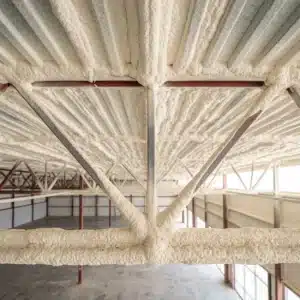
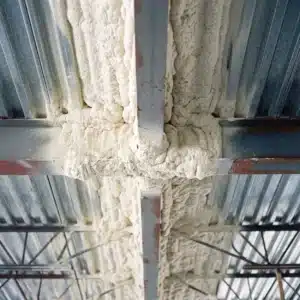
IBC (2021) Section 704.13 establishes five critical subsections governing sprayed fire-resistant materials application. The code mandates that SFRM application must be consistent with the tested fire-resistance rating and product listing. This includes minimum thickness, dry density, application method, and substrate surface conditions. Substrate preparation proves particularly critical. Surfaces must be free of dirt, oil, grease, loose scale, and any condition preventing adhesion.
Critical Compliance Considerations for Building Owners
Type IIB construction eliminates many fireproofing obligations, but not all of them. While IBC (2021) Table 601 permits zero-hour structural frame ratings, Sections 707.5.1 and 711.2.3 change the equation. They mandate that any structural members supporting fire-rated assemblies must achieve the same fire-resistance rating as those assemblies. Exit stairways, shaft enclosures, and occupancy separations commonly present in even modest commercial buildings trigger these requirements. This often requires extensive fireproofing in nominally non-rated construction types.
High-rise buildings achieve some design flexibility through construction type reductions when automatic sprinklers include monitored control valves on each floor. However, the bond strength escalation to 430 psf or 1,000 psf demands far more rigorous adhesion testing than standard buildings. The 2021 IBC’s inclusion of occupiable roofs in the high-rise definition catches developers by surprise. Rooftop amenities that do not count as stories can still trigger the entire IBC (2021) Section 403 regulatory framework if they exceed 75 feet above fire department vehicle access.
For legal accuracy and liability protection, building owners and facility managers must verify three critical factors. First, which construction type was used in original design and what IBC (2021) Table 601 requires for that type. Second, which structural members support fire-rated assemblies and therefore require protection regardless of construction type. Third, whether the building meets the high-rise definition and must comply with enhanced bond strength standards. Local amendments to the IBC can modify these requirements. This makes consultation with the authority having jurisdiction essential before finalizing fireproofing strategies.
Key Takeaways
- Type IIB construction permits zero-hour structural ratings but supporting construction for fire-rated assemblies must be protected to the same rating
- Sections 707.5.1 and 711.2.3 mandate fireproofing for structural members supporting fire barriers and horizontal assemblies in all construction types
- High-rise buildings (over 75 feet) require bond strength of 430 psf to 1,000 psf compared to 150 psf for standard buildings
- Special inspection under IBC (2021) Section 1705.15 is mandatory for certificate of occupancy issuance
- Construction type determines baseline requirements, but structural support relationships often trigger additional protection needs
If your next project demands commercial fireproofing that’s built to last and installed by professionals who understand code compliance inside out, our team serves clients throughout Texas, Kansas, and Oklahoma with expertise in spray-applied systems, intumescent coatings, and comprehensive fire protection solutions. Contact Bahl Fireproofing today to schedule a consultation or request a bid.
Disclaimer: This article provides general educational information about fireproofing and insulation systems and does not constitute professional engineering advice or product specification. System selection must be based on project-specific fire ratings, thermal requirements, acoustic performance needs, environmental conditions, substrate requirements, and budget constraints. Code requirements vary by jurisdiction and project type. Always consult with a licensed professional and verify UL or FM assembly listings before finalizing specifications.